The custody arrangement was simple: my sister’s divorce decree gave her the house, her ex the boat, and me — weekends, apparently — my niece Nora, age eight, full-time energy, part-time supervisor. That Saturday was supposed to be easy: pumpkin patch, one pumpkin each, cider donuts, home by six.
Kevin the goat ended the plan. Kevin lived in the petting zoo section of the patch and had, according to the hand-painted sign, “a personality.” Nora took one look at Kevin, informed me I was “boring compared to him,” and vanished into the goat orbit for the rest of the afternoon. I found a wheelbarrow. I sat. I accepted my ranking.
The pumpkin patch at dusk is a strange, beautiful place — string lights come on between the cornstalks, the air goes cold and cider-sweet, families drift toward the exit with their perfect pumpkins, and the whole field smells like straw and October. I was doing the math on how long a man could sit on a wheelbarrow before it became a lifestyle when she appeared.
Cream sweater. Jeans with straw on the knees. In her hands: a pumpkin so lopsided, so mottled, so spiritually awkward that it seemed less like produce and more like a statement.
“The patch closes in ten minutes,” I said. “I came with my niece, who abandoned me for a goat named Kevin. And you’re handing me the ugliest pumpkin here like it’s a diagnosis.”
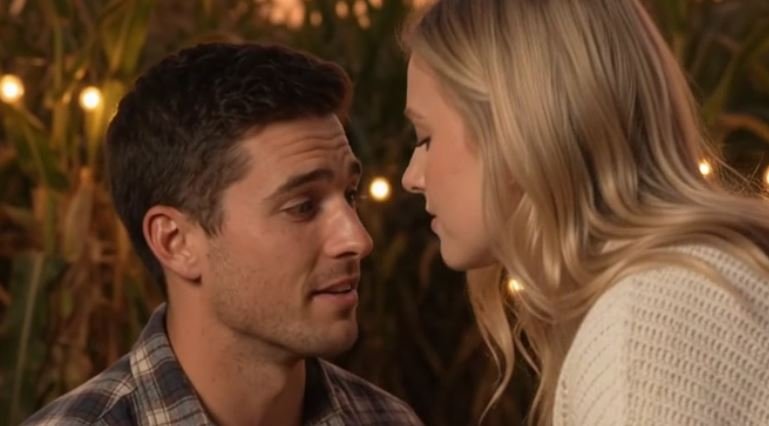
She didn’t speak. She set the pumpkin in my lap — it sat there like a prop from a play nobody had rehearsed — and leaned down over me, hands braced on the wheelbarrow handles, face close enough that I could see the cornstalk lights reflected in her eyes.
“If the owner comes by with the cash box,” I breathed, and the corn around us rustled like an audience, “she’ll see a strange man in her wheelbarrow, a woman standing too close, and a pumpkin between us that looks like it’s seen things—”
She kissed me. Slow. Harvested. It tasted like October and cider and the kind of decision you make with the season’s blessing. The loudspeaker cracked over the field — “Ten minutes to close — and whoever’s in the back rows, we can SEE you, the cornstalks aren’t walls!” — and we broke apart laughing, which is the best way to be caught.
She didn’t run. She picked up the ugly pumpkin, held it up to the loudspeaker like evidence, and marched — and I mean marched, me trailing behind like an accomplice — to the carving tent, where the patch ran a ten-minute closing-time contest. She set the pumpkin down, took a carving tool, and worked for four minutes while I stood there with no function whatsoever.
She turned it around. It read, in jagged letters:
STALL #4. SATURDAY. COME BACK UGLY.
“The carving contest,” the patch owner announced, arriving with the cash box and judging our pumpkin, the letters, and the two of us in that order, “goes to — whatever this is. Prizes are at the register. So is the shame.”
Saturday, stall #4 turned out to be her family’s farm stand — she ran it every weekend through fall, apples and cider and pies, and she had, I noticed with escalating delight, displayed the ugly pumpkin at the front of the stand like a mascot. When I arrived — having left Nora with my sister under protest; Nora had plans with Kevin, apparently, a recurring custody issue — the pumpkin wore a new carving beneath the first:
HE CAME.
“Your stand has a narrative arc,” I said.
“My stand has standards,” she said. First full sentence. She’d apparently spent her silence budget carving.
Her name was Sloane. The farm was her grandfather’s — eighty acres, apple orchard behind the pumpkin fields, and the stand was her attempt, year three, to keep the place alive. “I’m good at apples,” she said, handing me a cider donut across the counter like a treaty. “I’m bad at talking to men. The pumpkin was my sister’s idea. She said, ‘Give him the ugly one, it’s a conversation starter.'”
“Was it?”
“You kissed me behind a cornstalk. I’d call it a success.”
We were inseparable by November — literally; I kept finding excuses to drive Nora out for “agricultural education,” and Nora kept defecting to Kevin, which I privately suspected was a scheme between goat and niece to give us time. Thanksgiving was at the farm. Christmas was at the farm. In January, when the orchard was bare and the stand closed, she walked me through the empty fields at dusk and said, “This is the part nobody stays for. The nothing season.”
“I’m staying,” I said. “I checked with Kevin. He’s on board.”
We got engaged at the patch the following October — same wheelbarrow, which the owner had, upon hearing the story, bolted to a concrete pad with a plaque: THE PROPOSAL BARRROW — DO NOT MOVE. The pumpkin this time was not ugly; it was perfect, enormous, and carved by me across three secret weeks with the help of a stencil, my sister, and a YouTube tutorial titled “Carving Letters Without Crying.”
It said: MARRY ME ANYWAY.
She said yes before finishing reading it. The loudspeaker crackled with “we can SEE you” at that exact moment, which the owner later admitted was her, personally, every time, forever, having decided that some traditions must be maintained.
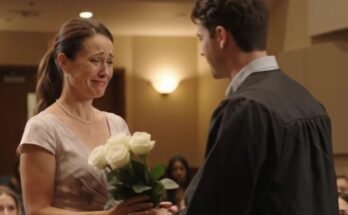
The wedding was at the patch, October, string lights, Nora as flower girl, Kevin as — this is true — ring bearer, the rings tied to his collar under heavy supervision. The ugly pumpkin sat on the welcome table under glass, the letters still legible, next to the new one.
Stall #4 still runs every weekend. The standard sign says APPLES • CIDER • PIES.
Under it, in marker, Sloane has added a fourth item:
PROPOSALS. WHEELBARROW BY REQUEST.