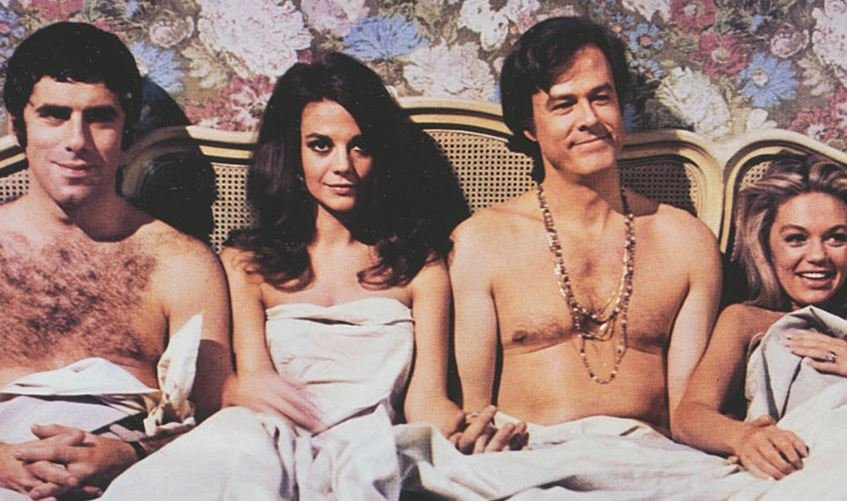
When Bob & Carol & Ted & Alice hit theaters in 1969, it struck a nerve. Directed by Paul Mazursky and starring Natalie Wood, Robert Culp, Elliott Gould, and Dyan Cannon, the film was a sharp, funny, and surprisingly tender satire of the sexual revolution. It followed two married couples — Bob and Carol Sanders, and their best friends Ted and Alice Henderson — as they navigated the minefield of “complete openness” after a weekend at an Esalen-style retreat.
It was nominated for four Academy Awards, including Best Screenplay and Best Cinematography, and became the fifth highest-grossing film of 1969. It was also a time capsule — capturing a moment when affluent Californians were experimenting with free love, group therapy, and a whole lot of terrible fashion.
But even a film this sharp wasn’t immune to mistakes. From disappearing records to vanishing topcoats, here are some of the most notable goofs and bloopers in Bob & Carol & Ted & Alice.
The Disappearing Record

In one of the film’s most famous scenes, the four characters are together after a party when Bob puts on a record. The music begins playing, setting the mood for one of the film’s most memorable sequences. But if you look closely at the background, you’ll spot a problem: the record player is clearly visible, and there is no record spinning on it. The music is still playing, but the turntable is empty.
It’s the kind of continuity error that only reveals itself on a second viewing — but once you see it, you can’t unsee it.
The Topcoat That Took Itself Off

When Carol confesses her affair to Bob, he reacts by walking toward the stairs, still wearing his topcoat. He sits down — and in the very next shot, the coat is gone. Carol is now holding it for him.
It’s a small detail, but a classic continuity slip. Either Bob has superhuman speed when it comes to removing outerwear, or the editor missed something in the cutting room.
The Case of the Switching Hands
In the restaurant kitchen scene, Carol Sanders takes hold of the waiter’s left hand. But in the next shot, she is suddenly holding his right hand.
It’s a moment that happens so quickly that most viewers would never catch it. But for those who notice, it’s a fun reminder that even the most polished films have their imperfect moments.
The Moving Ashtray
In Alice’s scene with her psychiatrist, there’s a large ashtray on the couch. The problem? It moves from her right side to her left side and back again across multiple shots.

It’s the kind of error that comes from shooting a scene out of order — and it’s a testament to how carefully viewers have to watch to catch it.
The Plural “Kids” Problem
When Ted is in the pool talking to Bob, he mentions that he “called home to make sure the kids were okay.” The only issue? Ted and Alice only have one child.
It’s a small dialogue error, but it’s one that careful listeners have pointed out for decades. Was it a script mistake? An improvisation that didn’t quite land? Either way, it’s a fun detail that adds a layer of human imperfection to the film.
The Camera Crew in the Reflection
During the opening helicopter shots, the camera crew’s reflection is visible in the footage.
It’s a brief moment, but it’s a classic production error — a reminder that even the most cinematic sequences are made by real people standing just out of frame.
The Original Ending That Almost Was
One of the most fascinating behind-the-scenes stories about Bob & Carol & Ted & Alice isn’t a mistake at all — it’s a creative choice. The original ending in the first draft of the screenplay involved the four characters crying in each other’s arms after an aborted orgy, complete with pulling themselves together on their way to a Tony Bennett show.
Director Paul Mazursky changed it. And when critics accused the final ending of being a cop-out, he had a perfect response: “The easiest thing in the world would have been to show those four making it together in that bed.”
His choice was more subtle — and more honest. It’s part of why the film still resonates today.
Casting That Almost Didn’t Happen
Robert Culp, who played Bob Sanders, wasn’t the producers’ first choice for the role. But he loved the script so much that he reportedly said he would have been willing to pay to be in the film.
It’s a testament to the quality of the screenplay — and to Culp’s willingness to fight for a role he believed in.
A Real-Life Therapist in the Cast
Here’s a detail that most viewers would never guess: Donald F. Muhich, the actor who played Alice Henderson’s therapist in the film, was actually Paul Mazursky’s real-life therapist.
It’s the kind of inside detail that adds a layer of authenticity to the film — and a touch of humor for those in the know.
Why the Mistakes Don’t Matter
Bob & Carol & Ted & Alice remains a landmark film of the late 1960s — a comedy-drama that captured the anxieties and absurdities of a generation trying to figure out what love, marriage, and honesty actually meant. The mistakes and bloopers don’t diminish it. They just remind us that it was made by human beings, working quickly, trying to capture lightning in a bottle.
And they did. 🤍