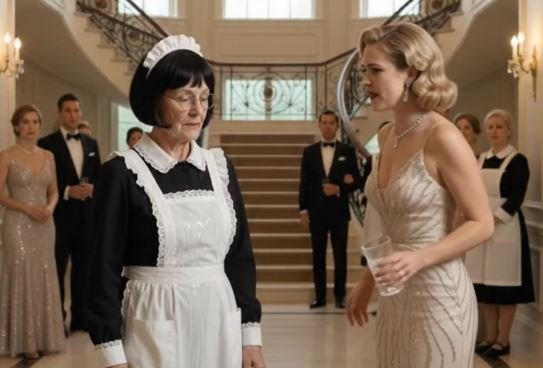
Chapter 1: The Woman Beneath the Gray Wig
The sound of the bucket hitting the marble floor brought me out of my office.
Then Vanessa called my name.
“Daniel, could you come downstairs?”
Her voice was sweet. Too sweet. It was the voice she used when photographers were nearby—or when she wanted someone else to appear unreasonable before I entered the room.
I left the contract open on my desk and stepped into the upstairs gallery. The central foyer of Whitmore House spread below me beneath a crystal chandelier my grandfather had purchased in Vienna. White orchids lined the curved staircase. Caterers moved quietly through the dining wing, preparing for our engagement dinner.
At the center of the marble floor stood an elderly housekeeper in a soaked gray uniform. Dirty water ran from her shoulders. A bucket lay on its side beside her.
Vanessa stood several feet away wearing a black one-shoulder evening gown. Her champagne-colored heels remained dry.
“You look disgusting,” she said.
The housekeeper did not answer. She wore thick glasses and a short gray wig. One hand rested against the handle of her cleaning cart while water dripped from her sleeves.
Vanessa looked up and saw me. Her expression changed instantly.
“Daniel.” She crossed the foyer and reached for my arm. “She threatened me, darling.”
I descended the stairs slowly. “What happened?”
“I found her going through a private cabinet.” Vanessa pointed toward the hallway beside the library. “She became aggressive when I confronted her. I was frightened.”
The elderly woman lifted her head. Her face remained partly hidden behind wet strands of synthetic hair.
“Did she touch you?” I asked.
Vanessa hesitated. “She moved toward me.”
“That wasn’t my question.”
Her fingers tightened around my sleeve. “Why are you interrogating me? Look at her. She has been disrespectful since she arrived.”
The temporary housekeeper had started work four days earlier under the name Martha Gray. Vanessa said the staffing agency sent her after our longtime housekeeper, Rosa Alvarez, requested medical leave. I had barely seen Martha. She moved quietly, avoided family rooms, and seemed older than anyone we normally employed. Vanessa claimed she was slow. I told her to be patient.
Now Martha stood in the center of the foyer drenched in filthy water while caterers, servers, and security guards watched from a careful distance.
“What was inside the cabinet?” I asked.
“Staff records.” Vanessa looked offended by the question. “Those files contain private information. She could have been stealing.”
The housekeeper finally spoke. “I was returning a document that had been removed from the payroll office.”
Her voice struck something in my memory. Not the sound. The certainty.
Vanessa laughed. “See? She admits touching confidential files.”
The woman reached up and removed her glasses. My body became still. She pulled one pin from the back of the gray wig. Then another. The wet disguise slipped away, revealing short platinum-blonde hair beneath it. Her shoulders straightened. The fragile posture disappeared.
I stared at the face I had known my entire life.
“Mom?”
The word barely left my mouth.
Evelyn Whitmore stood before me in a housekeeper’s uniform. Vanessa released my arm. “No.”
My mother looked toward her. “Yes.”
The room changed. The caterers stopped moving. Samuel Reed, our security director, stepped from the corridor carrying a sealed evidence case. Attorney Rebecca Lawson entered behind him.
Vanessa looked from them to me. “Daniel, this is some kind of trick.”
My mother removed a pearl brooch from the wet uniform. A green light blinked beneath its edge. “The brooch transmitted everything,” she said.
Vanessa’s face lost color. “What everything?”
“The staff threats. The altered payroll files. Your call with Blake Mercer. And the instructions you gave ten minutes before you poured that bucket.”
Vanessa took one step backward. “You disguised yourself to spy on me?”
Evelyn’s expression remained calm. “I returned because five employees reported crimes inside my house.”
“Your house?” Vanessa turned toward me. “You told me this was yours.”
“I said my family owned it.”
“That is not the same thing.”
Evelyn looked at me. “No, Daniel. It isn’t.”
The disappointment in her voice hurt more than anger.
Vanessa raised her chin. “This proves nothing. She threatened me. Everyone saw it.”
Samuel opened the evidence case and removed a tablet. The foyer camera feed appeared. Vanessa was shown entering the staff hallway with the bucket. Her own voice filled the room.
If the old woman refuses to sign, I’ll make sure no agency hires her again.
Then came another sentence. After the wedding, none of these people will matter.
Vanessa stared at the screen. The security cameras she believed she had disabled had recorded everything to an encrypted backup.
My mother looked toward the cabinet beside the library. “The file Martha supposedly stole contains six employees’ forged signatures.”
I turned to Vanessa. “What signatures?”
She said nothing. Rebecca handed me a payroll report. Payments totaling nearly three million dollars had been issued to household vendors that did not exist. Each payment carried approval from my executive account.
“I never authorized these.”
Vanessa’s expression shifted. Only slightly. Enough.
The documents were about to reveal what my fiancée had done with my name—and what else she had signed using the name she expected to marry.
Chapter 2: The Complaints I Called Misunderstandings
The engagement dinner never began. Guests arriving through the east entrance were redirected into the garden pavilion and informed that a private family emergency had occurred.
Vanessa demanded to leave. Rebecca advised her that she was not under arrest, but every device and document connected to household payroll had been placed under a legal preservation notice.
Vanessa laughed. “You cannot detain me over a spilled bucket.”
“No one is detaining you,” Rebecca said. “Destroying evidence after notice would create a separate problem.”
Vanessa looked toward me. “Daniel, say something.”
I wanted to. The difficulty was deciding which lie to address first. The false vendors. The forged signatures. The security cameras. The woman I planned to marry humiliating my mother because she believed an elderly employee could not defend herself.
“Give Samuel your phone,” I said.
Her face hardened. “You are choosing her?”
“She is my mother.”
“I am supposed to become your wife.”
“Not anymore.”
The sentence left my mouth before I had examined it. For once, certainty did not require examination.
Vanessa removed the engagement ring. She did not hand it to me. She threw it across the foyer. It struck the marble and spun beneath the staircase.
“You will regret humiliating me.”
My mother looked at the wet uniform. “Humiliation was your chosen language tonight.”
Vanessa left with her attorney. Victoria Cole, her mother, arrived twenty minutes later and accused us of staging an attack against her daughter. She wore a cream suit and enough diamonds to reflect the chandelier.
“This family has destroyed a young woman’s reputation over an unfortunate misunderstanding,” she said.
My mother replied: “Your daughter poured contaminated water over an employee and attempted to obtain forged payroll documents.”
Victoria looked at Evelyn’s uniform with disgust. “You created this spectacle by dressing like hired help.”
Several employees heard her. So did the brooch.
Victoria left without another word.
My mother changed into dry clothes upstairs. I waited in her private sitting room. The last time I had seen her was six weeks earlier, when she supposedly left for Geneva to supervise a hotel acquisition.
She entered wearing navy trousers and a white shirt. Without the wig and uniform, she looked exactly as she had at our last board meeting. Controlled. Elegant. Unimpressed.
“Why didn’t you tell me you came back?”
“I did not know whether you were part of the problem.”
The answer struck harder than I expected. “You believed I might be stealing from our employees?”
“I knew your credentials approved suspicious payments.”
“I didn’t sign them.”
“You gave Vanessa access to the family office.”
“She was helping plan the wedding.”
“She had administrator access to payroll.”
“I didn’t know.”
My mother sat opposite me. “That sentence has become expensive.”
She opened a folder. Inside were written complaints from six employees. Rosa Alvarez reported that Vanessa withheld tips from private events. Chef Marcus Bell reported that invoices had been changed after he signed them. Driver Anthony Wells reported being instructed to transport sealed cash packages to Victoria’s townhouse. Housekeeper Teresa Lin claimed Vanessa threatened to accuse her of theft unless she signed a vendor receipt.
I recognized three complaints. Vanessa had shown them to me months earlier. She said disgruntled employees were resisting her attempts to modernize the household. I believed her.
“Why didn’t the staff come directly to me?” I asked.
“They tried.”
My mother placed printed messages on the table. Anthony requested a meeting. I forwarded the message to Vanessa. Teresa emailed about payroll. I told my assistant to let Vanessa handle it. Rosa attempted to speak with me after dinner. I left for a charity event and asked Vanessa to resolve the disagreement.
Every road to me led back through the person they were reporting.
“I thought she was preparing to manage the household with me.”
“You treated management as a social role rather than authority over real people.”
I looked down. “Why the disguise?”
“Because the complaints changed when employees realized executives were listening.”
“You could have installed cameras.”
“Vanessa controlled the visible system. Samuel discovered sections were being deleted.”
“So you became Martha.”
“I observed. I asked for records. I did not invite abuse.”
That distinction mattered. My mother had not created a cruel test to measure Vanessa’s character. She entered an existing system and allowed it to reveal itself.
“What was in the cabinet?” I asked.
“Copies of forged wage waivers and false vendor receipts.”
“Why would Vanessa need household payroll?”
“To move money in amounts small enough to avoid board review.”
Rebecca entered carrying the first digital analysis. Twenty-three false vendors had received payments over eighteen months. Many were registered beneath the names of employees who never knew the companies existed. The total had reached $6.4 million. Every transfer carried approval from my executive profile.
Then Rebecca showed me a message between Vanessa and Blake Mercer, Whitmore Grand Hotels’ chief financial officer.
Daniel never reads secondary authorizations. Keep the totals beneath his alert threshold.
My mother watched me read it. “She understood your habits.”
I wanted to say Vanessa had deceived me. That was true. It was not complete. She could deceive me because I had decided details belonged to people beneath me.
The next file contained a draft authorization scheduled for our wedding day. It appointed Vanessa as my marital financial representative. My signature was already attached.
I had never seen the page.
Chapter 3: The Wedding Documents She Expected Me to Ignore
Our wedding was nineteen days away. Three hundred and fifty guests had received invitations. Whitmore Grand’s flagship ballroom had been closed for renovations that existed mostly to impress investors attending the ceremony.
Vanessa had selected the flowers, menu, orchestra, guest gifts, lighting, and photography schedule. She had also selected the signing folder.
The blue leather portfolio looked ordinary. Marriage license. Insurance acknowledgments. Photography releases. Charitable-donation forms.
Buried among them were four documents I had never approved.
The first gave Vanessa administrative authority over my personal accounts. The second pledged my future Whitmore distributions to secure a private credit line. The third authorized Blake Mercer to sell six historic hotels to Blackridge Capital. The fourth stated that my mother had exhibited cognitive decline and required temporary removal from voting decisions.
Evelyn read the last page twice. “Dr. Malcolm Price signed this.”
“He has never examined you,” Rebecca said. “He attended one foundation dinner.”
“That was enough for the draft.”
Dr. Price’s report described forgetfulness, suspicious behavior, unusual travel, and inappropriate attempts to disguise herself as an employee. The disguise had become part of the case before it occurred. Vanessa and Blake expected my mother to investigate. They were prepared to call the investigation evidence of illness.
“How long have they been building this?” I asked.
Rebecca displayed the metadata. The report was created five months earlier. Two weeks before I proposed.
My engagement had not caused the plan. It had become one of its tools.
Blackridge offered $780 million for the six hotels. Independent valuations exceeded $1.6 billion. The hotels included three union properties, a historic resort, and two buildings sitting on land expected to triple in value after a transportation project. Internal Blackridge documents described immediate staffing reductions, pension termination, and conversion of employee housing into luxury residences.
Whitmore executives would receive private completion payments. Blake: $22 million. Victoria Cole: $15 million. Vanessa: $12 million.
My name appeared beside a $30 million payment. The money would enter an account I did not control.
“Why put it under me?” I asked.
“To establish motive,” my mother said.
A prepared narrative claimed I forced the sale to escape company debt and finance a lavish married life. My wedding expenses had already been billed partly to hotel renovation accounts. The orchids. Private aircraft for guests. Designer suites. A custom staircase built for the ceremony.
Vanessa called each expense corporate hospitality. Blake approved them. My credentials appeared beneath his.
I had approved a general wedding-marketing budget without reading the attached allocations. Again.
“What happens if the sale closes?” I asked.
“Blackridge receives the properties,” Rebecca said. “The hidden payments leave the country. The company retains pension liabilities and regulatory exposure.”
“And my mother?”
“Declared temporarily incapable.”
“And me?”
My mother slid another document forward. A confession.
I, Daniel Edward Whitmore, independently directed the diversion of service charges, pension reserves, charitable donations, and household payroll funds…
My digital signature appeared on page forty-two. It had been copied from a board resolution. The confession described Vanessa as a trusting fiancée unaware of my crimes. Victoria would present herself as a concerned future mother-in-law. Blake would cooperate from another country. I would become the man left beside the empty accounts.
“Vanessa planned to marry me and send me to prison.”
“Possibly after obtaining your voting proxy,” my mother said.
“Why not leave before the wedding?”
“She needed your legal relationship to make the control documents appear believable.”
I remembered Vanessa asking whether we could sign everything immediately after our vows so paperwork would not interrupt the reception. She said the gesture would feel romantic. One signature. One life. No secrets.
Every phrase had been rehearsal.
Samuel entered with another discovery. Vanessa’s phone contained messages with an unidentified contact saved as B. At first, we assumed Blake. The conversation was personal. Hotel rooms. Late-night meetings. Promises that Daniel would be removed after the transfer.
B was not Blake Mercer. It was Blackridge executive Benjamin Cross.
Vanessa was having an affair with the buyer negotiating the sale. She had promised Benjamin that once the hotels transferred and my authority collapsed, they would leave together.
The scheme was no longer simply about wealth.
I had been the groom, guarantor, public face, and future defendant.
Chapter 4: The Employees Whose Names Became Companies
The false vendors were not random. Each carried the name of someone unlikely to challenge the records. A retired housekeeper. A dishwasher who spoke little English. A driver recovering from surgery. A temporary banquet server. A deceased maintenance worker.
Vanessa and Blake opened companies under variations of their names, then issued payments for consulting, event support, and emergency repairs. The employees never received the money. Their identities created distance between the funds and the executives stealing them.
Rosa Alvarez’s name appeared on Alvarez Domestic Consulting. The company received $640,000. Rosa earned $58,000 annually. When investigators showed her the record, she began crying.
“I thought I owed taxes.”
Vanessa had warned her that a payroll error might make authorities investigate her family. Fear kept Rosa silent.
Teresa Lin’s supposed company received $410,000. Anthony Wells’s received $780,000. Chef Marcus Bell’s name appeared on invoices for food never delivered to foundation shelters.
The false charities were worse. After hurricanes and wildfires, Whitmore guests donated to emergency-housing funds. The company promised to match contributions. Millions entered the Whitmore Family Foundation. Vanessa directed much of it through fake event vendors and luxury-consulting firms linked to Victoria.
Dirty water over an elderly maid looked cruel because it was visible. The financial scheme had poured humiliation over workers for years without staining a ballroom floor.
I met the employees inside the mansion’s service dining room. My mother attended. No public-relations team. No family attorneys controlling the conversation.
Rosa spoke first. “We told you.”
“I know.”
“You always said Vanessa would handle it.”
“I know.”
Anthony placed a folder on the table. “She threatened to report me for stealing a company vehicle.”
“Did you?”
“I drove her mother to a private bank after my shift. Vanessa ordered it. Then she said the trip was unauthorized.”
Teresa looked toward me. “Why did you trust her more?”
There was no answer that protected my pride. “Because I wanted marriage to feel easier than leadership.”
The room became silent.
“I treated her confidence as credibility and your fear as inconvenience.”
My mother said nothing. This was not her apology to give.
Rosa asked whether I would remain chief operating officer.
“I don’t know.”
“You own the company.”
“No.”
The employees looked surprised. The public believed I was heir to Whitmore Grand Hotels. I owned twelve percent of noncontrolling shares. My mother retained thirty-eight percent voting control through the Evelyn Whitmore Trust. Employees held eight percent through an old profit-sharing structure. Institutional investors owned the rest.
My father deliberately prevented one child from inheriting a throne. I had still behaved as though my surname granted one.
The independent board suspended me pending review. I accepted. For the first time since college, my office, assistant, company card, and executive access disappeared in one afternoon.
The loss felt humiliating. Then I remembered Rosa discovering a company worth hundreds of thousands had been opened in her name. My discomfort was not the center of the story.
Vanessa released a public statement. She claimed Evelyn had disguised herself to provoke a confrontation and that I had become emotionally manipulated by my mother. She described the dirty water as an accidental spill during a struggle. The brooch video showed no struggle. She then claimed the false companies were Blake’s work.
Blake responded through counsel by releasing messages where Vanessa selected employee names. Benjamin Cross denied any personal relationship with Vanessa. His hotel records and messages contradicted him.
Every alliance began breaking. Victoria remained loyal publicly. Privately, investigators intercepted a call.
“If this fails, Daniel takes the company fraud, Blake takes the transfers, and Benjamin takes the sale,” she told Vanessa.
“What about me?” Vanessa asked.
“You were a fiancée manipulated by powerful men.”
Vanessa became quiet. Her mother had promised protection. The sentence revealed a more dangerous truth.
Victoria expected Vanessa to remain believable only while appearing powerless.
Chapter 5: The Mother Who Taught Her Daughter to Target the Invisible
Vanessa requested a meeting three days later. Her attorney asked for immunity. Federal prosecutors refused. They offered to consider cooperation at sentencing.
Vanessa arrived wearing a plain navy suit and no engagement ring. She looked smaller without the black dress, cameras, and house staff moving around her.
“I didn’t create the financial scheme,” she said.
“You created parts of it,” Rebecca answered.
“Blake controlled the accounts.”
“You selected employee identities.”
“My mother said no one would be harmed.”
Rosa’s false tax notices sat inside the evidence folder. “Someone was harmed,” I said.
Vanessa avoided my eyes. She explained how Victoria raised her. Service workers existed to make important people comfortable. Employees who complained were ungrateful. Rules protected families without influence. Wealthy families created opportunities and therefore deserved flexibility. Vanessa learned that kindness was optional when the other person needed wages.
“Did your mother tell you to dump the water?” I asked.
“No.”
“That choice was yours.”
“Yes.”
“Why?”
“She opened the cabinet.”
“You believed she was a maid.”
“Yes.”
“Why did that make humiliation acceptable?”
Vanessa’s mouth trembled. “Because I knew no one would believe her over me.”
The honesty chilled the room. She had not lost control. She calculated the social odds.
Vanessa turned over Victoria’s encrypted messages. They showed the scheme began after Victoria learned my mother had rejected a proposed partnership with Cole Luxury Events. Victoria believed marriage offered another route into Whitmore. She encouraged Vanessa to pursue me while maintaining her relationship with Benjamin Cross.
“Did you ever love me?” I asked.
Vanessa looked toward her attorney. Then back at me. “I loved what life with you represented.”
“That wasn’t the question.”
“I liked you.”
The answer was more honest than affection performed for advantage.
Her cooperation exposed Dr. Price. Victoria hired him to build Evelyn’s incapacity file. He collected observations from board dinners, edited video clips, and private medical data obtained through a compromised foundation clinic. He never examined my mother. His conclusion existed before his evidence.
Vanessa also surrendered a recording from Victoria’s townhouse. Blake asked what would happen if Vanessa panicked. Victoria answered: Then she becomes a spoiled bride manipulated by Daniel. People forgive beautiful women when a powerful man controls the money.
Vanessa listened to the recording twice. “She was going to make me look stupid.”
“She relied on you looking less responsible than the men,” Rebecca said.
Vanessa had used vulnerability as a costume while denying it to actual vulnerable people. The symmetry did not make her innocent.
Blake was arrested attempting to board a flight to Singapore. His luggage contained offshore account keys and a second confession naming Benjamin as the architect of the hotel sale. Benjamin surrendered after Blackridge removed him. Victoria attempted to leave through a private airport. Officers found two passports and jewelry purchased with disaster-relief funds. She was arrested without cameras present.
My mother refused the media’s request to recreate her identity reveal. “I did not dress as an employee to become entertainment,” she said. “I did it because employees’ statements were being erased.”
The board scheduled a public emergency hearing. Evelyn planned to present the anti-coercion clause and restructure the company. Several family advisers urged her to keep complete control.
“You have proven only you can protect Whitmore,” one said.
She answered: “That is precisely the belief that made Daniel careless.”
My mother understood that replacing one unchecked family member with another was not reform.
Chapter 6: The Boardroom Without an Heir
Whitmore Grand Hotels held the emergency meeting inside the ballroom where Vanessa and I were supposed to marry. The floral arch had been removed. The signing table remained. Instead of a marriage license, it held pension reports, payroll files, and employee testimony.
My mother sat at the center of the board table. I sat in the second row. Not beside her. Not onstage.
Rosa Alvarez occupied the first employee seat. Anthony Wells sat beside her. A hotel housekeeper from Boston, a concierge from Chicago, a union representative from Miami, and two disaster-relief partners filled the remaining places.
The company had always displayed staff in advertisements. It had rarely allowed them near final decisions.
My mother began with the foyer recording. Vanessa’s voice filled the room.
You look disgusting.
The video showed the bucket. The threat. The claim that no agency would hire Martha again. Then Evelyn removed the wig. People expected the dramatic moment. My mother stopped the footage before my reaction.
“This meeting is not about the surprise that the victim was wealthy,” she said.
The room became still.
“What happened would have been wrong if Martha Gray had been exactly who Vanessa believed she was.”
She displayed the false vendors. The stolen service charges. The pensions. The charity money.
“Identity changed the consequences Vanessa feared. It did not change the dignity of the person she attacked.”
I looked down. The media had called the story billionaire mother teaches cruel fiancée a lesson. The headline missed every employee without a disguised owner beneath the uniform.
Rosa testified about the false company. Anthony described the threatened vehicle report. A banquet server explained how managers withheld service charges while guests believed the money went directly to workers.
Then I was asked to speak. I stood without prepared remarks.
“I believed Vanessa because confronting her would have made my private life difficult.”
I looked toward the employees.
“I told myself I was delegating. I was avoiding.”
No one interrupted.
“I received complaints and redirected them to the person being accused. I allowed my executive credentials to become accessible. I signed documents without reading them because other people carried the risk.”
My voice tightened. “I am sorry.”
Rosa’s expression remained unreadable. The apology created no debt.
My mother presented the company restructuring. Twenty-eight percent of voting authority would transfer to an employee trust. Twenty percent would belong to institutional investors under stronger ethics requirements. Fifteen percent would move to hotel-community and disaster-relief trustees. The Evelyn Whitmore Trust would decline from thirty-eight percent to eighteen over three years. My twelve percent would become nonvoting during my suspension.
No family member could chair the company and control its charitable foundation simultaneously. Employee service charges would enter transparent individual accounts. Pensions would receive independent oversight. Whistleblower reports would bypass hotel management. The mansion would no longer serve only as a family residence. Its lower floor would become a service-worker advocacy center.
Some shareholders objected. They claimed employees lacked experience.
Rosa answered: “We had enough experience to know money was missing before executives did.”
The restructuring passed. My suspension was fixed at three years. Any return required ethics training, independent evaluation, and an employee vote. I accepted the terms.
Vanessa appeared by secure video from detention during the legal portion. The anti-coercion clause permanently barred her, Victoria, Blake, Benjamin, and Dr. Price from Whitmore authority. She called the provision vindictive.
My mother read its date. My father wrote it fourteen years earlier after a hotel manager threatened immigrant workers into signing false records. The clause was not created for Vanessa. She had simply fulfilled every condition.
After the meeting, my mother found me in the empty ballroom.
“You expected me to protect your position,” she said.
“I hoped.”
“Do you still?”
“No.”
She studied me. “That is the first useful answer.”
The criminal trial remained ahead.
Chapter 7: The Rooms the Cameras Could Not Forget
The mansion’s encrypted archive preserved eleven months of deleted footage. Vanessa believed deleting clips from the household application erased them. Samuel had installed an independent backup after Rosa reported missing jewelry footage.
The recordings showed patterns. Vanessa throwing a server’s coat into the rain after he objected to unpaid overtime. Vanessa locking Teresa outside the staff entrance for forty minutes because she arrived late after a subway delay. Vanessa ordering Anthony to carry personal shopping bags during a hotel memorial event, then accusing him of abandoning his assigned vehicle.
No single clip looked as dramatic as the bucket. Together, they revealed a system. Reward obedience. Create humiliation. Keep incidents small enough that each victim feared appearing oversensitive.
Victoria appeared in several recordings. She taught Vanessa which employees depended on employer housing. Which workers lacked savings. Which managers needed recommendations.
“They cannot afford principles,” Victoria said during one dinner.
That sentence entered the prosecution’s case. Blake’s files connected the abuse to financial coercion. Employees who signed false invoices received stable schedules. Those who refused lost shifts or faced accusations. Fear operated as accounting infrastructure.
The trial began nine months after the engagement dinner. Vanessa pleaded guilty to several charges but contested others. Victoria went to trial. Blake and Benjamin entered cooperation agreements. Dr. Price admitted creating the false cognitive report.
The prosecution played the brooch recording first. Then the payroll evidence. Then the deleted footage.
Vanessa’s attorney argued that she had been controlled by Victoria. The prosecutor asked whether her mother held the bucket.
“No.”
“Who poured it?”
“I did.”
“Who threatened the housekeeper’s employment?”
“I did.”
“Who selected Rosa Alvarez’s identity for a false company?”
Vanessa closed her eyes. “I did.”
Influence explained her training. Choice established responsibility.
Victoria testified that everything she did protected her daughter’s future. The prosecutor displayed the escape itinerary. One ticket. Victoria Cole. Vanessa had no reservation.
“Why leave your daughter?” the prosecutor asked.
“I intended to arrange travel later.”
Messages showed otherwise. Victoria planned to portray Vanessa as another victim and allow her to face a shorter sentence while the money remained offshore.
Even maternal love had become strategic.
I testified for two days. Vanessa’s attorney asked why I had allowed my mother to spy inside the mansion.
“I did not know she was there.”
“Then Evelyn deceived you too.”
“Yes.”
“Why forgive her?”
“I have not described it as forgiveness.”
The attorney paused. “Do you approve of her disguise?”
“I understand why she believed ordinary reporting channels had failed.”
“Because of you?”
“In part.”
That answer ended the attempted conflict between my mother and me. The case did not require one perfect person. It required accurate responsibility.
The jury convicted Victoria on fraud, conspiracy, obstruction, identity theft, pension theft, and misuse of charitable funds. She received thirty years. Blake received twenty-four. Benjamin received fourteen. Dr. Price received twelve and lost his medical license. Vanessa received eleven years after cooperation, restitution, and forfeiture.
Before sentencing, she addressed the court.
“I thought powerful people were the only people whose humiliation mattered.”
She looked toward the employees.
“I treated workers as scenery until one of them removed a wig and became someone I feared.”
Her voice broke.
“The shame is that she should not have needed to become Evelyn Whitmore before I recognized what I had done.”
Rosa listened without expression. So did my mother.
Truth did not require applause.
Chapter 8: The House That Stopped Having a Servants’ Entrance
The first renovation at Whitmore House removed the staff entrance. The door had existed for ninety years. Family members entered beneath the chandelier. Employees entered through a narrow corridor beside the delivery bay.
Architects argued that removing it would disrupt the historic design.
My mother answered: “History is not a reason to preserve humiliation.”
The new entrance remained practical for deliveries but no longer separated people according to social rank.
The lower floor became the Whitmore Service Workers’ Advocacy Center. Rosa helped design it. Private interview rooms. Emergency grants. Payroll-review assistance. Immigration-law referrals. Temporary housing support. Secure evidence storage. A hotline independent of employers.
The center’s first client worked for another wealthy Manhattan family. Her employer withheld wages and threatened to report her for theft after she asked to be paid. She arrived wearing a uniform similar to the one my mother had worn. No wig. No hidden owner.
Her case mattered exactly the same.
I spent my suspension working outside Whitmore. Not at a competing luxury company. At a nonprofit hospitality-training center in Queens. My supervisor, Marcus Bell, had once cooked in our mansion.
He did not treat my surname as qualification. My first assignment involved reviewing time sheets and carrying supply boxes. I made mistakes. Nobody applauded when I completed ordinary tasks.
That was useful.
During ethics training, employees described executives like me. Leaders who never insulted staff directly but created the conditions where others could. Leaders who called complaints interpersonal conflict. Leaders who believed kindness in public corrected negligence in private.
I stopped dividing wrongdoing into villains and bystanders. Powerful bystanders maintain systems.
My mother visited the training center once. She stood near the doorway without announcing herself.
“No disguise?” I asked.
“Not today.”
We ate lunch from plastic containers.
“I was angry when you suspended me,” I admitted.
“I know.”
“I thought exposing Vanessa should have restored my place.”
“Her wrongdoing did not prove your fitness.”
“I understand now.”
“Understanding should remain visible in behavior.”
My mother had never been sentimental. Her clarity once felt cold. Now I recognized its respect. She refused to convert love into immunity.
Whitmore Grand’s reforms survived the first two years. Employee service charges became transparent. Pension reports were published. Anonymous complaints increased dramatically. Some shareholders claimed that meant conditions were worsening. It meant workers finally believed reporting might matter.
Several managers were disciplined. One senior executive resigned after refusing employee oversight. The hotels continued operating. Guests still arrived. Beds were prepared. Food was served.
Profit did not require silence as much as our family had claimed.
Vanessa wrote from prison during my second year. Her first letter blamed Victoria. I returned it. The second blamed Blackridge. I returned that too. The fourth contained one paragraph without explanation.
I knew the old housekeeper was vulnerable. That was why I chose her. Discovering she was your mother frightened me because consequences finally became personal. I am learning that remorse beginning with fear is not the same as conscience.
I stored the letter. I did not answer. My response was not necessary for her accountability.
At the end of my three-year suspension, the employee trust scheduled a vote on whether I could return in any leadership role. I was not offered chief executive. The position available was director of operational transparency, reporting to a board chaired by Rosa Alvarez.
My former housekeeper would become my supervisor.
Some family friends called it humiliating. I called it accurate.
Chapter 9: The Vote My Name Could Not Buy
The employee vote took place across thirty-two Whitmore properties. Housekeepers. Cooks. Drivers. Maintenance teams. Concierges. Managers. Warehouse workers. No family member could see individual ballots.
My mother did not campaign for me. I submitted a written application like every other candidate. It contained no photograph with Evelyn. No references to the criminal trial. No claim that losing my fiancée had transformed me. I described the work I completed during suspension, the systems I helped design, and the mistakes that made oversight necessary.
Rosa interviewed me before a panel of seven employees.
“Why do you want to return?” she asked.
“Because I understand the operations and believe I can contribute.”
“Why should anyone trust you?”
“They should not trust me automatically.”
“What should they trust?”
“Visible records, limited authority, and their ability to remove me.”
Anthony leaned forward. “What happens when another person you love becomes the subject of a complaint?”
“I do not route the complaint through that person.”
“And if the complaint threatens your private life?”
“Then my private comfort remains irrelevant to the investigation.”
Rosa watched me carefully. “Do you expect forgiveness?”
“No.”
“Do you want it?”
“Yes.”
The honesty surprised them. I continued. “Wanting it does not create an obligation.”
The panel recommended approval by a narrow margin. The full employee trust voted sixty-one percent in favor. I received a two-year term. No automatic renewal. My office was smaller than my old assistant’s workspace.
The first week, a hotel employee reported that a regional vice president pressured staff to hide overtime. The executive was one of my oldest friends. He called me privately.
“Daniel, this is a misunderstanding.”
The phrase returned me to Vanessa’s complaints. I ended the call. The independent team investigated. The allegation was confirmed. My friend lost his management role. He accused me of betraying him.
I answered: “You asked me to choose your comfort over their wages.”
For once, I recognized the choice before making it.
My mother completed the transfer of most of her voting shares. Employees, community trustees, and public-interest investors became the controlling coalition. She retained one board seat for two years. Then she resigned.
Reporters asked whether she trusted anyone else to protect her legacy.
“My legacy is not control,” she answered. “It is whether the institution remains ethical after I leave.”
Rosa became board chair permanently after another election. The mansion remained partly my mother’s residence, but its public floors belonged to the advocacy center. No one called it the servants’ wing.
On the anniversary of the engagement dinner, the center held a training session in the foyer. The marble had been restored. The chandelier remained. A glass display near the wall contained no bucket, wig, or black gown. We refused to turn humiliation into a tourist attraction.
Instead, the display listed the names of employees whose reports had been ignored and the reforms created from their evidence. My name appeared under: EXECUTIVE RESPONSIBLE FOR FAILED ESCALATION.
I approved the wording. Vanessa had poured the water. I helped create the room where she believed no one important would object.
Ordinary accountability lacked the satisfying simplicity of one villain and one heroic reveal. It also had a better chance of lasting.
Chapter 10: The Woman Who Never Needed the Disguise
Five years after the bucket hit the marble, my mother attended the opening of the center’s national service-worker network. She wore a platinum suit and no jewelry except the brooch camera. The device no longer recorded secretly. It had been mounted inside a display explaining evidence-preservation rights.
Evelyn stood beneath the chandelier where Vanessa had called her disgusting. Rosa introduced her. Not as billionaire owner. Not as the maid beneath the wig. As one of the founders of the worker-protection fund.
“The disguise made people pay attention,” my mother said. “The work begins when we protect someone without discovering that she is secretly powerful.”
The audience included hotel employees, domestic workers, attorneys, advocates, managers, and families who employed household staff. I stood at the side. No central seat. No need for one.
The national network connected workers to confidential payroll reviews, emergency housing, medical care, and legal support. It also trained employers to create real complaint channels rather than family-controlled ones. Whitmore contributed funding. It did not control the board.
After the event, my mother and I remained in the foyer. Workers folded chairs around us.
“You were right,” I said.
“About which thing?”
“That my surname had made me careless.”
“It gave you opportunities to become careless.”
“Is that different?”
“Yes. Opportunity is not destiny.”
She looked toward the staircase. “Your father worried inheritance would teach you that love and authority were the same.”
“He created the ethics clause.”
“He created limits because he loved you.”
At thirty-eight, I finally understood. A parent who removed consequences was not necessarily loving more. Sometimes limits were the only form of love that respected another adult’s capacity to change.
“Do you regret the disguise?” I asked.
My mother considered the question. “I regret that employees required the controlling owner to wear a uniform before their evidence became impossible to ignore.”
“That wasn’t what I meant.”
“I know.” She smiled slightly. “The wig was uncomfortable.”
I laughed. The sound traveled through the foyer without fear attached to it.
Vanessa remained in prison. Her later letters focused less on her mother and more on the people whose names she used. She worked in the prison education program and directed her earnings toward restitution. Useful actions mattered. They did not reopen our relationship.
Victoria continued appealing her conviction. Blake and Benjamin remained professionally barred. Dr. Price’s former evaluations underwent independent review, leading to several guardianship cases being reopened.
Whitmore Grand no longer belonged to one family in any meaningful sense. Employees controlled enough votes to stop sales. Communities held permanent interests in historic properties. Pensions remained independently protected.
My role was renewed once, then given to another candidate. I accepted the transition. Leadership no longer needed to become identity.
Rosa later became chief executive. At her first company dinner, she invited staff and board members through the same entrance. Nobody stood beside the wall waiting to become invisible.
My mother eventually moved from the mansion to a smaller apartment overlooking Central Park. The advocacy center expanded into the private family rooms. Bedrooms became temporary housing. The formal dining room became a legal clinic. The cabinet Vanessa accused “Martha” of searching became secure evidence storage.
One afternoon, I found the old gray wig inside a labeled archive box. Martha Gray — Investigative Disguise.
I carried it to my mother.
“Should we keep this?”
She looked at it. “No.”
“It is part of company history.”
“The evidence is preserved. The object has finished its work.”
We donated the synthetic material to a theater-training program. No shrine. No trophy.
The story had never truly been about a wealthy mother revealing herself to a cruel fiancée. It was about the danger of believing a person needed a powerful identity before humiliation counted.
Vanessa saw an old maid and believed no one important would care.
I saw complaints from employees and believed someone else could handle them.
My mother removed the wig and exposed both of us.
The identity reveal silenced a ballroom. What changed our family was learning to listen after the shock had faded.
THE END