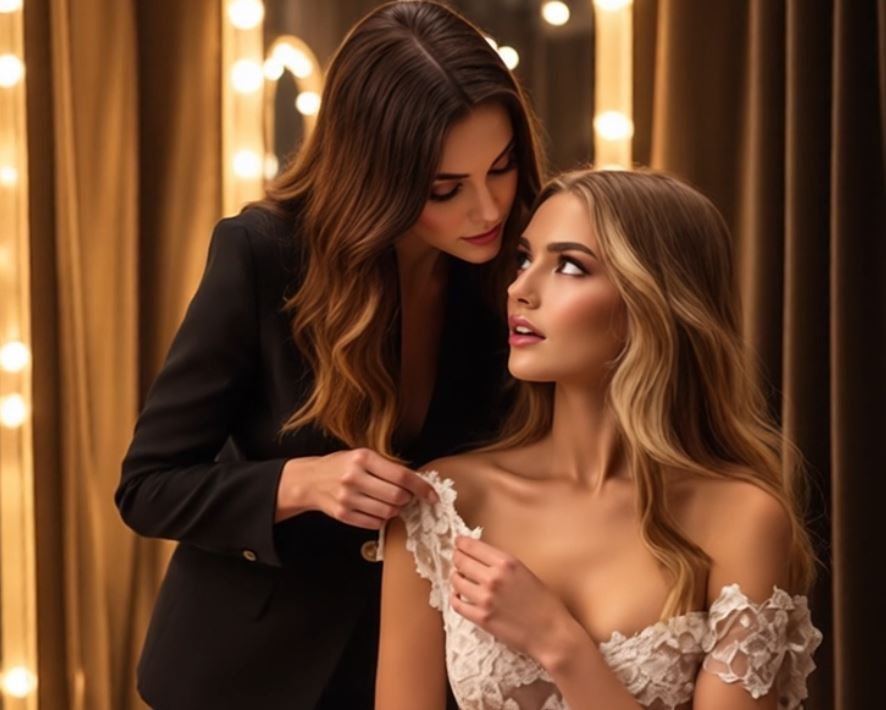
The boutique was called Maison Voss, and it existed in a realm where price tags were never discussed and appointments were granted only by referral. I had been given one by my sister — a gift for my thirtieth birthday, a “transformation” she called it. I arrived at 3 PM on a Tuesday, wearing jeans and a sweater, feeling completely out of place.
She was waiting for me.
Valentina Voss. The founder. The designer. The woman whose hands had dressed royalty and celebrities and women who moved through the world with a confidence I had never possessed. She was tall, with dark hair pulled back in a chignon that showed off her elegant neck, wearing a fitted black blazer with gold buttons that managed to be both professional and completely devastating.
“You’re Elara,” she said, her voice low and musical. “Your sister told me you need to remember what it feels like to be seen.”
“I don’t know what that means,” I admitted.
She smiled — slow, knowing, completely in control. “You will.”
She led me to the private fitting room — a space of velvet and mirrors and warm golden light that made my skin glow before she even touched me. She had me undress behind a screen, then handed me a garment bag.
“Put this on. Nothing beneath it. The fabric requires direct contact with skin to fall properly.”
I did as she said. The gown was ivory lace, sheer and delicate, woven in a pattern that seemed to shift with every movement. It draped off one shoulder, the semi-transparent fabric clinging to my silhouette in ways that revealed more than I was comfortable with. I stepped out from behind the screen, my arms crossed over my chest, my cheeks burning.
“Don’t hide,” she commanded softly. “Let me see.”
She guided me to the velvet ottoman, had me sit, then stood behind me, her hands adjusting the drape of the gown at my shoulder. Her touch was professional — warm, sure, completely controlled. She smoothed the lace over my collarbone, her fingers tracing the edge where fabric met bare skin.
“This lace was woven in Paris,” she murmured, her voice dropping to a register so deep and rough it felt like it came from somewhere beneath her chest. “Designed by artisans who understood that the most powerful thing a garment can do is suggest rather than reveal. To make the observer imagine what lies beneath.” Her hands moved lower, adjusting the fabric at my waist, her knuckles brushing my hip through the sheer lace. “And watching you in it… seeing how it clings to every curve… how your skin glows through the pattern… I think I’ve discovered something I wasn’t meant to see.”
“What’s that?” I breathed, my voice barely audible.
She leaned down, her lips close to my ear, her hands still moving over the lace with devastating slowness. “That you’ve been hiding,” she whispered. “Beneath your everyday clothes. Beneath your polite smiles. Beneath the armor you wear to survive.” Her fingers found a loose thread at my shoulder, pulled it slowly, watching the lace shift. “Something beautiful. Something hungry. Something that wants to be seen.”
I looked at her in the mirror. Our eyes met, and I saw myself reflected in her gaze — flushed, vulnerable, completely exposed in ways that had nothing to do with the gown.
“Tell me to step back,” she continued, her voice rougher now, emotion cracking through her professional composure. “Tell me to finish this fitting professionally and send you home in a beautiful dress. Tell me you don’t feel this connection. This electricity. This unbearable need to know what happens when the curtain closes and it’s just us and the lace.”
I didn’t speak. I couldn’t. My hand rose to touch the lace at my chest, my fingers brushing hers where they still rested on the fabric. She felt it — the tremor in my touch, the wanting I couldn’t hide.
“Or,” she whispered, her lips brushing my earlobe, “tell me to draw this curtain. To lock that door. To show you what this gown was truly designed for. Not to be worn. To be removed. Slowly. Deliberately. Until there’s nothing between us but the truth.”
I reached up. My hand found hers on my shoulder, my fingers lacing through hers, pulling her closer. She made a sound — half groan, half prayer — and then she was drawing the heavy velvet curtain, the click of the lock echoing in the quiet room.
She took her time. The gown was removed ribbon by ribbon, thread by thread, her hands worshipping every inch of skin she revealed. She explored me with the same focus she brought to her designs — finding every sensitive place, every gasp, every tremor. When she finally laid me back on the velvet ottoman, the discarded lace pooled around us like a cloud, she looked down at me with an expression of pure reverence.
“Beautiful,” she murmured, her hands finding my waist, my ribs, my thighs. “More beautiful than any gown I’ve ever created. And I’ve created thousands.”
“Valentina,” I gasped, arching into her touch.
“I know,” she whispered, her mouth finding my neck, my collarbone, the sensitive place where my pulse hammered. “I know what you need. I’ve known since the moment you walked in wearing jeans and a sweater, looking like you had forgotten how to be seen.”
She showed me. For hours, in that fitting room surrounded by velvet and mirrors, she showed me exactly what it meant to be seen. To be wanted. To be completely, utterly, beautifully exposed. Her mouth was hot and demanding, her fingers skilled and relentless, her whispered confessions mixing with my breathless moans until I couldn’t tell where I ended and she began.
When I finally came apart beneath her, it was with her name breaking from my lips, my fingers tangled in her dark hair, my body convulsing on the velvet that had been designed for exactly this purpose.
Afterward, she held me, her fingers tracing patterns on my stomach while I caught my breath. “I don’t do this,” she confessed softly. “With clients. With anyone. I’ve built this house on professionalism. On distance. On the belief that desire destroys craft.”
“And now?” I whispered.
“Now I know I was wrong,” she murmured, pressing a kiss to my forehead. “Desire doesn’t destroy craft. It reveals it. You are my finest creation, Elara. Not because I dressed you. Because I undressed you. Because I saw what was underneath and made it shine.”
I kept the gown. It hangs in my closet, the ivory lace still carrying her scent. And every time I wear it — which is often, which is always when she is near — she undresses me again. Ribbon by ribbon. Thread by thread. Until I am completely, utterly, beautifully hers.
Some fittings change your wardrobe. Others change your life.