Arizona heat doesn’t warn you. It just arrives. By noon, the asphalt at the grocery plaza was shimmering at 105 degrees. Steering wheels became weapons. Seatbelt buckles became brands. And the inside of a parked car became another climate entirely.
Officer Diego Vega had spent the morning checking on an elderly man at a bus stop, answering a shoplifter call, and letting a little boy feel the weight of his badge. By two o’clock, he was six miles away when dispatch called about a dog.
Not a baby. A dog.
The pharmacy clerk, a young man named Tyler, had watched the pit bull circle the silver SUV twice before the barking started. At first, he thought the dog wanted shade. Then the dog jumped at the rear window. Tyler had customers. He was alone at the register. He thought someone in the store owned the dog and would come out.
That is how delay happens. Not always from cruelty. From people filing urgent things into someone else’s responsibility.
The dog did not file it away.
He stayed.
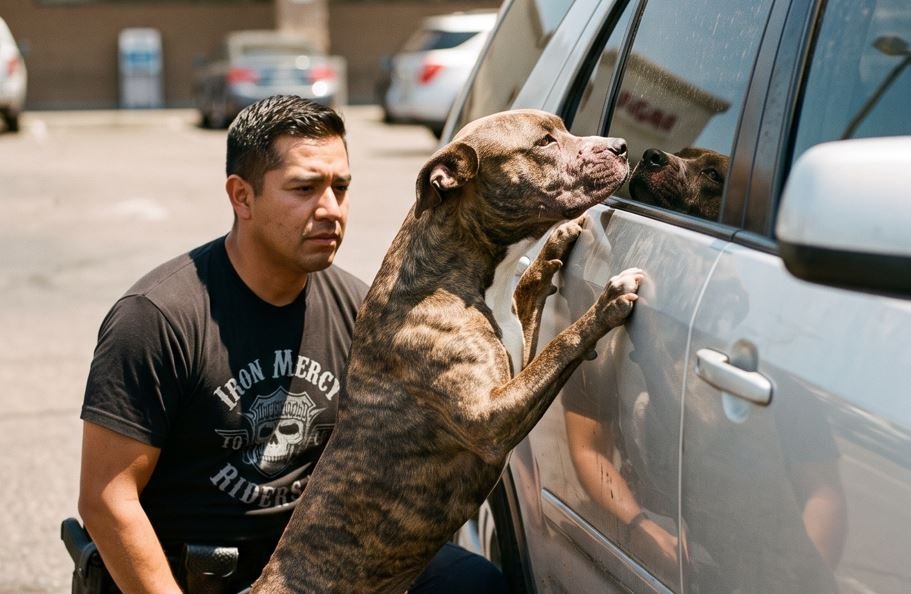
Diego arrived at minute 23. The pit bull was standing on his hind legs, front paws on the driver’s door, nose pressed against the glass. His body shook with each bark. Sets of three. Pause. Three more. His paws were already tender from the hot pavement. He could have moved to the shade of the building. He didn’t. Each time he stepped away, he came back.
Diego looked through the window.
A car seat. A baby. Six months old, maybe. Light brown hair damp at the temples. One yellow sock. The other had come off. Her head had fallen to one side. Her skin was too pink. Too still.
“Back, buddy,” Diego said.
The dog backed up one step. Only one.
Diego broke the window.
The glass fell inward. Heat poured out like a physical thing. Diego reached through, unbuckled the car seat, and lifted the baby into his arms. Her head fell against his forearm. Her skin felt wrong. Too warm. Breathing too shallow.
He moved her to the strip of shade along the pharmacy wall. The dog followed. He didn’t jump. Didn’t get in the way. He paced in a tight half-circle, whining each time the baby made no sound.
“Stay,” Diego said.
The dog sat.
When the ambulance arrived, the medics moved fast. Denise Carter, a paramedic with calm that felt like a rope thrown across water, took the baby from Diego’s arms. Her partner called vitals. The baby — Lily Parker — was alive. Dehydrated. But alive.
The dog barked once at the ambulance door when Lily went in.
Then stopped.
That silence hit Diego harder than the barking.
The Chip
Megan Parker came running from the store with a paper bag in one hand. She saw the broken glass first. Then the empty car seat. The bag slipped. Oranges rolled across the pavement.
“Where is she?”
“She’s with medics,” Diego said, using the voice officers use when panic needs a wall. “She’s alive.”
Daniel Parker arrived from the far end of the lot, phone still in his hand. Megan turned to him. “I thought you had her.”
“I thought you did.”
They both looked at the SUV. Then at the ambulance. Then at each other.
No sentence can hold that kind of realization.
Megan looked at the dog. “Is that our dog?”
“No,” Diego said.
That was the first twist.
The dog who had saved Lily did not belong to the Parkers. He was not their pet left outside. He was a stray — or what looked like one — who had passed a locked car and refused to keep walking.
Animal control was backed up, so Diego drove him to a veterinary clinic himself. The dog let him pour water into a paper bowl. He drank slowly. Then nudged the bowl once with his nose, as if checking whether the baby needed some too.
Diego named him Buddy in his report. Every animal needs something better than “unknown dog.”
Buddy’s paws were sore. Old dust in his coat. Burrs near his tail. A crescent scar across his muzzle. No collar, but the fur showed a faint flattened ring where one had once rested.
At the clinic, Dr. Priya Nair scanned him.
The machine beeped.
“Milo.”
The dog’s head lifted. Not fast. Not like a trick. Like a name had reached him through a year of dust.
Dr. Nair read the registration.
Primary owner: Hannah Whitaker. Marana, Arizona. Reported missing: eleven months, twenty-six days ago.
The stray was not a stray.
The Family He Had Lost
Hannah Whitaker arrived forty minutes later with her husband Tom and their son Caleb. They walked into the clinic like people afraid hope might punish them if they touched it too quickly. Hannah was forty-four, sun-freckled arms, face older than her years until she saw Milo.
Then she looked like someone whose missing piece had crossed a room.
“Milo,” she said.
He froze. One second. Two. Then his tail moved so hard his hips followed. Hannah dropped to the floor, and Milo went into her lap as if the year between them had been a bad hallway he had finally crossed. Tom covered his mouth. Caleb, sixteen, stood by the door and cried without trying to hide it.
Milo had disappeared during a monsoon storm nearly a year earlier. A gate latch broke. Fireworks started early. Milo ran. The family searched for weeks. Flyers. Shelters. Night drives. Bowls left outside. A blanket on the porch.
Nothing.
“He was my daughter’s dog first,” Hannah said.
That sentence changed the room.
Their daughter Sophie had died two years earlier at age seven from complications after a congenital heart condition. Milo had been her dog through surgeries, recovery days, hospital returns, and quiet afternoons when she was too tired to play but not too tired to rest one hand on his head.
Caleb opened his phone and showed Diego a picture.
A little girl in a purple hospital blanket. Milo beside her bed, younger, shinier, his white chest patch bright. Sophie’s fingers rested on his folded ear.
“She taught him the three-bark thing,” Caleb said.
“What three-bark thing?”
“When she needed help but couldn’t call loud. Three barks, pause, three barks. We’d come running.”
That was the second twist.
Milo had not invented the alarm in the parking lot. He had used an old language from a child he loved. A language she had taught him from her hospital bed. Three barks. Pause. Three more. Until someone listened.
He had stood on burning asphalt for twenty-two minutes, using the only language Sophie had given him, to save a baby he had never met.
Milo Day
A year later, Diego took his daughter to the park in Marana for what the two families called Milo Day.
The Whitakers and Parkers had chosen a Saturday near the date of the rescue. They rented a ramada, brought shade tents, water bottles, and a small kiddie pool for Milo’s feet because nobody forgot the asphalt.
Lily was eighteen months old then. Walking in the uncertain way toddlers do. Megan followed close, marked by the memory of a day that had changed how she breathed near parking lots. Daniel carried a cooler and checked the stroller twice before locking his car.
Nobody made jokes about that.
Hannah brought a framed photo of Sophie and set it on the picnic table beside a bowl of dog treats. Caleb wore sunglasses though the ramada was shaded. Tom grilled hot dogs and pretended smoke was the reason his eyes watered when Milo leaned against his leg.
Milo arrived last. He stepped from the truck wearing a blue collar with two tags now. One had his name and number. The other was shaped like a tiny sun and said LISTEN.
His paws had healed. His scar remained. One ear still folded. His white chest patch still looked like a broken heart, though Diego’s daughter said it looked more like a map.
Milo greeted the Whitakers first because they were his home. Then he crossed to Lily. She was holding the yellow sock from the rescue day, clean now and tied to her stroller handle. Megan had kept it. Some objects become proof that the worst moment did not get the last word.
Milo sniffed the sock. Then he sat beside Lily. She put one hand on his head.
The park went quiet.
Hannah and Megan spoke together to a small group from a child safety nonprofit. No speeches about blame. No easy answers. They talked about exhaustion, heat, and how one interruption can break a routine. They handed out window cards and thermometer tags.
Milo slept through most of it.
That felt right. His work had already been done.
Diego’s ritual began after that day. Every summer shift, before leaving the station, he clips his daughter’s pink dinosaur to his mirror and says one sentence under his breath:
“Listen for the third bark.”
It is not official policy. It is his.
He checks parking lots more slowly now. Looks through windows. Listens longer when something sounds wrong but looks ordinary. Sometimes it is nothing. Sometimes it is a loose dog, a confused tourist, a sleeping teenager.
Sometimes nothing is worth checking.
Because once, nothing was a baby.
And a dog knew before anyone else did.
Milo is old now. Not ancient. Just older in the way dogs become after their bodies carry more story than muscle. His muzzle has gone pale. His paws are careful on hot days.
Lily is four now. She calls him “My-low,” like the name belongs in two soft pieces. On Milo Day, she brings him a yellow sock. Every year. Hannah brings Sophie’s photo. Caleb brings treats. Daniel brings water. Megan brings silence sometimes, and nobody tries to fill it too fast.
Diego brings his daughter, who is almost a teenager now and pretends she is too old to love Milo until he rests his head on her knee. Then she folds. Every time.
People ask Diego what kind of dog Milo is.
He says Pit Bull mix.
Then he says lost dog.
Then he says found dog.
Then, if they have time, he tells them he was outside the car.
That is the part that matters.
He was not trapped. He was not protecting his own baby. He was free to walk away.
He did not.
He stood on burning pavement. He barked until one person listened. He saved a child. Then a chip beneath his skin saved him back.
Two families gather now because of one dog who would not leave a locked door alone.
A child went home. A dog went home.
And the rest of them learned to stop. To look. To listen.
Three barks. Pause. Three more.
Enough.