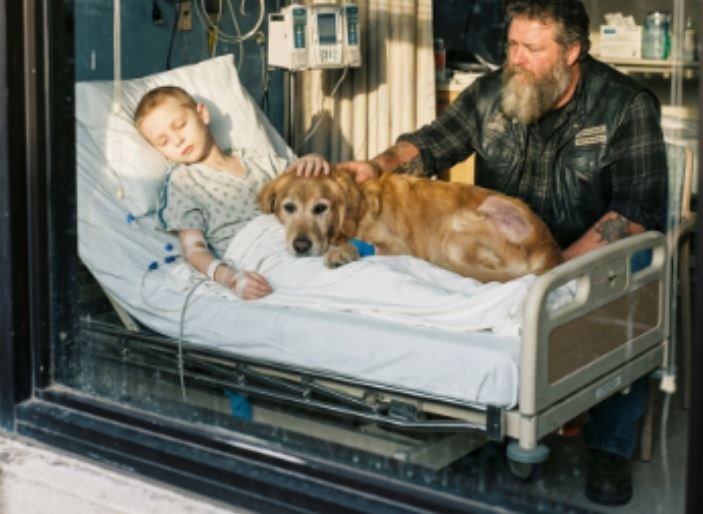
Nurse Patricia had worked the pediatric oncology floor for fourteen years. She had seen children cry from pain, from fear, from the unfairness of being small and sick in a world that didn’t make sense. She had learned to read the difference. She had learned when to hold a hand, when to call a parent, when to page the doctor for more morphine.
But Elijah’s crying was different.
It had started at 11 AM. A Tuesday. Soft at first — the kind of crying a boy does when he’s trying to be brave. Then harder. Then continuous. A sound that didn’t pause for breath, that seemed to come from somewhere deeper than lungs.
Elijah was nine. Leukemia, stage 4. He had been in the hospital for six months. He had survived two rounds of chemo, a bone marrow transplant, a lung infection that should have killed him. He was the strongest kid on the floor. The nurses called him “the warrior.”
But two weeks ago, he had stopped speaking.
Stopped eating. Stopped looking at anyone. Just lay in his bed, staring at the ceiling, the wall, the window — anywhere that didn’t have a face.
The doctors said it was depression. Common in long-term pediatric patients. They adjusted his medication. They brought in a child psychologist. They played his favorite movies, his favorite music, read his favorite books.
Nothing.
And now, at 2 PM, he had been crying for three hours. His mother, a small woman named Gloria with dark circles under her eyes that had become permanent, sat in the corner chair and held his hand and cried with him. The chaplain had come and gone. The psychologist had come and gone. The doctor had ordered more morphine, but Patricia knew — she knew — this wasn’t pain.
This was grief.
And nobody knew what the boy was grieving.
The Dog
Bear Callahan didn’t belong in a hospital.
He knew it. The security guard at the main entrance knew it. The woman at the information desk knew it. A six-foot-four man with a gray beard, tattooed arms, scarred hands, and a black leather vest that said IRON MERCY RIDERS on the back did not blend in with the pastel walls and the hand-sanitizer stations.
But Darlene had called him.
Darlene “Doc” Reeves, retired Army medic, tattooed forearms, twice divorced, trust issues with pit bulls. She volunteered at the hospital twice a week, reading to kids, holding hands, being present. She had been there when Elijah stopped speaking. She had been there when the crying started.
And she had called Bear because she knew something the doctors didn’t.
“His dog died,” she had said on the phone. “A golden retriever named Sunny. Twelve years old. Slept in his bed every night since he was two. Died last week at home. Gloria didn’t tell him. She thought he was too sick. Thought it would make things worse.”
“She was wrong,” Bear said.
“She was wrong,” Darlene agreed. “But I can’t fix it. I don’t have a dog. And even if I did —”
“I have a dog,” Bear said.
Hoarding
The dog’s name was Rusty, though he didn’t know it yet.
Bear had found him three days earlier, in a hoarding case outside Flagstaff. Forty-seven dogs in a single-wide trailer. Rusty was a golden retriever, maybe six years old, skin and bones, fur matted with urine and feces. He had a shaved patch on his side from a wound that had gone untreated — a bite from another dog, probably, in the chaos of too many animals and not enough space.
He didn’t bark. Didn’t wag. Didn’t make eye contact. When Bear reached for him, he flinched so hard he hit the wall. When Bear put him in the truck, he curled in the farthest corner and trembled.
Darlene had been treating him at her makeshift clinic. Cleaning the wound. Feeding him small amounts. Letting him learn that hands could be gentle. That space didn’t have to be fought for.
He was not a therapy dog. Not trained. Not certified. Not even fully healthy.
But when Bear looked at him, he saw something. A stillness. A patience. The way Rusty would sit in the corner of Darlene’s clinic and watch the other dogs without moving, without reacting, just… present.
“He’s broken,” Darlene had said.
“So is Elijah,” Bear had replied.
The Room
Bear didn’t ask permission.
He didn’t fill out forms. Didn’t call ahead. Didn’t explain himself to the floor supervisor who tried to stop him at the elevator. He just walked — Rusty on a leash, head down, tail tucked — to room 412.
Gloria looked up when the door opened. Her eyes went wide. She started to stand, to speak, to object.
Then she saw Rusty.
The dog didn’t run to the bed. Didn’t jump. Didn’t bark. He just stopped. Looked at Elijah. Looked at the boy who was crying, really crying, the kind of crying that shakes a small body from the inside out.
And Rusty walked to the bed.
Slow. One paw at a time. Like he was walking through water. He reached the side rail — too high for him to jump, especially in his weakened state. Bear lifted him. Set him on the bed.
Rusty didn’t lie down immediately. He stood there, trembling, on the blanket beside Elijah. The boy didn’t open his eyes. Didn’t stop crying. Didn’t acknowledge the dog at all.
Rusty looked at Bear. Bear nodded.
Rusty lay down. He turned in a small circle — three times, the way dogs do — and settled his chin on Elijah’s chest. Right over the boy’s heart.
Elijah’s crying changed.
Not stopped. Not immediately. But the rhythm shifted. The gasps grew longer. The sobs grew quieter. Elijah’s hand — the one with the IV line, the one that had been clutching the blanket in a fist — opened. Moved. Found Rusty’s fur.
His fingers sank in. Tightened. Held on.
And Elijah stopped crying.
Not because the pain was gone. The cancer was still there. The fear was still there. The grief was still there.
But someone else was there too. Someone broken. Someone who had known fear and hunger and the chaos of too many bodies in too small a space. Someone who didn’t need words. Someone who just… stayed.
Elijah’s eyes opened. He looked at Rusty. Looked at the shaved patch, the visible ribs, the trembling that still ran through the dog’s body.
“You’re scared too,” Elijah whispered.
It was the first thing he had said in two weeks.
The Truth
Gloria told him that night.
She sat on the bed, Rusty between them, and she told Elijah about Sunny. About the vet visit. About the tumor they hadn’t known about. About the peaceful passing. About how Sunny had been old and tired and ready, and how she had waited — Gloria was sure of this — until Elijah was safely in the hospital, surrounded by people who loved him, before she let go.
Elijah cried again. But it was different crying. The crying of someone who finally knew what they were crying about. The crying of goodbye.
Rusty stayed through all of it. Chin on Elijah’s chest. Warm. Present. Still.
The Weeks
Elijah didn’t get better.
The cancer was too advanced. The doctors had been honest about that from the beginning. He had weeks, maybe. A month if they were lucky.
But he started eating again. Started talking. Started asking for his LEGOs, his books, his movies. Started letting the nurses braid his hair, paint his nails, draw tattoos on his arms with marker.
And every day, Bear brought Rusty.
Not officially. Not with permission. The hospital eventually stopped trying to stop him. The nurses started looking forward to it. The other kids on the floor started asking when “the biker dog” was coming.
Rusty learned the hospital. Learned the elevator. Learned to walk past the hand-sanitizer stations without flinching. Learned that the clatter of the medication cart didn’t mean danger. Learned that small hands reaching for him were gentle.
He never became a therapy dog. Never got certified. Never wore a vest.
He just became Rusty. The dog who learned to be still.
The Last Day
Elijah died on a Thursday morning, just after dawn.
Gloria was there. Darlene was there. Bear was there, in the corner, his leather vest draped over the chair because the hospital was warm and because he had learned, in these weeks, to be soft when softness was needed.
Rusty was on the bed. Chin on Elijah’s chest. The boy’s hand in his fur.
Elijah’s last words were to the dog.
“Thank you for being scared with me.”
Then he closed his eyes. And the crying stopped for good.
After
Bear took Rusty home.
Not to the shelter. Not to another foster. Home. To his small house on the edge of town, with the couch that smelled like dog and the yard that needed mowing and the quiet that didn’t feel lonely anymore.
Rusty slept on Elijah’s blanket — Gloria had given it to Bear, the one from the hospital bed, the one that smelled like antiseptic and boy-sweat and the last days of a life that had been too short but too full.
He slept deeply now. No more trembling. No more flinching. No more corner-curling.
He had learned to be still. And in learning that, he had taught a boy to speak. Taught a mother to forgive herself. Taught a biker that his scarred hands could hold something gentle.
Every morning, Bear sat on the porch with Rusty beside him. They watched the sun come up. They didn’t talk. They didn’t need to.
They just were.
And that was enough.