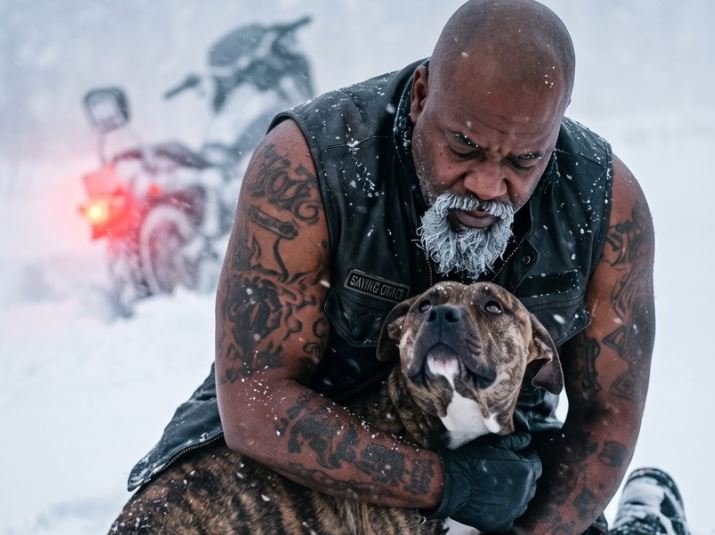
Preacher Boone was not supposed to be on Highway 93 at 3 AM.
He was supposed to be in Missoula by midnight. A funeral. A brother from another chapter, dead at 47 from a heart attack that came without warning. Preacher had his suit — the only one he owned, black, bought in 2009 for his mother’s service — folded in his saddlebag. He had planned to ride through the afternoon, check into a motel, sleep, wake up clean and pressed and ready to say goodbye.
But the storm had other plans.
By 10 PM, the blizzard had closed the mountain pass. By midnight, Preacher was rerouted onto a county road that hadn’t been plowed in hours. By 2 AM, he was crawling at 20 miles per hour, his Harley’s headlight cutting through a wall of white that seemed to have no end.
At 3:17 AM, he saw the shape.
It was not a deer. Deer don’t sit in drainage ditches. It was not a snowdrift. Drifts don’t have ears. It was a dog. A brindle pit bull, snow up to her chest, sitting upright like a statue carved from patience and ice. Three small shapes wriggled beneath her belly. Puppies. Tiny. Probably less than a week old, from the size of them.
Preacher stopped. Killed the engine. The wind screamed in the sudden silence.
He walked to the ditch. The snow was waist-deep, powdery and sharp. The dog didn’t move when he approached. Didn’t growl. Didn’t lift her head. She just sat there, snow collecting on her eyelashes, her nose, the fold of her ears.
Her eyes were open. But they weren’t looking at him. They were looking past him. Through him. At nothing.
“Hey, mama,” Preacher said. His voice was swallowed by the wind.
He reached out. His gloved hand touched her shoulder. She was cold. Not frozen — her body was warm underneath, where the puppies were — but her back, her head, her exposed ears were crusted with ice.
He didn’t think. He just acted.
He unzipped his leather vest. The Iron Mercy Riders patch on the back — the iron cross with the dog silhouette — faced the wind for one second before he draped the vest over her like a tent. Then he unzipped his thermal shirt. Then his undershirt. He stood in the blizzard in nothing from the waist up, six-foot-four of Black man with tattooed arms and a bald head turning white with snow, and he lifted the mother and her puppies together.
She was lighter than he expected. Maybe forty pounds, but she felt like twenty. The puppies were three. Two brindle, one white. They didn’t make a sound. Just nursed, even as they were lifted, even as the world moved.
Preacher sat in the snow. Back against the ditch wall. He tucked the mother into his lap, pressed her against his bare chest, and wrapped his arms around her. The puppies stayed against her belly, warm between her body and his.
He sat there for 47 minutes.
He didn’t have a phone signal. Didn’t have a blanket. Didn’t have anything but his own body heat, which was leaving him fast. His arms went numb. His fingers turned white. His teeth chattered so hard he thought they might crack.
But he didn’t move.
The dog didn’t move either. She just rested her head against his collarbone and breathed. Every few minutes, she would lift her nose and sniff his neck. Not suspiciously. Curiously. Like she was memorizing him.
When the county snowplow finally came, the driver — a white man named Hank, 60 years old, third shift for 22 years — found them like that. A giant Black man, shirtless, covered in snow, holding a dog and three puppies in a ditch at -19 degrees.
Hank didn’t ask questions. He just opened the cab door and turned the heat to maximum.
The Vet
Dr. Elena Vargas worked the emergency clinic in Kalispell. She had seen hypothermia before. She had seen frostbite. She had never seen a man walk into her clinic at 5 AM, shirtless, carrying a dog wrapped in his own leather vest, and simply say: “Check her first. I’ll wait.”
They checked him anyway. Mild hypothermia. Frostnip on his fingers. Nothing permanent.
But when Dr. Vargas examined the dog, she found something that made her call Preacher back into the room.
“She’s blind,” Dr. Vargas said. “Cataracts in both eyes. Advanced. She’s been blind for at least a month, probably longer.”
Preacher looked at the dog, lying on the examination table, puppies nursing in a warming box beside her. Her eyes were open, milky, unfocused. She was looking at the sound of his voice, not at him.
“She’s been blind through the pregnancy,” Dr. Vargas continued. “The blindness might have been caused by the pregnancy itself — eclampsia, hypertension, something that went untreated. She was probably dumped when the breeder realized she couldn’t see anymore. Couldn’t breed. Couldn’t navigate. Worthless to them.”
Preacher didn’t say anything.
“She’s been sitting in that ditch for at least two days,” Dr. Vargas said. “Maybe three. The snow covered her. She couldn’t see to find shelter. Couldn’t see the road. She just… sat there. Kept them alive with her body heat. It’s a miracle they’re all alive.”
Preacher walked to the table. The dog lifted her head at his footsteps. She didn’t look at him. She looked toward him. Her nose twitched. She whined — a soft, broken sound.
Preacher put his hand on her head. She leaned into it immediately. Pressed her whole face into his palm.
“Hey, Nova,” he whispered.
Dr. Vargas looked at him. “You know her?”
“No,” Preacher said. “But she needs a name. Nova. Like the star you can’t see, but you know it’s there.”
The Home
Preacher missed the funeral.
He called the chapter president from the clinic. Explained. The man understood. Iron Mercy Riders had a rule: you don’t leave a dog in the snow. You don’t leave a mother alone. You don’t keep riding when something needs you to stop.
Preacher took Nova home.
Not to a shelter. Not to a foster. Home. His small house in Billings, with the wood stove and the drafty windows and the couch that smelled like motor oil and old leather.
He set up a whelping box in his bedroom. Heated blankets. A space heater. Nova settled in like she had been waiting for this room her whole life. The puppies — he named them North, Drift, and Ember — grew. They opened their eyes. They learned to walk. They learned to find Nova by smell and sound, the way she had learned to find her way through darkness.
Nova never bumped into furniture. Never missed a step. She mapped the house by scent and memory. She learned the sound of Preacher’s Harley from three blocks away. She would stand at the door, tail wagging, before he even turned off the engine.
She learned his voice. His footsteps. The rhythm of his breathing at night.
And every night, she slept on his chest. The same position she had been in, in the ditch. Her head on his collarbone. Her body warm against his heart.
Preacher didn’t fix her eyes. The vet said surgery was possible, but risky. Expensive. Preacher paid for the consultation anyway. But when the vet described the procedure — the anesthesia, the recovery, the stress — Preacher looked at Nova, sleeping peacefully on his couch, navigating his home with perfect confidence, and he said no.
“She don’t need to see,” he told Dr. Vargas. “She sees better than most people I know. She sees with her heart.”
The Spring
By April, the puppies were weaned. North went to Caleb. Drift went to Luis. Ember stayed with Preacher. She became Nova’s eyes when they walked — leading her mother around obstacles, nudging her away from curbs, standing still when Nova needed to map a new space.
Preacher took Nova everywhere. To the garage. To the diner. To the Iron Mercy meetings, where she sat at his feet and listened to every voice, her ears tracking the speakers like radar dishes. She became the chapter’s mascot. The blind dog who saw everything.
One night in May, Preacher sat on his porch. The snow was gone. The air smelled like lilacs. Nova lay beside him, Ember on his other side, and he thought about the man in Missoula whose funeral he had missed. He thought about the brother he hadn’t said goodbye to.
He had carried guilt about that for months. The what-if. The should-have.
But Nova shifted against his leg. Pressed her nose into his palm. And Preacher understood.
He had been riding to a funeral that night. But he had stopped for a life instead. Three lives. Four, counting Nova. He had been where he was needed most.
Some goodbyes can wait.
Some hellos can’t.
He looked down at Nova. Her milky eyes were closed. She was dreaming, paws twitching, probably chasing something through a world she could see perfectly in her sleep.
“Hey, Nova,” he whispered.
She woke. Lifted her head. Looked toward his voice with that same steady, trusting gaze.
And Preacher Boone, who had given his jacket, his shirt, his warmth, and 47 minutes of his life in a Montana ditch, smiled.
“Thank you for seeing me,” he said.
She licked his hand once.
And that was enough.