Marcus Wrench Holt had not slept in 42 hours.
This was normal for him. Since Afghanistan, since the bodies he had found in the dark, since the digging he had done with his bare hands in places where the earth should not have been disturbed — sleep had become a country he could no longer visit. He rode instead. Filmed instead. Documented the world at 3 AM when everyone else was dreaming, because he had forgotten how to dream.
That night, he was riding the Columbia River Gorge. Washington side. The storm had been pounding the Pacific Northwest for two days. The dams were at capacity. The spillways were scheduled to open at 6 AM to release the pressure.
His GoPro was running. He filmed everything. The rain on his visor. The lightning over the river. The way the dam looked like a wall holding back the sky.
Then he heard it.
A howl.
Not the wind. Not the water. Something older. Something that cut through the storm like a blade.
Marcus stopped. Killed the engine. Listened.
It came again. From below. From the dam.
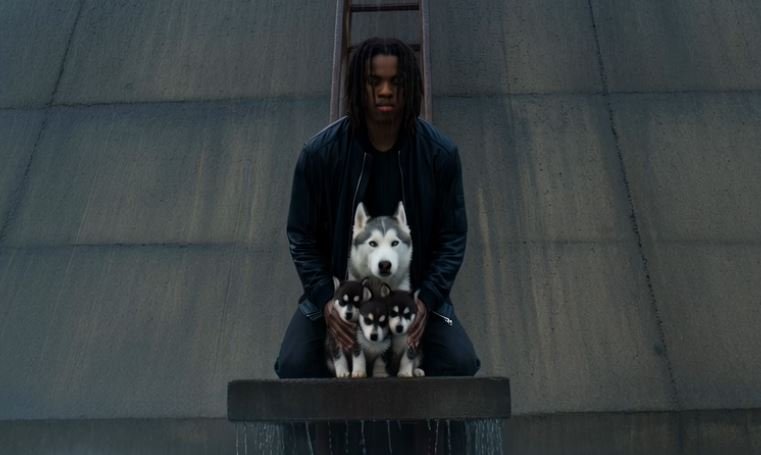
He walked to the edge. The maintenance ladder — rusted, forbidden, bolted to the concrete face — descended into darkness and mist. Thirty feet down. A narrow platform. And on it, a shape.
White and grey. Fluffed fur, soaked through. A husky. Standing on the platform, nose lifted, howling into the storm.
Marcus pulled out his flashlight. The beam cut through rain and found her. A husky mother. Ice-blue eyes, pale as the moon. And beneath her belly, four small shapes. Puppies. Huddled. Trembling.
The water was already lapping at the platform’s edge. Four inches from the bottom. The river was rising. By dawn, when they opened the gates, the platform would be underwater. The current would take them all.
Marcus didn’t call 911. The dam was automated. The control room was empty until morning shift. The emergency line routed to a voicemail in Portland.
He didn’t wait.
He climbed down the ladder.
The Platform
The ladder was slick with algae and rain. Marcus descended one rung at a time, bare hands gripping wet steel, his dreadlocks heavy with water, his camera still running on his helmet. He didn’t look down. He had learned in Afghanistan not to look down.
The platform was six feet wide. Concrete. Covered in an inch of standing water. The husky watched him descend. She didn’t growl. Didn’t back away. She just stood over her puppies and waited to see what kind of human this was.
Marcus knelt. The water soaked his knees. He reached out slowly. Let her smell his hand. She sniffed — rain, leather, motorcycle oil, something else. Something familiar. Dirt. Sweat. The smell of someone who had dug in the earth before.
She licked his knuckles.
Marcus looked at the puppies. Four of them. Maybe three weeks old. Eyes barely open. One was white like the mother. One grey. One black and white. And one — the smallest — was grey with a crooked front paw. It turned in slightly, making him waddle when he tried to walk.
Marcus lifted the smallest one. The puppy didn’t cry. Just shivered. He tucked it inside his leather jacket, against his heart. Warm. Safe.
Then he lifted the second. The third.
When he reached for the fourth — the black and white one — the puppy didn’t react to his touch. Didn’t flinch. Didn’t turn toward his hand. Marcus clicked his fingers near its ear. Nothing.
Deaf.
He looked at the mother. She was watching him with those ice-blue eyes. Not afraid. Just tired. Resigned. She had been waiting for someone to come. Or for the water to rise. Whichever came first.
Marcus wrapped all four puppies in his jacket. Zipped it halfway. They nestled against his chest, four heartbeats against his own.
Then he turned to the mother. She was big. Sixty pounds of wet fur and muscle. He lifted her in his arms, puppies and all, her belly pressed against his chest, her head over his shoulder.
He climbed the ladder one-handed.
The Breeder
At the top, Marcus sat on the wet gravel and held them. The mother didn’t struggle to get down. She just rested her head on his thigh and let the rain wash over her. The puppies nursed through the open zipper of his jacket, not caring that the leather smelled like road and smoke.
A truck passed. Slowed. Stopped.
A white man, 50s, rain jacket with a logo. Riverview Kennels. He rolled down the window.
“That’s my dog,” he said.
Marcus looked up. His hand moved to the mother’s head. Protective.
“Her name’s Freya. Got out two days ago. Took her litter with her.”
“Got out,” Marcus repeated. Not a question.
The man shifted. “Look. I raise huskies. Premium. Those puppies — the grey one with the paw, the black one that don’t hear — they’re not right. Can’t sell ’em. Freya was supposed to leave ’em. It’s nature. She wouldn’t. Kept trying to carry ’em back to the house. So I drove ’em to the dam. Figured she’d come home once they were… gone.”
Marcus didn’t move. Just stared.
“She’s a good dog,” the man said. “Worth money. I’ll take her back. You can keep the messed-up ones. Do what you want with ’em.”
Marcus stood. Slowly. The mother stayed in his arms. The puppies stayed in his jacket. He walked to the truck. The man rolled up his window an inch.
“She’s not your dog anymore,” Marcus said. His voice was quiet. The kind of quiet that had learned to be loud in other ways. “You left her to drown. You left four puppies to drown. Because they weren’t perfect.”
“Listen, kid—”
“My name is Marcus Wrench Holt. I served with the 82nd Airborne in Afghanistan. I dug bodies out of the ground with these hands. I know what imperfect looks like. I know what disposable looks like. You don’t get to decide who lives and who dies because a puppy’s paw turns left.”
He pulled out his phone. He had filmed everything. The platform. The puppies. The rising water. The man in the truck.
“I’m going to the sheriff. Then the news. Then every rescue page in the Pacific Northwest. And you are going to drive away from here and pray I never see your logo again.”
The man drove away. Fast. Tires spraying gravel.
Marcus sat back down. The mother — Freya — lifted her head and licked his chin. Once. A thank-you. A promise.
The Imperfect
Darlene met them at the clinic. She checked every puppy. The crooked paw — congenital, not painful, wouldn’t need surgery. The deafness — permanent, but the puppy was healthy otherwise. The other two were perfect. Whatever perfect meant.
Freya was malnourished. Her milk was drying up. Darlene set up a feeding schedule. Formula. Warm blankets. A quiet room.
Marcus didn’t leave. He sat in the corner of Darlene’s clinic, filming. The puppies stumbling. Freya watching them with her ice-blue eyes. The deaf puppy — Marcus named him Echo — learning to feel vibrations in the floor. The crooked-paw puppy — he named her Compass — walking in circles because straight lines bored her.
He filmed for three days. No sleep. Just filming. Editing. Posting.
The video went viral.
Not because it was sad. Because it was true. A man who couldn’t sleep, saving a dog who wouldn’t leave. Puppies who weren’t perfect, being loved anyway. The comment that broke the internet came from a mother in Ohio: “My daughter has a crooked foot. She watched this 20 times. She says she’s a Compass now.”
Marcus adopted Freya. Echo and Compass stayed with him too. The other two puppies — North and West — found homes with Iron Mercy Riders.
Freya rides in his sidecar now. She wears goggles. She doesn’t howl at storms anymore. She sleeps through them, her head on Marcus’s thigh, her puppies snoring in the carrier behind her.
Marcus still doesn’t sleep. But now, when he’s riding at 3 AM, he doesn’t film the darkness. He films the road ahead. The sunrise coming. The dog beside him.
And sometimes — just sometimes — he closes his eyes at a red light and doesn’t open them until the car behind him honks.
Not sleep. Not really.
But close enough.