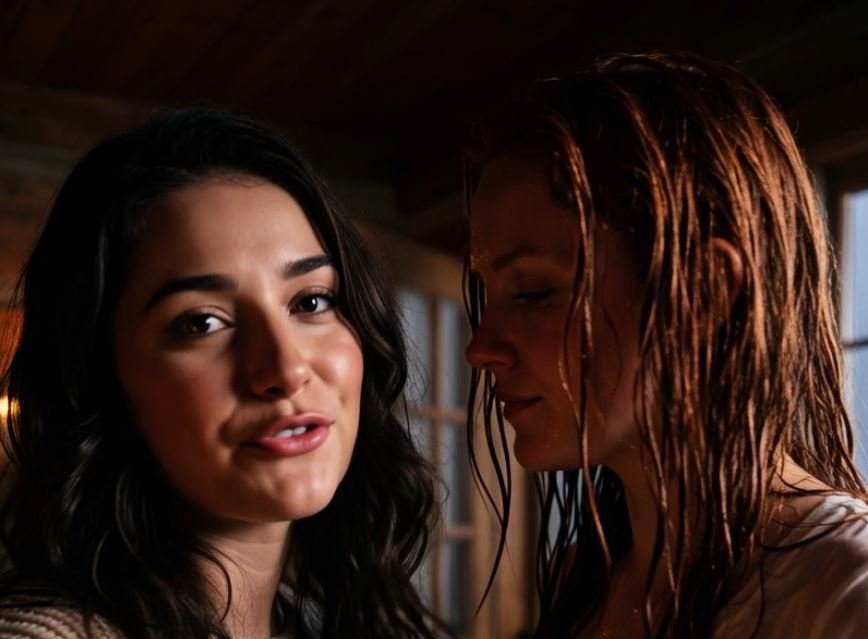
The power went out at midnight, and the darkness was so complete that I thought I’d gone blind.
I was alone in the cabin I’d rented to escape everything—my job, my city, the woman who’d left me three weeks ago with nothing but a note on the kitchen counter and a broken lease that I couldn’t afford to break. The cabin was supposed to be healing. Solitude. Silence. The kind of isolation that forces you to confront your own damage.
Instead, it was just dark. And cold. And full of sounds that were probably trees against the roof but felt like something else entirely.
I’d lit every candle I could find—six of them, scattered around the living room like tiny islands of warmth in an ocean of black. I was sitting on the floor with my back against the couch, wrapped in an oversized sweater that smelled like the previous renter’s detergent, when the thunder cracked loud enough to shake the windows.
And then the door opened.
I didn’t hear it at first. The storm was too loud, the rain against the roof like a thousand fingers drumming. But I felt the cold air rush in, felt the candles flicker, felt the temperature drop by ten degrees in a single second.
She stood in the doorway. A silhouette at first, backlit by the storm. Then she stepped inside, and the candlelight found her.
Rain dripped from her hair—dark red, plastered to her skull and shoulders. Her white t-shirt was completely soaked through, clinging to every curve with a transparency that made my mouth go dry. She was holding a flashlight like a weapon, the beam sweeping the room and landing on me, on my face, on my hands that were suddenly shaking.
“You’re not supposed to be here,” I whispered. My voice barely carried over the storm.
She didn’t speak. Just stood there, shivering, her teeth chattering audibly, her eyes wide and dark in the candlelight. She looked like a ghost. Like a hiker who’d gotten lost and found something she didn’t understand. Like the manifestation of every lonely night I’d spent in this cabin, wishing for company and dreading it in equal measure.
I should have told her to leave. Should have pointed back at the storm, at the woods, at whatever path had led her to my door. But I was looking at her shirt. At the way it clung to her stomach, her ribs, the dark outline of her bra underneath. She knew I was looking. She didn’t try to cover herself. She just stood there, letting me see, letting the candlelight do its work.
I set down my candle. Stood up. Walked over.
Her flashlight beam followed me, trembling in her shaking hand. I reached out and took it from her—gently, like taking a toy from a child—and set it down on the table where the candlelight couldn’t reach. Then I touched her wet cheek with fingers that were warmer than they should have been, warmer than the storm outside, warmer than the loneliness that had been my only companion for three weeks.
“But the storm doesn’t care about supposed to,” I whispered.
I grabbed her wet shirt. The fabric was ice-cold, heavy with rain, and I could feel her heartbeat through it—fast, desperate, matching my own. I pulled her toward me. She came without resistance, her freezing body pressing against my sweater, her cold lips finding mine with a heat that made no sense, that defied physics, that made me forget the storm and the cabin and the woman who’d left.
She tasted like rain and pine needles and the exact moment when loneliness becomes something else entirely. Her mouth opened under mine, her tongue sliding against my teeth, her hands finding my waist and gripping with a desperation that felt like drowning. I walked her backward, toward the fire I’d built in the hearth, toward the warmth that was the only thing that mattered.
My hand was on the hem of her shirt, ready to pull it over her head, when the thunder cracked so loud that the windows rattled and the candles all blew out at once.
We were in complete darkness. Just her breathing and mine. Just her hands on my waist and mine on her ribs. Just the storm outside and the storm between us.
“Wait,” she whispered. Her voice was the first thing she’d said, and it was rough, broken, like she hadn’t used it in days. “Before you see me. Before the light comes back. There’s something—”
The lightning flashed. Just once, brief and blinding, illuminating the room like a camera flash. And I saw them.
Scars. On her back. Thin, white, parallel lines that crossed her shoulder blades like a map of somewhere she’d been and I’d never visited. They were old. Healed. But unmistakable.
I had the same ones.
On my thighs. Hidden under my sweater, under my jeans, under every layer of clothing I’d worn since the night I’d made them. The night she’d left. The night I’d decided that pain was the only thing I could control.
The lightning died. Darkness again. But I’d seen enough.
“Who are you?” I whispered.
She was silent for a long moment. Then: “Someone who saw your light from the woods. Someone who’s been walking for three days. Someone who was left by the same woman who left you.”
I pulled back. Not away. Just enough to breathe. “What?”
“Emma,” she said. The name hit me like a physical blow. “She left me six months ago. With a note. And a broken lease. And scars that I didn’t know how to explain. I’ve been walking ever since. Through cities. Through woods. Through storms. Until I saw your light.”
The thunder rumbled, distant now. The storm was passing. But the storm between us was just beginning.
I found her hand in the darkness. Interlaced our fingers. Led her to the couch, to the blankets, to the warmth that we’d both been searching for without knowing it.
We didn’t make love that night. We held each other, naked and shivering, while the storm died outside and something else took its place. She traced my scars with her fingertips. I traced hers. We didn’t speak. We didn’t need to.
In the morning, the power was still out. But the sun was shining, and she was still there, and her hair was dry and tangled and beautiful. She made coffee with the camping stove I’d never used. I made eggs that were slightly burned. We ate in silence, and when we were done, she reached across the table and touched my hand.
“She didn’t deserve either of us,” she said.
I nodded. “But maybe we deserve each other.”
We’re still in the cabin. It’s been three months. The lease is month-to-month now, and we pay it together. The scars are still there, but they’re fading. Both of ours. We trace them sometimes, in the dark, and remind each other that pain isn’t permanent.
The storm brought her to my door. But I like to think that something else led her there. Something that knew we needed each other. Something that doesn’t care about supposed to.
Something like love. Or lightning. Or the exact moment when two broken people realize they fit together.