Part 2: The Whiteout
The field trip to Pine Ridge was Elena’s idea. Snowshoeing. Nature walk. A reward for six months of progress. Mia had spoken eleven words. Not sentences. Words. But words were earthquakes in her world.
The weather turned at noon.
What started as flurries became a whiteout in twenty minutes. The bus driver called for early pickup. Elena counted heads. Seven. Eight. Nine.
Mia was gone.
They found her red mitten at the trailhead. Then nothing. The snow erased her in minutes. The search team brought two tracking dogs — a bloodhound and a Malinois. The bloodhound lost the scent at the creek. The Malinois circled in confusion, overwhelmed by the wind.
Elena stood in the snow, her lungs frozen with something worse than cold. Mia was non-verbal. Mia wouldn’t answer a whistle. Mia would hide from the wind, from the noise, from the world. She would find a hole and disappear into it.
Then she heard the bark.
Not from the search team. From the bus.
Bumper had clawed through his crate. He was standing in the open door, his nose lifted to the wind, his white face coated in snow. He wasn’t looking at anything. He was scenting.
Elena ran to him. She grabbed his collar — the one Mia had picked, bright red with a bell. “Find her,” she whispered. “Bumper, find Mia.”
He didn’t run. He drifted.
Into the white wall of the blizzard, nose to the ground, ears rotating like radar dishes. He didn’t follow footprints. He followed something older. Something the wind couldn’t steal. The smell of lavender shampoo. The whisper of The Very Hungry Caterpillar. The particular salt of a child’s skin when she pressed her forehead against his ribs every morning at 8:15 AM.
He led them through the creek. Past where the bloodhound stopped. Up an embankment that no child should have climbed. The search team struggled to keep up, their flashlights useless in the whiteout.
Then Bumper stopped.
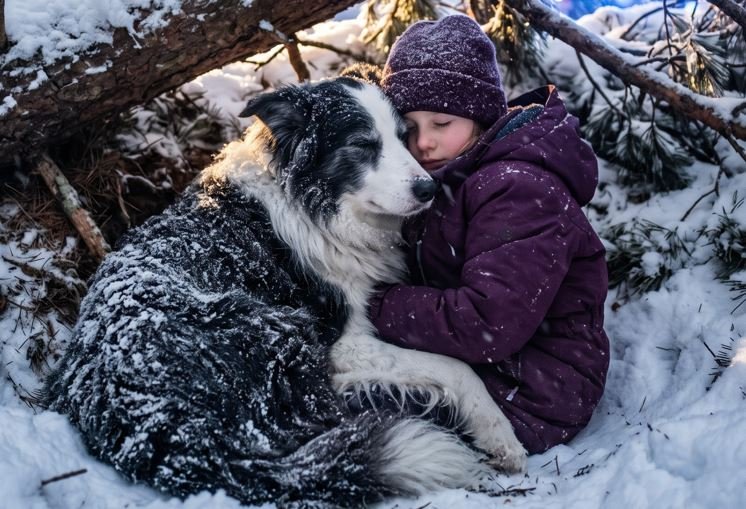
He stood at the base of a fallen pine, its roots ripped from the earth by the wind, creating a hollow beneath the trunk. The snow had half-buried the entrance. Inside, barely visible, was a flash of purple.
Mia’s coat.
She had crawled into the hollow for shelter. She was conscious. Hypothermic. But alive. Her arms were wrapped around her knees, her face buried, her body rocking in the silent panic that had kept her hidden from rescuers.
Bumper didn’t bark. He didn’t alert.
He crawled in.
He wedged his body against hers, filling the hollow with his warmth, his chest pressed to her back, his chin over her shoulder. He was too big for the space. Snow fell on his hindquarters. He didn’t move.
Elena and the rescuers dug them out. Mia’s fingers were locked in Bumper’s fur. Her eyes were open. And when they lifted her onto the stretcher, she looked at the dog — at his milky, useless eyes — and she spoke her first full sentence.
“Bumper sees me.”
They rushed her to the hospital. Mild frostbite. Nothing permanent. The doctors said another hour in that hollow would have been different. They said the dog’s body heat had saved her. They said it was a miracle.
But Elena knew.
Bumper hadn’t saved Mia with his warmth. He had saved her because he was the only one who knew where to look. Not with eyes. With memory. With love. With the map he had built of her — her scent, her rhythm, her heartbeat — over six months of listening to whispers.
He was blind. But he had spent his whole life learning to see the things that mattered.
The school made him a vest. It read: “Therapy Dog. I See You.”
It had braille on it. Mia insisted.