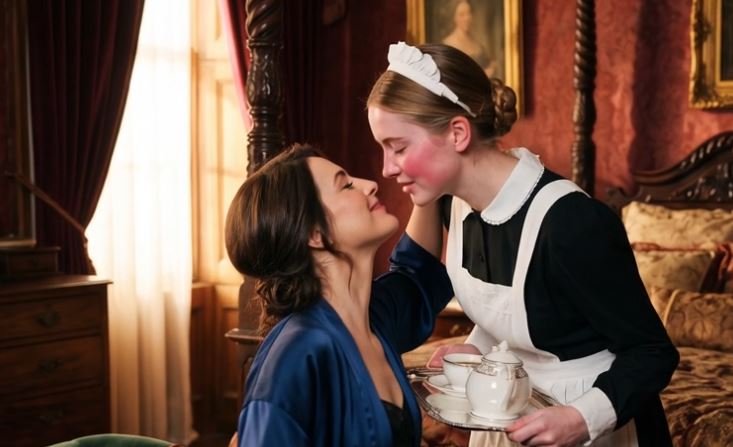
The vase had been Ming dynasty. A gift from my husband’s great-grandfather to his great-grandmother, passed down through generations of women who’d kept it polished and perfect and completely untouched by passion. It had survived wars, revolutions, and three house fires.
It didn’t survive Clara.
She’d been dusting the mantelpiece. Or pretending to dust. I’d been watching her for weeks—watching the way her hands trembled when I entered a room, the way her uniform seemed to fit tighter every day, the way she found reasons to be wherever I was. The library when I was reading. The garden when I was walking. My bedroom when I was supposed to be napping.
The vase fell when I walked in. She turned, startled, her duster hitting the porcelain, and the Ming dynasty shattered across the Persian rug in a thousand pieces that sounded like breaking promises.
“I’m sorry, madam,” she gasped, dropping to her knees. “I’ll clean it. I’ll replace it. I’ll—”
“You’ll stand up,” I said. My voice was steady. Commanding. The voice I’d learned from my mother, who’d learned it from hers, who’d kept this house running through two marriages and one scandal that the papers still whispered about.
Clara stood. Her uniform was black and white, crisp and proper, the costume of service and submission. But her cheeks were flushed, and her eyes wouldn’t meet mine, and I could see her hands shaking at her sides.
That was Tuesday.
On Wednesday, she dropped the Wedgwood teacup. On Thursday, my patience.
“You’ve been dropping things all week, Clara,” I said on Friday, reclining on my chaise in the afternoon light. I was wearing a silk robe that I’d chosen specifically because it matched my eyes and revealed my throat. Because it was a weapon disguised as loungewear. “The vase. The teacup. My patience.”
She stood beside my bed, the silver tray in her hands rattling slightly. Her uniform was still crisp. Her posture still perfect. But something had shifted between us—a current that had started as static and was building into something that would burn this house down if we let it.
I set down my wine. The crystal made a soft sound against the marble side table. I stood, my bare feet sinking into the Persian rug that still held the memory of shattered porcelain, and I walked over to her. The silk brushed against her uniform as I stopped close—too close, close enough that she could smell my perfume, close enough that I could see the pulse hammering in her throat like a trapped bird.
“Or perhaps,” I whispered, lifting her chin with one finger, forcing her to meet my eyes, “you’ve been trying to get my attention.”
Her eyes met mine. Wide. Wanting. Terrified. The exact combination I’d been craving since the day she arrived, fresh from the countryside, her hands rough and her accent thick and her gaze so hungry I could feel it from across the ballroom.
“The master,” she breathed. Her voice was barely audible. “He’ll be home—”
“Let him come,” I said.
And I pulled her down onto the bed.
The silver tray fell. It made less noise than the vase, less noise than the teacup, but the sound was louder in my ears because it was the sound of finality. Of crossing a line that had been drawn by generations of women who’d kept their desires locked in jewelry boxes and their passions buried in garden plots.
Clara’s body was warm beneath me. Her uniform was rough against my silk, a contrast that felt like everything—power and submission, luxury and labor, the mistress and the maid finally becoming something that had no name in polite society.
I kissed her. Hard. My hand finding the buttons of her uniform, undoing them with a speed that spoke of weeks of practice in my imagination. She gasped into my mouth, her hands flying to my hair, pulling me closer, begging me silently to continue.
The front door opened.
We both heard it. The heavy oak, the familiar footsteps, the sound of my husband’s cane against the marble foyer. Clara froze beneath me, her eyes wide with panic, her half-undone uniform revealing a white cotton undergarment that was the most erotic thing I’d ever seen.
I didn’t stop.
I looked at the doorway. Waited. And when his shadow appeared—tall, distinguished, completely unsurprised—I simply adjusted my robe and smiled.
“I’ve promoted her,” I said, my voice carrying the authority of generations. “Personal attendant. She lives here now. In my wing.”
My husband looked at us. At Clara, flushed and disheveled on his grandmother’s bedspread. At me, composed and commanding and completely unashamed. He nodded. Once. The way he’d nodded when I’d redecorated the ballroom, when I’d fired the butler, when I’d made every other decision in this house that was mine in every way that mattered.
“Very well,” he said. And he went to his study.
Clara stared at me, her mouth open. “He—he didn’t—”
“He knows who owns this house,” I said, turning back to her. “Now. Where were we?”
I showed her. For hours. In my dressing room, where I taught her exactly how to fasten a corset and exactly how to unfasten one with her teeth. In my bath, where I showed her that service could be reciprocal. In my bed, where I made her scream my name with a passion that shattered more than porcelain.
She lives here now. In my wing. Her uniform hangs in the closet, unused. She wears my silk now. My perfume. My smile.
The Ming dynasty was irreplaceable. But Clara? Clara is the only treasure this house has ever held.