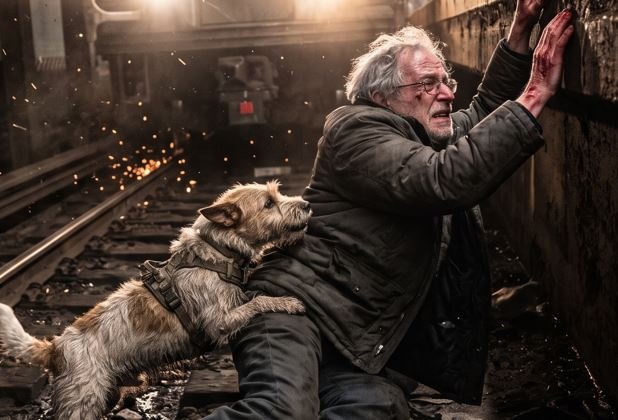
Milo jumped.
Not gracefully. Not confidently. His back legs slipped on the wet edge. His front paws scrabbled at the track bed. He fell harder than Arthur had, landing on his shoulder with a yelp that Arthur heard even over the train.
But he got up.
He limped to Arthur. Three legs working, one held slightly off the ground. He didn’t check his own pain. He checked Arthur’s. Nose to face. Nose to chest. The train was 150 meters now. The headlight filled the tunnel. The wind began to push.
Milo did something no one had taught him.
He got behind Arthur. He wedged his small body under the old man’s hips — the bad hip, the one that wouldn’t lift. He braced his front legs against the rail. He pushed.
Arthur felt it. Felt the dog’s back become a lever. Felt his own body lift, inch by impossible inch. He grabbed the platform edge with bleeding fingers. Hands reached down — finally, finally — and caught his wrists.
But Arthur was 180 pounds. The hands couldn’t lift him alone.
Milo pushed harder. His back legs slipped on the gravel. His body compressed like a spring. He made a sound — not a bark, not a whine, something between a growl and a prayer. He pushed until his muscles shook. Until his injured shoulder screamed. Until the train was 50 meters away and the light was blinding.
Arthur’s chest cleared the edge.
Hands grabbed his coat. His belt. His arms. They dragged him up, onto the platform, into the screaming crowd.
Arthur rolled. He looked back.
Milo was still on the tracks. The dog had pushed until the last second, and now there was no time to climb. The train was 20 meters. 10. The headlight washed everything white.
Milo didn’t run. He didn’t cower. He flattened himself into the drainage gap between the rails — a space barely wider than his body. He pressed his belly to the concrete, his legs splayed, his nose tucked under his tail.
The train passed over him.
The roar was everything. Wind that peeled paint. Sound that shattered thought. Arthur watched from the platform, hands reaching down uselessly, screaming a name he had never screamed before.
The train kept going. 8 cars. 10. 12.
Then silence.
Milo didn’t move at first. Arthur thought he was dead. Crushed by the undercarriage. Broken by the wind. He tried to jump down. Hands held him back.
Then Milo’s tail twitched.
He stood. Slowly. Shaking. His injured leg held him, barely. He looked up at Arthur. And he wagged.
Once.
Twice.
Three times.
The platform cheered. Strangers wept. Someone lifted Milo up — a young man with tattoos and tears — and placed him in Arthur’s arms. Arthur held him so tight the dog wheezed. He didn’t loosen his grip. He would never loosen his grip again.
The train engineer never stopped. He didn’t know. The station reported a “near miss.” The news called it a “miracle.”
Arthur called it Milo.
They took a cab home. Arthur refused the ambulance. He sat in the back seat with Milo on his lap, the dog’s heartbeat against his chest, and he cried. Not from fear. From the weight of being loved that much.
The vet said Milo’s shoulder was dislocated. His back was bruised. He had gravel embedded in his belly that would take weeks to heal. But he would live. He would walk. He would tremble in crowds and hide from loud noises and sit on Arthur’s feet every morning at 6:47.
Arthur threw away his newspaper subscription. He never went back to Platform 7.
Instead, every morning at 6:47, he and Milo sit on their porch. They watch the sun rise. Arthur drinks coffee. Milo trembles slightly at the sound of distant trains, then presses closer to Arthur’s leg until the trembling stops.
On the anniversary of the fall, Arthur took Milo to the shelter where he had been adopted. Not to return him. To sponsor every “anxious” dog they had. The ones too scared to be brave. The ones who trembled in corners. The ones nobody wanted.
Because Arthur understood now what he hadn’t understood before:
Bravery isn’t the absence of fear.
Bravery is being so afraid that every instinct screams run — and choosing to push instead.
Milo had been afraid his whole life. Of thunder. Of crowds. Of the world.
But he had never been afraid of losing Arthur.
And on a wet Thursday morning, on Platform 7, with a train 200 meters away and his own body shaking with terror, Milo made the only choice his heart allowed.
He jumped.
Not because he was brave.
Because love doesn’t ask permission.