Wednesday. 6 PM.
Maya was at her desk when the alert came through. Eight-month-old. Female. Last seen with mother at a motel on Highway 9. Father had custody. Mother had fled. The system had failed — a restraining order pending, a hearing delayed, a woman who had chosen flight over another broken bone.
The search dogs came at 7.
Two German Shepherds, professional, certified, tracking from the motel room. They found the mother’s scent easily — fear, milk, the particular desperation of flight. They followed it to the highway. To the rest stop. To the point where she had entered a vehicle, changed vehicles, disappeared into the particular anonymity of interstate traffic.
They lost her there.
Not because they were bad dogs. Because the trail was cold. Because she had planned. Because she had switched cars, switched directions, switched everything that could be switched to throw off pursuit.
Maya stood at the highway’s edge, watching the search dogs circle, confused, their noses working air that held no answers. She felt the particular helplessness of a detective who knew the system was broken but couldn’t fix it with a badge.
She went back to the station.
Nose was behind the dumpster. As always. Nose to the wind. Body vibrating with the particular intensity that Maya had learned to recognize — not hunger, not greeting, but purpose.
Maya walked to her. She didn’t have food. She didn’t have energy. She just had the particular need to sit with something that didn’t demand answers.
Nose stood.
She approached Maya. Not slowly — urgently. She pressed her nose to Maya’s hand. Then to her knee. Then to her boot. She made a sound — not a bark, not a whine, something between a demand and a prayer.
She ran.
Not toward the dumpster. Not toward the food. Toward the station’s parking lot. Toward Maya’s cruiser. She stopped at the driver’s door. She looked back. She made the sound again.
Maya didn’t understand.
She followed anyway. Because she was tired. Because Nose had never asked for anything. Because sometimes you follow a dog for the same reason you follow a hunch — not because it makes sense, but because the alternative is standing still.
Nose led her to the cruiser. She sniffed the door handle. She sniffed the seat. She sniffed the particular combination of leather and coffee and gun oil that was Maya’s car.
Then she ran again.
Toward the highway. Not the rest stop where the search dogs had failed. Toward the on-ramp. Toward the particular current of air that moved east every afternoon, carrying scents from the industrial district, the warehouse district, the places where no one looked because no one was supposed to be.
Maya drove.
Slowly. Following a dog who ran beside her cruiser, nose to the ground, body low, the particular gait of a tracker who had found something that professionals had missed. She didn’t call it in. She didn’t explain. She just followed.
Nose led her five miles.
Past the rest stop. Past the search dogs’ failure point. To a warehouse complex — abandoned, condemned, scheduled for demolition in six months. The kind of place where squatters slept and dealers met and the city pretended not to look.
Nose stopped at a loading dock.
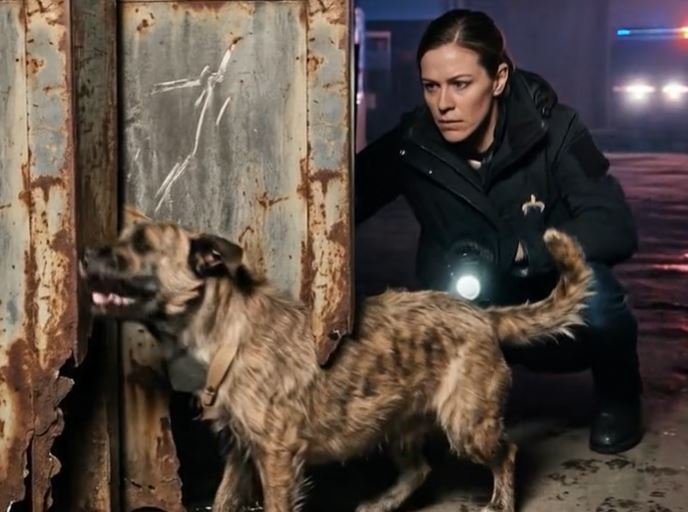
She sniffed. She circled. She found a gap in the metal door — small, rusted, just wide enough for a dog. She squeezed through. Maya followed, flashlight out, gun drawn, the particular recklessness of a detective who had stopped caring about protocol.
The warehouse was dark.
Not empty. Maya smelled it before she saw it — urine, fear, the particular sourness of a space where humans hid. She swept her flashlight across concrete floors, past empty pallets, toward a corner where cardboard had been arranged into a shelter.
Nose was already there.
She stood over the cardboard. Not aggressive. Protective. Her body between Maya and the shelter, her nose working the air, her eyes — dark, intense, certain — fixed on Maya’s face.
Maya approached.
She saw the mother first. Young. Thin. Asleep or unconscious — Maya couldn’t tell, not yet, not with the adrenaline and the darkness and the particular disorientation of having followed a dog into a warehouse.
Then she saw the baby.
Wrapped in a blanket. The same blanket from Monday. The same powdery sweetness that Nose had cataloged behind the dumpster. The baby was breathing — Maya could see the rise and fall, could hear the small, wet sounds of infant lungs working.
She called it in.
Not the Amber Alert team. Not the father. EMS. Social services. The particular machinery of a system that was broken but still capable, sometimes, of doing the right thing when someone found the right lever.
The mother woke as the paramedics arrived. She didn’t run. She didn’t fight. She just held the baby and looked at Nose — at the mutt who had found her, who had protected her, who had led a detective to a warehouse that no one was supposed to find.
“She came yesterday,” the mother said. “The dog. She found us. She sat with us all night. I thought she was a stray.”
Maya looked at Nose. At the dog who had sat behind a dumpster for six months, reading the air, cataloging scents, waiting for the moment when her particular knowledge would matter.
“She was,” Maya said. “She just stopped being one.”
Part 3: The Transfer
The system moved.
The mother was arrested — technically. The charges were dropped — eventually. The father was investigated — finally. The custody was reassigned — to the mother’s sister, to a safe house, to a life that would never be normal but might be safe.
Nose became evidence.
Not officially. But the prosecutor wanted her. The defense wanted her. The media wanted her — the stray dog who had solved an Amber Alert that professionals couldn’t solve. She was photographed, interviewed, celebrated, claimed.
Maya claimed her first.
Not with paperwork. With presence. She moved Nose from behind the dumpster to her apartment. From scraps to dog food. From cardboard to a bed that smelled of lavender and gun oil and the particular safety of a person who had stopped being alone.
Nose didn’t change.
She still sat with her nose to the wind. Still cataloged scents. Still waited for the moment when her particular knowledge would matter. But now she sat by a window. Now the scents were of a neighborhood, not a station. Now the waiting was shared.
Maya solved three more cases in Nose’s first year.
Not because Nose tracked suspects. Not because she found evidence. Because she sat. Because she listened. Because she smelled the particular chemical signature of lies — cortisol spikes, sweat changes, the particular sourness that humans emitted when they were hiding something.
Maya would bring suspects to her apartment. Casually. Coffee. Conversation. Nose would sit in the corner, nose working, body still. And when the suspect lied — about alibis, about motives, about the particular details that made or broke a case — Nose would stand.
Not bark. Not growl. Just stand. A signal. A confirmation. A dog who had learned to read humans better than humans could read themselves.
The department wanted to make her official.
K9 unit. Certification. Vests. The particular machinery of institutionalizing something that had been born in the gap between systems. Maya refused.
“She’s not a police dog,” she said. “She’s a witness. She sees what we miss.”
Nose died at 14.
Not suddenly. The particular decline of a dog who had worked too hard for too long, who had spent six months reading air behind a dumpster and eight years reading humans in an apartment, who had given everything she had to a world that hadn’t asked for her.
Maya buried her behind the station.
Not the dumpster — a garden, newly planted, funded by officers who had heard the story, who had fed Nose scraps, who had learned that sometimes the best detectives were the ones the system ignored.
The marker was simple. Maya carved it herself.
NOSE — She Smelled What We Couldn’t. She Found What We Missed. She Waited Until We Were Ready.
Maya still sits there.
Every Tuesday. Her hardest day. With a sandwich, half-eaten, the other half placed on the grass beside the marker. She doesn’t talk. She doesn’t cry. She just sits, nose to the wind, reading the air, waiting for the particular scent that will tell her what comes next.
Sometimes, when the wind shifts east, she smells it.
Baby powder. Fear-sweat. The particular sweetness of a life that hasn’t learned to be cynical yet. She doesn’t follow it. She can’t. She’s not Nose.
But she remembers. And she waits. And she believes — in the way that Nose taught her to believe — that the world is full of scents that matter, of stories that haven’t been told, of dogs sitting behind dumpsters who are waiting for someone to notice that they know something important.
The system is still broken.
But Maya is still sitting. Still waiting. Still believing that the next Nose is out there, nose to the wind, reading the air, ready to lead someone to the truth if only they would follow.