Claire Bennett had spent eight months preparing herself for the possibility that Diane Whitfield might never fully accept her, but nothing had prepared her for the specific moment it would happen in front of ninety guests holding champagne glasses.
She’d met Ethan two years earlier, at a mutual friend’s housewarming, and had known within the first hour of conversation that he was the kind of steady, funny, unhurried person she’d stopped believing existed. What she hadn’t known — not fully, not until months into dating him — was that his mother came from the kind of old-money Connecticut family that measured a person’s worth in country club memberships and last names, and that Claire, a public school art teacher whose parents ran a small hardware store in Ohio, was going to spend every family gathering being quietly, politely measured and found wanting.
Diane was never crude about it. She was, if anything, a master of the compliment that wasn’t one. “What a brave choice, teaching,” she’d said the first time they met, in a tone that made clear she meant the opposite of brave. “Ethan mentioned your family has a little shop back home — how quaint.” At Thanksgiving, she’d introduced Claire to a room full of relatives as “Ethan’s friend,” a full year and a half into their relationship, in front of Ethan himself, who’d corrected her immediately but couldn’t undo the sting of the moment.
Ethan had apologized for his mother more times than either of them could count, always with the same weary explanation — that Diane had a rigid idea of what their family was supposed to look like, and that it had nothing to do with Claire specifically and everything to do with Diane’s own insecurities about a status she’d married into rather than been born with. Claire believed him. She also, privately, had started to wonder whether an apology that repeated every few months was actually a solution or just a pattern they were both learning to live inside of.
The engagement itself had happened quietly, just the two of them on a hiking trail in Vermont, exactly the way Claire had always wanted it — no audience, no performance, just Ethan getting down on one knee at the exact spot where they’d had their first real conversation about the future, two years earlier almost to the week. Diane had not been pleased to hear about it secondhand rather than being consulted beforehand, a fact she mentioned more than once in the weeks that followed.
The engagement party, held at the Whitfield family’s sprawling backyard under a rented tent strung with warm lights, had been Diane’s idea from the start — her chance, she’d said, “to properly introduce Claire to everyone who matters.” Claire had gone along with it, hoping, in the quiet optimistic way people hope right before being disappointed, that a formal celebration might soften something between them.
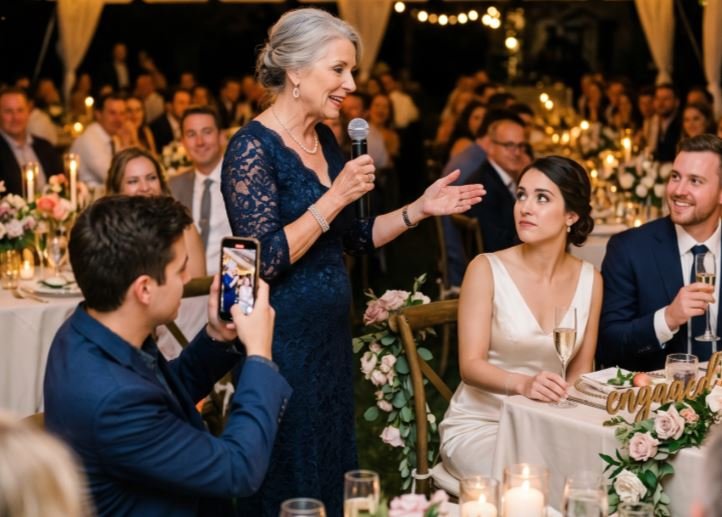
Ninety guests filled the tent that evening — extended family, Whitfield family friends, a scattering of Ethan’s own friends including his childhood best friend, Marcus, who’d flown in from Chicago specifically for the occasion and had positioned himself near the head table with his phone out, filming candid moments for a video montage he was planning as a wedding gift.
The toasts began after dinner. Ethan’s father spoke first, warm and brief. Then Diane rose, took the microphone from the caterer with practiced ease, and began what everyone in the tent assumed would be a similarly warm, if slightly stiff, tribute to her son’s engagement.
“I’ll be honest with all of you,” Diane said, smiling in the particular way she smiled when she believed she was being charmingly candid rather than cruel, “I never thought Ethan would end up with someone like Claire.” A small, awkward ripple of laughter moved through part of the crowd, the kind that comes from people unsure whether they’re supposed to laugh. Diane continued, apparently encouraged. “She’s lovely, of course. But she’ll never truly be good enough for this family, and I think it’s important we’re all honest about that tonight, rather than pretending otherwise.”
The tent went silent in a way that ninety people rarely manage all at once. Claire felt her face go hot, her hand tightening around the stem of her champagne glass, every instinct telling her to smile through it the way she always had, to absorb it quietly and deal with the fallout later, privately, the way she and Ethan always had.
Marcus, standing near the side of the head table with his phone still raised from filming the earlier, gentler toasts, hadn’t stopped recording. He’d assumed, right up until that sentence, that he was capturing warm family footage for a wedding montage. Now his expression sharpened, phone steady, catching every second of Diane’s face as she said it.
Ethan didn’t sit still for it. He rose from his chair slowly, deliberately, the scrape of it against the patio stone audible in the silence.
“Mom,” he said, his voice calm but carrying clearly across the tent. “Everyone at this party just watched you say that to my future wife.”
Diane’s confident expression faltered for the first time. “Ethan, I only meant—”
“I know exactly what you meant,” Ethan said. “You’ve meant it for two years. You’ve just never said it this clearly, in front of this many people, before.”
Diane’s eyes swept the tent, and it was only then, watching the room, that she seemed to register how many phones had quietly turned toward her — not just Marcus’s, but two or three others among the younger guests, the reflexive instinct of a generation that filmed first and processed later.
The rest of the party dissolved into an uncomfortable, murmuring quiet, guests unsure whether to keep eating or pretend nothing had happened. Diane set the microphone down and left the tent entirely, disappearing into the main house. Claire sat frozen for a long moment, humiliation and something closer to relief tangled together in her chest — relief that, for once, the moment hadn’t happened quietly enough to be smoothed over and forgotten by morning.
The video Marcus had captured circulated within their small friend group within days, not out of malice but because several people who’d witnessed it firsthand had asked him for a copy, wanting proof of a moment they still could barely believe they’d watched happen live. It never went further than that — Marcus made sure of it, sending it only to Ethan and Claire themselves, along with a short message: thought you two should have this, for whenever you need to remember it actually happened and you’re not crazy.
What mattered more than the video was what happened the next morning. Ethan drove to his parents’ house alone, sat down across from his mother at the kitchen table where he’d eaten breakfast his entire childhood, and told her, calmly and without raising his voice, that she would not be attending the wedding unless she was prepared to apologize to Claire directly and mean it — not the practiced, diplomatic almost-apology she’d offered a dozen times before, but an actual one.
It took Diane three days to come around. When she finally called Claire directly — not through Ethan, not through a card, but her own voice on the phone — the apology was halting and clearly uncomfortable for her to deliver, but it was real, acknowledging specifically what she’d said and why it had been cruel rather than simply regretting that it had been said in front of people.
Claire didn’t fully trust it right away, and told Ethan as much. But six months later, watching Diane help Claire’s mother arrange flowers before the wedding ceremony, laughing at something genuinely funny rather than performing warmth for an audience, Claire allowed herself to believe that some things, once finally said out loud where everyone could hear them, were harder to keep quietly pretending away.
Sometimes it took a room full of witnesses for a truth to finally become impossible to take back.
THE END