Sandra Whitmore had suspected something was wrong for almost two months before she had any proof at all — nothing concrete, just the accumulated weight of small inconsistencies that, individually, meant nothing, but together had started to form a shape she didn’t want to look at directly.
Her husband Greg traveled often for his job as a regional sales director, usually two or three nights a week, a schedule that had been a fact of their marriage for over a decade without ever causing much friction. What had changed, over the past two months, was the frequency of a name that kept surfacing in casual conversation — Marissa, a new hire Greg’s company had brought on to help coordinate his travel logistics and client meetings. Marissa had booked his flights. Marissa had recommended a restaurant. Marissa had apparently developed opinions about which hotel gym was better across three different cities, opinions Greg relayed at dinner with a level of detail that struck Sandra as slightly too specific for someone he supposedly worked alongside only a few hours a week.
Sandra hadn’t said anything at first. She told herself she was being paranoid, that a decade of a stable marriage didn’t deserve to be undone by vague unease over a coworker’s name coming up too often. But three weeks ago, scrolling through old photos on Greg’s laptop while looking for a picture of their daughter’s birthday party, she’d found a folder of hotel loyalty program screenshots — not damning on their own, until she noticed the same woman’s name listed as a co-traveler on two separate bookings, both trips Greg had described to her as solo business trips.
She hadn’t confronted him immediately. Instead, quietly, methodically, the way she approached most problems in her life, she’d started paying closer attention. She checked flight confirmation emails that occasionally synced to their shared family calendar by accident. She noted that Greg’s most recent trip — four days to Denver, ostensibly to close a major client account — had, according to the same calendar sync, included a return flight booked for two passengers on the same reservation, one of them under the initials M.T.
Sandra didn’t say a word about any of it. Instead, she quietly booked her own ticket on the same return flight, three rows back, paid for out of an account Greg didn’t monitor, and told him only that she and the kids would be picking him up at arrivals as a surprise, the way she sometimes did after his longer trips.
What she hadn’t told him — what she’d learned almost by accident during a layover conversation at the gate, waiting for the same connecting flight — was that Greg’s regional vice president, a soft-spoken but sharp man named Harold Voss, was also on that flight, returning from the same conference. Harold had recognized Sandra from a company holiday party the previous year and struck up a friendly conversation while they waited to board, mentioning, entirely without guile, that he’d run into Greg at the conference hotel bar two nights earlier — “with his new assistant, Marissa, I assume, though I have to say, it’s unusual for logistics staff to attend the executive dinner.” He’d said it lightly, clearly unaware he was handing Sandra confirmation of something she’d spent weeks quietly assembling on her own.
Sandra had thanked him for the small talk and said nothing further, tucking the detail away with the same calm, methodical care she’d applied to everything else.
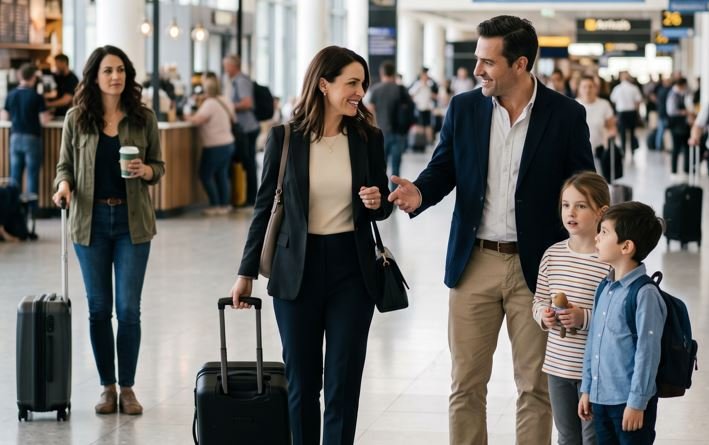
The flight landed on schedule. Sandra gathered the kids — six-year-old Lily and eight-year-old Tyler, who she’d brought along specifically because Greg loved being surprised by them at arrivals — and made her way toward the gate area, letting them run ahead the last stretch toward their father, who emerged from the jet bridge a few minutes later, wheeling his carry-on, laughing at something the woman beside him had said.
Sandra recognized her immediately from the loyalty program screenshots. Marissa was younger than Sandra had pictured, professionally dressed, laughing easily at whatever Greg had just said, walking close enough beside him that there was no mistaking the familiarity between them.
Greg spotted the kids first, his face breaking into genuine delight, clearly unaware Sandra was watching from near the coffee kiosk a short distance away, where she’d deliberately positioned herself to observe before approaching.
“Hey, look who’s here!” Greg said, crouching to hug Tyler and Lily as they reached him. Straightening up, he gestured warmly toward Marissa, entirely at ease. “This is Daddy’s assistant, Marissa. She helped Daddy on his work trip.”
Lily tilted her head, six years old and utterly without guile. “Mommy’s assistant is named Marissa too,” she said. “Mommy said she saw her at your hotel.”
It was, of course, not a real thing Sandra had ever said to Lily — a small, spontaneous fiction Sandra had planted with her daughter two days earlier, a harmless-sounding game of “let’s surprise Daddy,” designed to do exactly what it had just done. Greg’s smile faltered instantly, his eyes darting past his daughter toward the coffee kiosk, where Sandra was now walking toward them, calm, unhurried, her own suitcase rolling behind her.
“Actually,” Sandra said, arriving beside the group, her voice steady and quiet in a way that carried more weight than shouting ever could have, “funny thing. Your boss is on the flight I just landed on too. He had quite a bit to say about this ‘assistant.'”
Greg’s face drained of color in a way Sandra had never seen before, not in twelve years of marriage. Marissa, beside him, took a small, involuntary step backward, her professional composure cracking into something closer to panic.
“Sandra, this isn’t—” Greg started.
“Harold mentioned the executive dinner,” Sandra continued, still perfectly calm, still holding her daughter’s hand. “Said it was unusual for logistics staff to be there. I found that interesting, given you told me Marissa handled your scheduling, not client relations.”
A few nearby travelers had started to slow their pace, sensing the tension without yet understanding its shape. Greg glanced around, aware suddenly of how public the terminal was, how many strangers were within earshot of a conversation he’d clearly never imagined happening in daylight, surrounded by luggage carts and departure announcements.
“Can we please talk about this at home,” he said, quieter now, some of his earlier ease completely gone.
“We can,” Sandra said. “But the kids are coming with me right now, and you can figure out your own ride, because I already have one arranged.” She turned to Tyler and Lily, her voice shifting instantly into the warm, ordinary tone she used every day, as if the last ninety seconds hadn’t happened at all. “Come on, guys, let’s go get ice cream before we head home.”
She walked away without waiting for Greg’s response, her children’s hands in hers, leaving him standing in the arrivals hall beside a woman whose presence he’d have to explain to a great many more people than just his wife in the days that followed — his boss, who would ask pointed questions about expense reports the following week; the HR department, once the loyalty program details and travel records eventually surfaced in the divorce proceedings six months later; and, hardest of all, his own children, old enough eventually to understand exactly what had happened that day at the arrivals gate, even if neither of them had understood it fully in the moment.
Sandra never raised her voice once, not that day and not through the months that followed. She’d learned, watching the shape of the lie assemble itself piece by piece over two quiet months, that the loudest reactions rarely land as hard as the calm ones — that sometimes the most devastating thing you can do to someone who’s underestimated you is simply arrive, exactly where they didn’t expect you, with all the proof already in hand.
THE END