Every evening, housekeeping at the Grand Crest Hotel followed the same routine.
Collect forgotten items.
Log them.
Turn them over to hotel security.
One Tuesday morning, a housekeeper found a single key card lying on the carpet near the elevators.
Nothing unusual—until she looked at the sleeve.
It read:
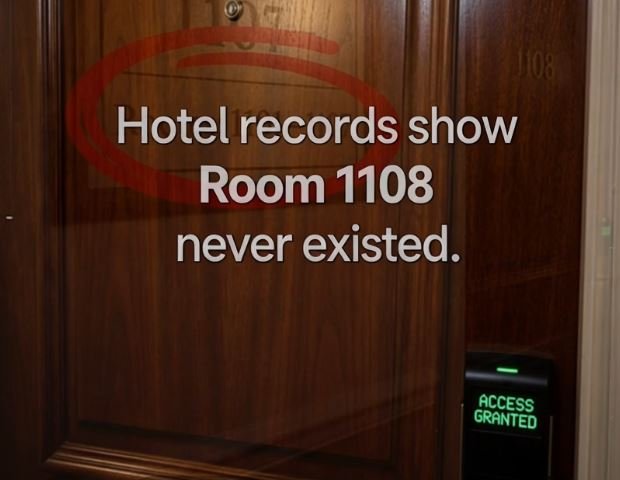
Room 1108
She picked it up without thinking and carried it to the security office.
Security manager Alan Brooks scanned the card to deactivate it before adding it to the hotel’s lost-and-found inventory.
Instead of displaying an error, the computer produced a valid access history.
According to the system, the key had opened Room 1108 three separate times during the previous night.
That immediately raised a problem.
The eleventh floor had only seven guest rooms.
Room numbers ended at 1107.
There had never been an 1108.
Assuming it was a software mistake, Brooks checked older building plans.
They matched the current layout perfectly.
No renovation had removed a room.
No hidden suite appeared in archived drawings.
Curious, he reviewed electronic lock logs from the previous night.
Each time the key card had been used, the system recorded the same message:
ACCESS GRANTED
But there was no corresponding room controller assigned to that number.
The software acknowledged the door…
Yet the hotel’s hardware had nowhere to send the command.
Engineers inspected the electronic lock network.
Every room lock reported normally.
No duplicate addresses.
No corrupted database.
No unauthorized devices.
The mystery deepened when surveillance footage showed a guest walking down the eleventh-floor hallway at 1:18 a.m.
He stopped where Room 1108 should have been.
He lifted a key card.
Paused.
Then stepped out of camera view for several seconds.
When he reappeared, he continued walking toward the elevators.
Investigators measured the hallway.
There was no alcove.
No service door.
No concealed entrance.
Only a continuous wall between Rooms 1107 and the emergency exit.
The guest was later identified and interviewed.
He insisted he had entered his room, slept normally, and checked out the next morning.
When shown the floor plan, he looked genuinely confused.
“That’s impossible,” he reportedly said.
“My room was right there.”
He even described details of the room’s furniture and the city view from the window.
None matched any room in the hotel.
Digital forensic specialists later examined the hotel’s key-card management software.
They found no malware, no database corruption, and no evidence of tampering.
Unable to explain the anomaly, the incident was officially closed as an unexplained systems error.
The hotel quietly upgraded its electronic locks a few months later.
No similar event has ever been reported.
Yet the original key card still sits in an evidence envelope, accompanied by electronic logs showing three successful entries into a room that never appeared on any blueprint.
Technology usually leaves clear answers.
This time…
It left only a question.
If Room 1108 never existed…
Who checked into it?