The operation was called — per the staff’s confession session over post-shift pizza that I was invited to that very night, still trembling, still holding Sloane’s hand — “CORRIDOR B,” and it had been running for three weeks.
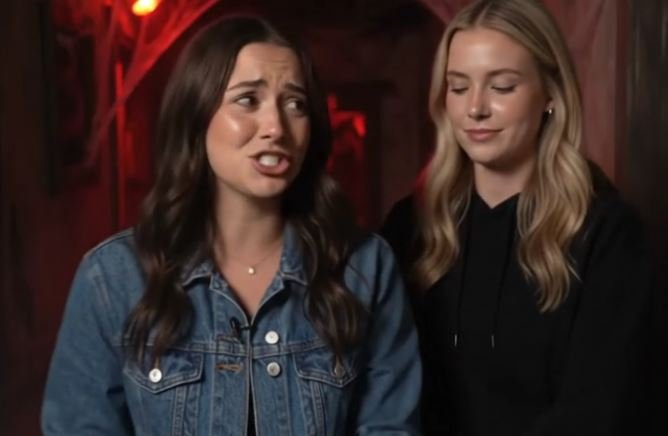
Sloane had spotted me on a random Tuesday, chicken-ing out at the entrance for a full twenty minutes before leaving. She’d mentioned it at the break room — “the girl in the denim jacket, third time this week, someone should just hold her hand through it” — and the staff, bored and eleven-strong and possessed of the collective judgment of a golden retriever, had decided to help.
The plan, such as it was: whenever I showed up, staff would route the crowd away from Sloane’s fog corridor (“maintenance hold, sorry folks”), leave the entrance unattended, and let physics do the rest. Three weeks. I came twice more and chickened out twice more. The staff had a betting pool. Marcus’s chainsaw — which he’d sputtered in frustration every time I left — had cost him thirty dollars in the pool by the night of the story.
“You DESCRIBED me to your whole staff?” I said, over pizza, surrounded by eleven haunted-house actors in various stages of monster makeup, all of whom were watching us with the open sentimentality of people who spent their nights terrifying strangers and their days shipping coworkers.
“She said ‘denim jacket, scared of everything, laughs at the skeleton sign,'” Marcus said, wiping greasepaint off his jaw. “That’s a type. That’s a WIFE type.”
Sloane worked the haunted house seasonally — October only — her real job was pediatric nursing, which explained the hand-lace, the calm, the way she’d taken my fear seriously without taking it for weakness. “I hold scared people’s hands for a living,” she said. “You just had the decency to be scared of something fake.”
We spent that whole October together — her shifts, my visits, the staff rotating themselves through my corridors with escalating theatrics once they knew. The zombie in the nursery room started waving at me. The hallway crawl-actor whispered “she’s a keeper” as I passed. Marcus, at the exit, took to shouting “SHE CAME BACK!” whenever I arrived, in the exact tone of a man announcing royalty.
The relationship outlasted the season — which surprised the staff, who’d run the pool at three weeks, and delighted them, because Sloane had been a fixture of their October crew for four years and they’d watched her describe exactly zero customers to anyone, ever. “Corridor B was unprecedented,” the makeup artist told me, at our engagement party, held at the haunted house during off-season, empty corridors dressed in fairy lights. “We knew she was gone the day she said ‘denim jacket.'”
The proposal: Sloane, October of the following year, mid-shift, in the fog corridor, holding the entry rail herself for once — nervous, uncharacteristically so, until I realized the fog was thicker than usual, the strobes slower, and the whole corridor empty except us and, hidden in the fog machine ports, eleven actors with their phones out.
“I’ve watched a lot of people chicken out at that entrance,” she said, going down on one knee in the fog, in her black hoodie, chainsaw sounds distantly faked by Marcus for atmosphere. “You were the only one I ever wanted to walk in for.”
Marcus — who had, by then, appointed himself our wedding planner with zero qualifications and total commitment — gave the toast at the wedding. It was one sentence: “I have scared eleven thousand people. The only one I ever helped was me, by routing her to Corridor B. You’re welcome, and I’m sorry about the chainsaw.”
We go back every October. As guests now — we refuse to be actors, we tried once, Sloane laughed mid-scare and broke character — and every year, in the fog corridor, we recreate the hand-lace. The staff times it. The pool reopens annually. It always pays out the same way: Corridor B delivers.