I ended restaurants. That was the job, and I was the best at it in the city — not because I was cruel, but because I was specific, and specificity is cruelty’s more punctual cousin. I’d written the review that closed Chez Renard. I’d written the paragraph that made a three-generation diner family sell their griddle. Restaurateurs had a nickname for me that they used in group chats and denied in interviews.
Sloane’s place was called Marrow. Eighteen seats. No sign — just a marrow bone etched in the window. It had survived two years on reputation alone, which was exactly the kind of arrogance I scheduled my visits around.
The first thing I noticed was that the chef didn’t come out. Ever. No table visits, no greeting, no theater. The second thing I noticed — course by course — was that the food was talking for him. Course four, a beet dish arrived shaped like something that had survived a fire, and the server set it down and said, verbatim: “He says this one is about coming back from things.” Course seven, a broth with no spoon — you drank it from the rim of the bowl — came with: “He says some things you have to commit to fully.”
Course eleven arrived at 10:45 PM. The dining room had emptied. And the server set down the final plate and said, quietly, “He says this one isn’t on the menu. He says it’s for the table that’s staying.”
It was a single bite. Perfect.
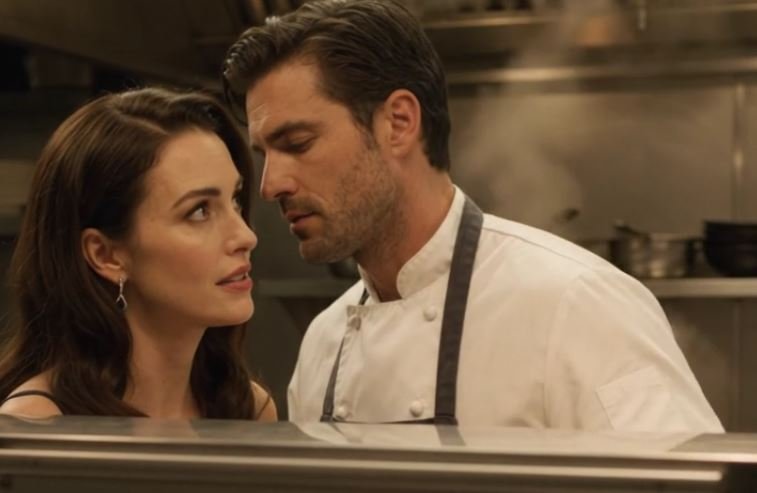
I stayed. The dining room emptied completely, the lights dimmed to service mode, and the kitchen noise behind the pass softened to its after-hours murmur — pots soaking, the walk-in humming, the sound a kitchen makes when it thinks nobody’s listening. Then he appeared at the pass. White coat. Sleeves pushed up. And across eleven courses and three hours, he looked at me directly for the first time.
“My review closes your restaurant if I write what I actually tasted tonight,” I whispered, and meant it, and hated that I meant it, because what I’d tasted was a man saying eleven things and me wanting a twelfth.
He set one more plate on the pass. Unlisted. He leaned over the steel.
“If your sous chef looks up,” I breathed, “he’ll see the head chef and the critic, and my notebook is open, and the first line is already written—”
He kissed me across the pass. Slow. Plated. And it occurred to me, mid-kiss, that this was the twelfth course — the one course that couldn’t be served, only taken.
The ticket machine spat. The sous chef looked up. “Chef? What is that plate? It’s not on the menu—”
He straightened, wiped the pass, and said — the first words I ever heard him say, low, unhurried, devastating — “It’s off the menu.”
I wrote the review at my kitchen table, rewrote it five times, and filed the version that ran:
“MARROW — four stars. The chef plates like a man with nothing left to lose, and after eleven courses, I understand why: he already lost it, and what he’s serving now is what came back. Book the late seating. Stay for the table that’s staying.”
Marrow’s waitlist hit four months. My editor asked if I’d lost my edge. I said no — I’d found a fork.
The first real date was 3 AM in his kitchen, sitting on steel counters, splitting staff meal risotto. He was — he is — quiet by design, not by wound. “Food talks better than me,” he said, shrugging, in the longest sentence of that first date. “The menu is the conversation. Everything else is small talk.”
“So what was the pass?”
“The one time I interrupted.”
We married in the off-season, in the restaurant, eighteen chairs full, the menu printed like a wedding program. His vows were two words — “Table twelve,” the table I’d sat at — and everyone thought it was a kitchen joke. I cried for ten minutes, because I was the only one in the room who knew it meant: you stayed. You were the table that stayed.
He still doesn’t do table visits. But there’s a standing rule at Marrow now, written on the staff board in his handwriting: “Late seating stays. Always ask what they tasted.”
Every anniversary, he cooks me eleven courses. The twelfth is never on the menu.
It never has to be.