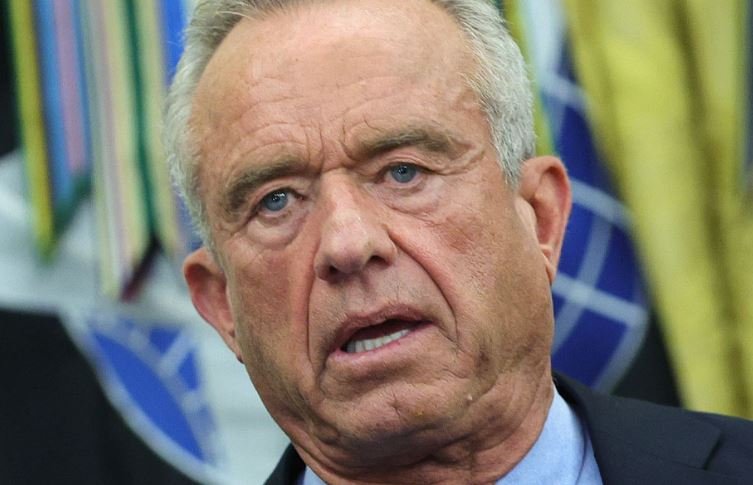
Health and Human Services Secretary Robert F. Kennedy Jr. is raising alarms over America’s declining birth rate — and he’s pointing to a startling statistic to make his case.
Speaking at a White House event on maternal health on May 11, Kennedy called the nation’s falling fertility rate an “existential crisis” tied to growing concerns about reproductive health and environmental factors. “It’s a threat not only to our economy,” he said, “but to our national security.”
The Claim
Kennedy pointed directly to male fertility, stating: “In 1970, men had twice the sperm count as our teenagers do today. This is an existential crisis for our country.”
He has made similar claims in previous interviews, telling Fox News host Jesse Watters in April 2025: “We have fertility rates that are just spiraling. A teenager today, an American teenager, has less testosterone than a 68‑year‑old man.”
What Kennedy Says Is Driving It
According to Kennedy, his department is investigating whether factors including obesity, metabolic health, pesticides, endocrine disruptors, and what he described as a “toxic soup that our young women are walking around in” could be contributing to fertility problems. He also claimed that the decline in fertility among women began around 2007, pointing to government data showing birth rates have generally dropped since then.
The Science Is More Complicated
Kennedy’s claim references findings from a widely discussed 2022 global review published in the journal Human Reproduction Update, which analyzed sperm count trends over decades and found substantial declines. However, there’s a critical caveat: the study did not specifically mention teenagers.
In fact, according to FactCheck.org, there is very little data on sperm counts in teenagers in the scientific literature at all. The studies establishing sperm counts in healthy adolescents have “never been done,” Dolores Lamb, a researcher who studies male reproductive biology at Children’s Mercy Kansas City, told the outlet.
While some studies have found about a 50% drop in sperm counts among adult men over the past half‑century, other studies have not found such declines — and comparisons to the past are complicated by inconsistencies in how sperm is counted.
“I would argue that we don’t yet have consensus,” Allan Pacey, a professor of andrology at the University of Manchester, told FactCheck.org.
Experts Caution Against Drawing Conclusions
Even among researchers who believe sperm counts are declining, there’s skepticism about Kennedy’s specific framing. Dr. Hagai Levine, an epidemiologist who co‑authored the major reviews on sperm count trends, told FactCheck.org that declining sperm counts are expected to impact population birth rates significantly only at very advanced stages, as men have multiple opportunities to conceive.
Dolores Lamb put it more bluntly in a 2023 interview with Scientific American: “The idea of a global decrease in sperm count is an important hypothesis, but the data is not good enough to be able to draw conclusions.”
A Growing Political Focus
The issue has become a growing focus for the Trump administration. Over the weekend, the administration proposed a new rule designed to make it easier for employers to offer fertility‑related benefits. President Trump has said reversing the country’s falling birth rate will be a priority during his second term.
The Bottom Line
Kennedy’s warnings have thrust male fertility into the national spotlight — and the conversation is far from settled. While multiple studies suggest sperm counts may be falling, researchers caution that measuring long‑term reproductive trends is notoriously difficult, and the specific claim about teenagers having half the sperm count of men in 1970 is not directly supported by the scientific literature.
What is clear: the debate over fertility, environmental health, and declining birth rates is only getting louder — and Kennedy is determined to keep it there.