Chapter 1: The Wedding and the Plan for Willowbrook
The wedding died before the champagne ever touched a glass.
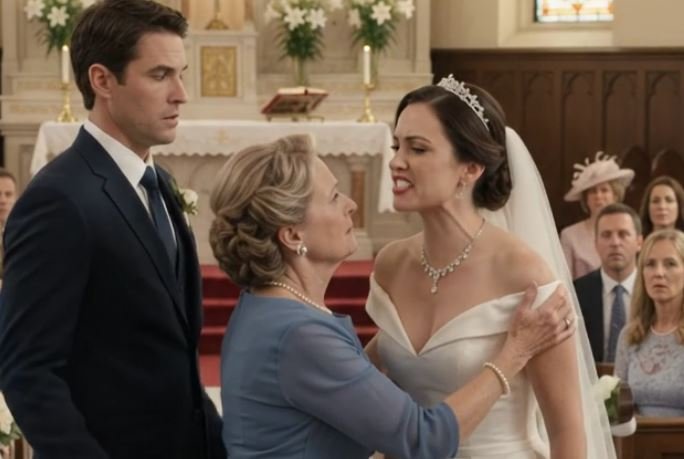
It didn’t die with a runaway bride, a last-minute confession, or some trembling doubt whispered behind a church door. It died beneath the white lilies of St. Mary’s, in front of 260 guests dressed in silk and diamonds, when the woman I was supposed to marry looked at my mother like she was something dragged in from the dirt.
My mother, Margaret Hartwell, had only wanted to hug her.
She stood three feet from us in the hand-stitched blue dress she had spent six weeks altering because she refused to pay a tailor for something she could do herself. Her gray hair was pinned carefully at the back of her head. She wore my grandmother’s pearl earrings. Her eyes were shining.
At sixty-nine, she still carried the faint smell of earth and morning air with her—the kind that came from feeding animals before sunrise, checking fence posts after storms, and spending more of her life outdoors than inside rooms with polished marble floors. Willowbrook Farm had been in our family for generations. It had raised my grandfather. It had raised my father. And after my father died when I was twelve, it had raised me—mostly because my mother refused to let losing her husband mean losing everything else too.
That morning, before driving to the church, she had probably checked the north pasture, put out grain, and reminded our neighbor which calf needed watching. That was who she was.
She took one small step toward Stephanie. Her arms opened.
Stephanie leaned back. Not gently. Not accidentally. She recoiled as if my mother had carried disease into the church.
Then she laughed.
“Please don’t hug me,” Stephanie said. She was not whispering. She made sure of that. “You smell like manure. Keep that peasant away from me.”
The silence that followed was worse than a scream.
My mother’s arms stayed frozen in the air. Her smile remained for one painful second longer than it should have, like her heart had not yet caught up with what had happened. Then her hands lowered slowly to her sides.
Someone laughed. Then someone else. Not loudly. That almost made it worse. It was the quiet, polished laughter of people who knew how to make cruelty sound socially acceptable. Stephanie’s cousin Brooke covered her mouth with two fingers. Her uncle looked down as though studying the church floor, but his shoulders moved. A woman from Stephanie’s country club circle whispered something to the man beside her. He smirked.
My mother heard them. I knew she did because I saw the color rise into her face.
Still, she smiled. She actually tried to make them comfortable.
“I’m sorry,” she said.
Sorry. My mother apologized because someone had humiliated her.
Something inside me went cold.
For forty-four years, I had been Charles Hartwell. Engineer. Son. Caretaker of Willowbrook whenever my mother needed help. And, until that moment, groom-to-be. I had also been a fool.
For months I had been telling myself that Stephanie’s family simply did not understand where I came from. Her father, Richard Vale, had called me “the farm boy with the engineering degree” during our engagement dinner. I laughed. Her mother had once told Stephanie, while I was standing close enough to hear, that my mother might be “more comfortable skipping the club Christmas dinner.” I pretended not to notice. Stephanie had corrected the way my mother pronounced the name of a French wine in front of six people and then squeezed my knee beneath the table afterward.
“Don’t be so sensitive,” she had whispered.
Every time something happened, Stephanie gave me the same explanation. “They don’t mean it that way.”
I wanted to believe her because believing her was easier than admitting the truth. They meant it exactly that way.
My mother had raised me alone after my father died from a heart attack in the south field when he was forty-one. I remembered the day with cruel clarity. The ambulance. My mother standing in the kitchen afterward with both hands wrapped around a coffee mug she never drank from. Bills stacked beside the telephone. A twelve-year-old boy pretending not to cry because he thought that was what being a man required.
What happened next was the part Stephanie’s family never understood.
My mother did not collapse. She got up the next morning at 4:50. She milked. She fed. She called the bank. She called my father’s attorney. Then she went outside and fixed a broken section of fence because cattle did not care that her husband was dead. She sold vegetables at roadside stands before dawn. She repaired equipment with secondhand parts. She took bookkeeping work in winter. When I was accepted into engineering school, she told me not to worry about money. Years later, I discovered she had sold a small parcel she had inherited from her aunt to cover what my scholarships did not. She never told me.
That woman was standing in St. Mary’s now, apologizing for smelling like the life that had paid for mine.
“Mom,” I said. She looked at me. “Charles, honey, it’s all right.”
It was not.
I turned toward Stephanie. “Apologize to my mother.”
Her expression changed immediately. Not into regret. Into irritation.
“Oh my God, Charles.”
“Apologize.”
She glanced around at the guests as if I were embarrassing her. “It was a joke.”
“No. It wasn’t.”
“Don’t start this today.”
Her cousin laughed again. Stephanie looked over at her, then back at me. “Your mother knows I’m kidding.”
My mother touched my arm. “Charles, please.”
There was panic in her eyes. She was begging me not to make a scene. And that look hurt more than Stephanie’s words. Because suddenly I understood something I should have understood years earlier. My mother had spent most of her life making cruel people comfortable. She apologized to angry customers at farmers markets. She thanked bankers who talked down to her. She laughed when wealthy landowners treated her like hired help. And now she wanted me to accept my future wife humiliating her so nobody’s expensive afternoon would be ruined.
I had been helping them. Every time I told Mom to ignore a comment. Every time I explained Stephanie’s behavior. Every time I said Richard was “old-fashioned.”
I had been helping them.
I reached inside my jacket. My fingers touched the thick cream envelope I had been carrying for two weeks. The return address belonged to Harold Weiss, the attorney whose firm had represented my family since my father was alive. The envelope concerned Willowbrook.
I had not opened it. The wedding had consumed everything, and part of me had been afraid it contained another problem I did not have time to handle.
I looked at Stephanie. “Take off the ring.”
She blinked. “What?”
“The ring.”
“Charles.”
“This wedding is over.”
Somewhere behind us, a chair scraped. The quartet stopped playing. Stephanie’s face went pale. Then red.
“You cannot be serious.”
“I am.”
“Because of a joke?”
“Because of everything I kept pretending was a joke.”
She moved closer. Her voice dropped.
“Do not do this to me in front of everyone.”
That sentence settled something inside me. Not don’t hurt your mother. Not I’m sorry. Not I shouldn’t have said it. Do not do this to me.
Even then, she was thinking about the audience.
I held out my hand. For several seconds she stared at it. Then she pulled the engagement ring from her finger and dropped it into my palm.
“You’ll regret this,” she whispered.
Maybe I would. But not as much as I would regret marrying her.
I closed my hand around the ring, folded the ivory seating card at my place in half, and walked toward my mother.
“We’re leaving.”
“Charles, no.”
“Yes.”
She looked horrified. “What about everybody?”
“They’ll go home.”
“The reception—”
“Can feed whoever wants to stay.”
Her mouth trembled. “This cost so much money.”
“So did my education.”
She stared at me. I lowered my voice.
“You never made me feel guilty for that. Don’t ask me to feel guilty for this.”
Her eyes filled. I took her hand. We walked down the center aisle together. No music. No applause. Just whispers.
At the church doors, I heard Richard Vale call my name. I did not turn around.
My mother and I drove back to Willowbrook in my truck. For the first twenty minutes, neither of us spoke. Then she said quietly, “I ruined your wedding.”
I pulled onto the shoulder so fast gravel cracked beneath the tires.
“You did not ruin anything.”
“Charles—”
“She called you a peasant.”
“I’ve been called worse.”
“That doesn’t make it acceptable.”
Her eyes dropped toward her hands. “She comes from a different world.”
“So do I.”
Mom gave a tired little smile. “You worked hard to enter that world.”
“No, Mom. I worked hard to become an engineer. I never worked hard to become someone who would be ashamed of you.”
That ended the conversation.
Chapter 2: What Survived After the Wedding Died
By midnight, my phone had become almost unusable. Stephanie sent eleven messages. Richard sent six. Her mother sent three. Two members of the wedding party called repeatedly. Richard’s first message said I had humiliated his daughter. His second warned that canceling the wedding could create “financial consequences.” His third said we needed to speak before I made “any additional emotional decisions.”
Then, at 12:17 a.m., a message came from Stephanie’s younger sister, Emma. We had never been close. Emma was twenty-nine, seven years younger than Stephanie—quiet where Stephanie was loud, observant where the rest of the Vale family seemed determined to dominate every room.
Her message contained one sentence.
Charles, I think you need to know what Stephanie has really been planning.
I read it three times. Then I called her. She answered immediately.
“I can’t tell you over the phone,” she said.
“What is this about?”
“Your mother.”
Every muscle in my body tightened. “What about my mother?”
A long pause. Then Emma whispered, “Tomorrow morning. Stephanie’s apartment. Nine o’clock. She won’t be there.”
“How do you know?”
“Because she and Dad are meeting with someone about your farm.”
The line went silent after that.
I barely slept. At 8:58 the next morning, Emma unlocked Stephanie’s apartment. She looked like she had not slept either. Without a word, she led me past the white living room, past the framed engagement photographs, and into the office.
There was a marble desk against the far wall. Covered in paper.
My mother’s name appeared everywhere. Margaret Hartwell. Margaret Elaine Hartwell. E. Hartwell.
I picked up the first document. POWER OF ATTORNEY.
My mother’s signature sat at the bottom. It looked almost perfect.
Almost.
I had seen Mom sign thousands of checks, birthday cards, land forms, school documents. She always made the final stroke of the H in Hartwell too long. This signature did not.
My hands started shaking.
Another folder contained two medical evaluations. Both described memory loss. Confusion. Poor judgment. Possible dementia. My mother had never met either doctor listed.
A third folder contained guardianship paperwork. Stephanie’s name appeared as proposed guardian. Richard’s company accountant was listed as a financial consultant.
Then I found a brochure for a private elder care facility forty miles away. My mother’s information had already been entered on the preliminary placement form. Name. Age. Address. Marital status. Property ownership.
I looked at Emma. “What the hell is this?”
Her face had gone white. “Keep looking.”
Beneath the elder care forms were architectural renderings. Large luxury houses. Stone entrances. A private road. A clubhouse. A lake feature.
At the top of the page: WILLOWBROOK ESTATES — PRELIMINARY DEVELOPMENT CONCEPT.
My knees almost gave out.
Willowbrook. Our barns were gone. The south pasture was gone. The old maple tree where my parents had been married was gone. In its place were fifty-eight luxury homes.
Emma put her phone beside the drawings. “I took screenshots before they could delete anything.”
She opened an email.
Wedding in June. Guardianship proceedings begin in July. Property transfer by fall. Charles will cooperate once the marriage is finalized.
I stopped breathing for a second. “Who wrote that?”
“Stephanie.”
The recipient was Richard.
Another message followed. Margaret is emotionally dependent on Charles. Once we are legally family, we can frame intervention as being for her safety.
Another: The land is wasted in agricultural use.
Another: Do not discuss development value with Charles until after the wedding.
I felt physically sick. My phone began ringing. Richard Vale.
Emma looked at me. I answered and put him on speaker.
“Charles,” he said carefully, “there are things about this situation you don’t understand.”
I looked at the forged signature. The fake evaluations. The nursing home brochure. The development maps.
“No,” I said quietly. “I understand perfectly now.”
Three hard knocks sounded against Stephanie’s apartment door. Emma’s eyes widened. Richard went silent on the phone. Then a woman’s voice came from the hallway.
“Emma?”
Stephanie.
“Open the door.”
For one second, neither Emma nor I moved.
Stephanie knocked again. Harder. “Emma, I know you’re in there.”
Her father was still connected through my phone.
I heard him breathe. Then Richard said, “Charles, don’t do anything foolish.”
I stared at the screen. “Interesting choice of words.”
I ended the call.
Stephanie tried the handle. Locked. “Emma!”
Emma looked terrified.
“You don’t have to stay,” I told her.
“Yes, I do.”
“Your family is going to know you showed me all of this.”
“They already know I disagreed.”
“That isn’t the same thing.”
She swallowed. “I should have told you sooner.”
There was so much shame in her voice that I believed her.
I opened the door.
Stephanie stood in the hallway wearing dark glasses and the same white coat she had worn when she left the rehearsal dinner two nights earlier. For half a second she looked surprised to see me. Then she saw Emma behind me. Then she saw the documents spread across the desk.
Her entire face changed.
“What are you doing here?”
I almost laughed. “Really?”
She pushed past me. “You have no right to go through my private things.”
“Those private things have my mother’s forged signature on them.”
Stephanie stopped. Not because she was shocked. Because she was calculating.
I saw it happen. The emotion drained from her face and was replaced by control.
“Charles, you don’t understand what those papers are.”
“Your father said the same thing.”
“They were drafts.”
“Drafts of my mother having dementia?”
“Contingency planning.”
“For what?”
She took off her sunglasses. Her eyes were swollen. For a moment, part of me remembered the woman I had loved. The woman who once stayed awake with me all night when a bridge project failed inspection. The woman who brought soup when I had pneumonia. The woman who stood under Christmas lights and said she wanted to build a life with me.
I needed that memory. Because it reminded me why betrayal hurt.
Stephanie had not been a stranger. She had been someone I trusted.
She glanced toward Emma. “You had no right.”
Emma shook her head. “You were going to take his mother’s farm.”
“We were going to protect an elderly woman whose property is becoming too much for her.”
“My mother runs Willowbrook every day.”
“She’s sixty-nine.”
“That is not a diagnosis.”
Stephanie sighed as though I were a difficult child. “Charles, do you have any idea what that land is worth?”
There it was. Not concern. Value.
“How much?”
She hesitated.
“How much, Stephanie?”
“Potentially twelve to fifteen million after rezoning and development.”
My mouth went dry.
I had known Willowbrook’s value had risen. The city had expanded toward us. New roads had appeared. Developers occasionally mailed offers. But my mother threw most of them in a drawer without opening them. The farm was not an investment to her. It was home.
Stephanie stepped closer. “Your mother is sitting on an asset she cannot possibly use efficiently.”
“She uses it as a farm.”
“That’s not what I mean.”
“I know.”
She folded her arms. “Richard has contacts. We had preliminary conversations. Nothing was final.”
I picked up the power-of-attorney form. “Her signature is forged.”
“It was a sample.”
“You filled out legal documents with a fake signature.”
“It was part of preparing options.”
“And the dementia evaluation?”
Her jaw tightened. “That doctor reviewed information.”
“What information?”
“Things you’ve told me.”
“I never told you my mother had dementia.”
“You said she forgot where she left her keys.”
I stared at her. “She misplaced her keys once.”
“You said she repeated a story at dinner.”
“She’s sixty-nine. People repeat stories.”
Stephanie’s voice sharpened. “This is exactly the emotional reaction Dad said you would have.”
I looked at Emma. She closed her eyes.
Stephanie continued. “Your mother will eventually need help. You know that. This could solve everything. She gets excellent care. You’re no longer responsible for keeping a failing farm alive. And the property becomes something useful.”
Useful.
Willowbrook had survived droughts, floods, my father’s death, two recessions, and the year Mom sold half our equipment just to avoid missing the mortgage. Stephanie called it useless because no one had put a gatehouse on it.
I held up the development map. “When were you going to tell me?”
“After the wedding.”
“Why?”
“Because you would have reacted exactly like this.”
“So you needed me legally tied to you first.”
She went quiet.
That silence answered me.
Emma spoke from behind us. “Tell him about the petition.”
Stephanie spun toward her. “Stop.”
“What petition?” I asked.
Emma looked at me. “They planned to file for temporary guardianship if Margaret refused the medical appointment.”
Stephanie’s face hardened. “Emma.”
“And if Charles fought it?”
“Enough!”
Emma flinched. I did not.
“If I fought it, what?”
Stephanie’s shoulders rose and fell. Finally she said, “Dad thought you would come around.”
“Because I’d be your husband.”
“Yes.”
“And if I didn’t?”
She looked away.
That hurt more than I expected. Because there had been a plan for me too. Maybe not legal papers. Maybe not a care facility. But pressure. Marriage. Money. Family. Humiliation. Whatever it took.
Stephanie reached for the documents. I moved them away.
“Those are mine.”
“Anything involving my mother stays with me.”
“You cannot steal documents from my home.”
“I’m not taking originals.”
I photographed every page. Every signature. Every email Emma had saved. Then I sent copies to myself, to a secure work account, and to a folder Stephanie could not access.
She watched me. “You’re destroying your life because you’re angry.”
“No.” I slipped my phone into my pocket. “I almost destroyed it yesterday.”
I left.
Chapter 3: The Truth Comes Out
My mother was sitting at the kitchen table when I returned to Willowbrook. She had changed out of the blue dress. Jeans. Work shirt. Coffee. Normal.
That somehow made everything harder.
She looked up. “You went somewhere early.”
I set my keys down. “Mom, I need to ask you something.”
Her expression changed. “What?”
“Has Stephanie ever asked you to sign anything?”
Mom frowned. “Not exactly.”
My stomach tightened. “What does ‘not exactly’ mean?”
“She brought some papers a few weeks ago.”
I pulled out a chair. “What papers?”
“She said they were insurance documents. Something about making things easier after you two married.”
“Did you sign?”
“No.”
Relief hit so hard I almost felt dizzy. “Why not?”
Mom shrugged. “Because I’m not an idiot.”
Despite everything, I laughed once. She smiled. Then her expression became serious. “She got upset.”
“What did she say?”
“That I didn’t trust her.”
“Anything else?”
Mom looked toward the window. “She asked about the deed.”
I stopped moving. “When?”
“Several times.”
“Why didn’t you tell me?”
“You were getting married.”
“Mom.”
“I did not want to cause trouble.”
There it was again. Her instinct to absorb discomfort so everyone else could remain peaceful.
I put both hands on the table. “You are never trouble.”
Her eyes met mine.
I told her everything. Not all at once. I tried. But there is no gentle way to tell your mother that the woman you almost married planned to declare her incompetent, remove her from her home, and sell the land where she buried her husband.
Mom listened without interrupting. When I reached the fake medical evaluations, her face changed. When I mentioned the care facility, she looked toward the hallway where my father’s photograph hung. When I showed her Willowbrook Estates, she touched the drawing with one finger.
“They removed the maple tree.”
That was what she noticed first. Not the houses. Not the money. The tree.
Mom and Dad had been married beneath it in 1974.
“I’m sorry,” I said.
She lifted her eyes. “For what?”
“For bringing her into our lives.”
“You didn’t know.”
“I should have.”
“You loved her.”
“That doesn’t excuse being blind.”
“No,” Mom said. “But love and blindness have been neighbors for a very long time.”
I sat there, staring at the table. Then I remembered the envelope. Still inside my wedding jacket.
I went upstairs, retrieved it, and brought it back to the kitchen. HAROLD WEISS, ATTORNEY AT LAW.
Mom recognized the name immediately. “Harold?”
“He sent this two weeks ago.”
“And you didn’t open it?”
“I was busy planning a wedding that lasted seven minutes.”
That earned another tired smile.
I opened the envelope. Inside were copies of Willowbrook’s updated property records, trust documents, and a handwritten letter.
I read the first page twice. Then a third time.
“What?” Mom asked.
I looked at her. “Did you know Dad put restrictions on the farm?”
Her expression went still. “Some.”
“Apparently not some.”
The original arrangement had been created after my father’s death and updated years later with my mother’s approval. Willowbrook was held through the Hartwell Family Land Trust. My mother controlled the property during her lifetime. I was successor trustee. Any permanent sale or development agreement involving more than a small parcel required independent legal review and the signatures of both of us. A power of attorney alone could not override the trust terms.
At the bottom of Harold’s letter was one sentence underlined twice:
Charles, I have recently received unusual inquiries regarding Willowbrook. Please contact me before signing anything connected to the Vale family or any development entity associated with them.
I looked at the date. Two weeks before the wedding.
A chill moved through me.
“What inquiries?” Mom whispered.
“I don’t know.”
I reached for my phone. Harold answered on the second ring.
“Charles?”
“Yes.”
A pause. Then he said, “I was wondering when you would open my letter.”
“I need to see you.”
“Bring Margaret.”
“When?”
His voice changed. “Now.”
Harold Weiss had aged since I last saw him. He was in his seventies now—thin, silver-haired, with reading glasses hanging from a black cord around his neck. But the moment my mother and I entered his office, he stood and came around the desk. He hugged her.
No hesitation. No recoil. No joke.
“I heard about yesterday,” he said.
Mom looked embarrassed. “News travels.”
“In this county? Faster than weather.”
Then he looked at me. “You did the right thing.”
I was not sure I believed that yet. My canceled wedding had already cost thousands. My professional phone had twenty-seven missed calls. People I had known for years were choosing sides in a fight they did not understand. But I nodded.
Harold closed his office door. I placed photographs of Stephanie’s documents on his desk. He read them one by one. The farther he got, the quieter he became.
Finally he removed his glasses. “Margaret, did you sign any of these?”
“No.”
“Did you authorize anyone to sign for you?”
“No.”
“Did you attend either of these medical evaluations?”
“No.”
Harold turned toward me. “Then we have a serious problem.”
“What did Richard ask you?”
“He didn’t contact me directly.” Harold opened a file. “Three weeks ago, a land-use attorney from the city requested trust information. He said he represented a party considering a future development agreement involving Willowbrook.”
“Who?”
“He refused to identify the client.”
“Can he do that?”
“He can ask. I can refuse.”
“Did you?”
“Immediately.”
Harold pulled out another page. “Four days later, I received a second inquiry asking whether a guardian for Margaret could petition the court for authority to sell trust property.”
My mother’s face drained of color.
Harold continued. “That was when I contacted you.”
I stared at the letter in front of me. “And I carried your warning around in my jacket for two weeks without reading it.”
“You didn’t know.”
“I should have opened it.”
Harold leaned back. “Maybe. But blaming yourself won’t protect Margaret now.”
That word mattered. Protect. It gave me something to do besides hate myself.
For the next two hours, we worked. Harold documented that my mother had never granted Stephanie, Richard, or anyone connected to them financial authority. He prepared formal notices to the banks, county records office, and trust administrator. He contacted another attorney who specialized in elder law. He explained that any legitimate guardianship petition would require evidence, review, and notice. The papers on Stephanie’s desk did not magically give her power. But the forged documents showed intent.
And intent mattered.
“We need to assume they may try to move quickly now that the wedding failed,” Harold said.
Mom looked at him. “Why would they bother? Charles didn’t marry her.”
“Because the property is worth enough money to make desperate people behave stupidly.”
I hated hearing Willowbrook discussed as a number. But Harold was right. Money had turned my mother into an obstacle in Stephanie’s mind.
By lunch, we had done everything immediate we could. I thought we were finished.
Then Harold looked at Mom. “Margaret, there is something else.”
She stared at him. He knew. I could see that he knew something I didn’t.
“What?” I asked.
Mom looked down. Harold waited.
Finally she said, “Stephanie came here once.”
I turned to her. “When?”
“Two months ago.”
“What?”
“She wanted to talk about the trust.”
My chair scraped the floor. “You never told me.”
“No.”
“Why?”
Mom’s eyes filled. “Because she made me feel foolish.”
The anger I had been holding became something hotter. “What happened?”
Mom folded her hands. “She said you were worried about me.”
“I wasn’t.”
“I know that now.”
“What did she say?”
“That you had noticed I was forgetting things. That you were afraid I might sign something without understanding it. She said marriage would make her part of the family and she wanted to help.”
“Did Harold meet with her?”
“No,” Harold said. “My receptionist called Margaret when Stephanie arrived asking for trust documents. Margaret told us not to release anything.”
Mom nodded. “I told Stephanie the farm was handled.”
“What did she do?”
“She smiled.”
That frightened me more than shouting would have.
Mom continued. “Then she asked whether I had ever considered moving somewhere easier.”
“The care facility?”
“She didn’t name it.”
I closed my eyes.
Mom touched my wrist. “Charles.”
“You should have told me.”
“I know.”
“No, Mom. You don’t get to protect me from something like this.”
She pulled her hand back. Immediately I regretted my tone. I lowered my voice.
“I almost married her.”
“I didn’t want to destroy something that made you happy.”
“But it wasn’t making me happy.”
That realization landed slowly. Had I been happy? Or had I been working constantly to keep Stephanie happy? Keeping her from being embarrassed by where I came from. Keeping her family impressed. Keeping Mom quiet. Keeping two worlds from colliding. Maybe I had mistaken exhaustion for commitment.
My phone buzzed. Emma.
“Charles, they know.”
“Know what?”
“That you went to an attorney.”
“How?”
“Dad has people watching county filings.”
I looked at Harold. “Richard knows we’re protecting the trust.”
Harold’s expression did not change. “Good.”
Emma continued. “There’s something else. Stephanie is saying your mother manipulated you into canceling the wedding.”
Of course she was. “What does that accomplish?”
“She’s telling people Margaret is unstable and controlling.”
My stomach turned. The narrative was already changing. My mother had been insulted publicly. Now they were going to make her responsible for my decision.
“I need copies of every message you have,” I said.
“I’ll send them.”
“Emma.”
“Yes?”
“Why are you helping me?”
Silence. Then she said something I did not expect.
“Because Stephanie did this to our grandmother too.”
I sat very still. “What?”
“She didn’t take property. Nothing like that.” Emma’s breathing trembled. “But when Grandma started getting sick, Stephanie decided what everyone was allowed to know. She convinced Dad that Grandma couldn’t manage money before there was any real evaluation. She likes being the person in control.”
“Why didn’t anyone stop her?”
“You know my family.”
Unfortunately, I did.
Emma continued. “I told myself this situation was different. Then I saw those papers with Margaret’s signature.” Her voice cracked. “And I realized I was doing exactly what everyone always does around Stephanie. I was staying quiet because speaking was uncomfortable.”
My mother looked at me across Harold’s desk. The same lesson. Different family. Silence protected whoever was willing to be cruelest.
Chapter 4: The Forged Signature
That afternoon, Mom and I returned to Willowbrook. A black SUV sat near the gate.
I slowed. A man stepped out. Suit. Leather portfolio. For one wild second I thought Richard had sent someone to threaten us.
Instead the man introduced himself as Paul Mercer, an attorney representing a development group.
My entire body tightened. “What do you want?”
He looked uncomfortable. “I was told Mrs. Hartwell had expressed interest in selling.”
“She hasn’t.”
Paul glanced toward Mom. “Mrs. Hartwell?”
“I’ve expressed interest in staying in my house,” she said.
He shifted his portfolio. “I think I may have been given inaccurate information.”
“By whom?” I asked.
He hesitated. “A consulting entity associated with Richard Vale.”
There it was. Directly. No longer hidden behind family conversation.
I took out my phone. “Say that again.”
Paul raised one hand. “I’m not here to be recorded.”
“Then leave.”
He did. But before getting into his car, he said something that changed the situation again.
“For what it’s worth, Mr. Hartwell, our group was told the family had already agreed in principle.”
“What family?”
Paul looked at me. “You.”
My stomach dropped. “They said you were on board.”
“I never spoke to them.”
He stared at me for a long second. Then he opened the SUV door. “You should probably ask to see the letter bearing your name.”
“What letter?”
But he was already inside.
I called Harold before the SUV reached the end of the road. “There may be another forged document.”
He was silent. Then he said, “Do not contact Stephanie.”
“Why?”
“Because if there is a document with your signature, I want whoever has it to preserve it before anyone knows we’re looking.”
I stood beside my mother at the gate. Behind us, Willowbrook stretched under the afternoon sun. The same fields my father had worked. The same fields Stephanie had already promised to strangers. And now, apparently, she had not only forged my mother’s name. She may have used mine too.
The letter surfaced forty-eight hours later. Paul Mercer sent it directly to Harold.
It was titled FAMILY CONSENT REGARDING FUTURE DEVELOPMENT.
My name appeared at the bottom. Charles Hartwell.
The signature was not mine. It was good. But it was not mine.
Above it sat language stating that I supported “the eventual transition of Willowbrook from agricultural use to residential development” and that I believed relocating my mother would be “in her long-term health and financial interests.”
I read the sentence five times. Then I pushed the paper away.
My mother was sitting beside me in Harold’s conference room. She did not speak. She did not have to.
That document made me look like the son Stephanie had been trying to turn me into. A son willing to remove his mother from her own home for money.
Harold folded his arms. “This changes things.”
“How?”
“We are no longer dealing only with preparation for a possible guardianship petition. Someone represented to a third party that you had agreed to this transaction.”
“Can we prove Stephanie did it?”
“Not yet.”
The phrase irritated me. Not yet. Everything felt obvious. The apartment. The emails. The wedding timeline. The fake medical evaluations. But obvious and provable were not the same thing.
Harold knew that. So did Richard Vale. That was why people like him loved paperwork. Paper created distance between intention and responsibility. Richard could say he relied on Stephanie. Stephanie could say she relied on an adviser. An adviser could say drafts were preliminary. Everyone could stand around the truth without touching it.
Then Emma called. She had found the missing link.
Not a new secret. Not some miraculous recording. A reply buried in an email chain she had already copied.
Richard to Stephanie: Do not use Charles’s actual signature from the engineering contracts. It will be too easy to compare. Have the consent prepared as an internal family acknowledgment until after the marriage.
I stopped reading. Harold took the phone from my hand. Mom stared out the window.
No one spoke for almost a minute.
Finally I said, “That’s him.”
Harold nodded. “It certainly appears to be.”
The next several days were not dramatic in the way movies make legal fights dramatic. There was no screaming judge. No surprise witness crashing through a courtroom door. There were forms. Affidavits. Copies. Dates. Phone calls. Statements. Documents compared against documents.
And underneath all of it, there was fear.
Stephanie’s family had money. Connections. Lawyers. My mother had spent her adult life measuring rain in old gauges and writing feed expenses in spiral notebooks.
But facts did not care which dining club you belonged to.
Harold helped Mom submit a sworn statement confirming she had never signed the power of attorney. The two doctors whose names appeared on the supposed evaluations were contacted. One had never met Mom. The other had not authored the report carrying his electronic signature.
That ended any pretense that the documents were harmless planning notes.
The proposed guardianship filing stopped before it could begin. The development group withdrew. The county placed additional verification requirements on any attempt to modify Willowbrook’s title.
Richard’s attorneys began using phrases like “unauthorized drafts” and “miscommunication.”
Stephanie called me for the first time since the apartment confrontation. I almost ignored it. Then I answered.
“What?”
She was crying. Not quietly.
“You’re destroying my father.”
I closed my eyes. “I’m protecting my mother.”
“Dad never meant for any of this to go this far.”
“There were fake medical records.”
“He didn’t make those.”
“Then who did?”
Silence.
“Stephanie?”
“Charles, I loved you.”
The sentence hurt. That angered me. Because part of me still remembered loving her too.
“You loved the version of me that was useful.”
“That’s not fair.”
“You told a developer I agreed to remove my mother from her home.”
“I thought once you saw the financial opportunity—”
“You thought once we were married, I’d give in.”
She started crying harder. “We could have had an incredible life.”
“Built on my mother’s land?”
“No.”
“Then why didn’t you tell me?”
No answer.
I sat at my kitchen table. The same table where Mom had helped me with algebra. The same table where Dad’s chair remained empty for years because neither of us could bring ourselves to sit in it.
“Do you know what the worst part is?” I asked.
Stephanie whispered, “What?”
“It isn’t the money.”
“Charles—”
“It isn’t even the forged papers.”
I looked toward the window. My mother was outside carrying a bucket toward the barn.
“The worst part is that you understood exactly who my mother was to me, and you counted on me being too weak to defend her.”
“That isn’t what happened.”
“It is exactly what happened.”
She said my name again. I ended the call.
Chapter 5: The Hearing and the Healing
The formal hearing connected to the disputed guardianship paperwork took place several weeks later.
I sat beside my mother. Stephanie sat across the room with her attorneys. Richard was there too. For the first time since I met him, he looked old. Not powerful. Not polished. Old.
No one wore evening clothes. No one had champagne. No one laughed when Mom walked in.
The issue before the court was narrow. Was Margaret Hartwell an incapacitated adult who required another person to control her affairs?
The answer became obvious quickly.
My mother gave her full name. Her address. Her date of birth. She described the farm’s acreage, tax obligations, bank relationships, and trust structure more accurately than I could.
When asked about the supposed medical appointments, she said, “I never attended them.”
When asked whether she wanted Stephanie Vale managing her finances, Mom looked across the room.
“No.”
One word. Nothing dramatic. But I had never been prouder of her.
Stephanie’s lawyer tried to suggest concern had arisen because Mom lived alone and worked physically demanding land. Mom replied, “Being old enough for someone to worry about me is not the same as being incapable of choosing how I live.”
Even the attorney paused after that.
The petition was dismissed. The questionable documents were referred for further review by the appropriate authorities.
Harold told me not to expect instant justice. Investigations took time. Responsibility could be divided. Lawyers would argue about who created what.
I understood.
For me, the important part had already happened. My mother walked back into Willowbrook that evening knowing nobody was coming to take her keys.
We stood beside the old maple tree. The sun was dropping behind the west pasture. Mom touched the bark.
“I thought I was going to lose this.”
I looked at her. “You never told me you were scared.”
She smiled sadly. “I’m your mother.”
“You’re allowed to be scared.”
“So are you.”
That stopped me. Because I had been terrified. Terrified that canceling the wedding had ruined my future. Terrified that Stephanie’s family would destroy my reputation. Terrified that I had failed to see what was happening in front of me.
Mom leaned against the tree. “Do you still love her?”
I wanted to say no. It would have sounded stronger. Cleaner. Instead I told the truth.
“Part of me probably does.”
Mom nodded. “That’s unfortunate.”
I laughed. She did too.
Then she said, “Loving someone does not require you to let them hurt you.”
I looked across Willowbrook. All those acres. All that history.
For the first time, I understood the farm differently. Stephanie saw property. Richard saw units. A developer saw return on investment. My mother saw the place where she had buried a husband, raised a son, survived grief, and built a life.
I finally saw what she had been protecting. Not dirt. Choice.
The story did not end with the court hearing. Real endings rarely happen in one clean moment. Stephanie’s wedding dress stayed at the bridal shop for months because neither of us wanted to deal with it. Deposits disappeared. Mutual friends stopped calling. Some people believed I had overreacted at the church. Then the documents became known. Those people became quieter.
Richard resigned from two community boards while the investigation surrounding the disputed paperwork continued. His attorneys maintained that some documents had been preliminary and that responsibility for the altered signatures had not yet been fully established.
I did not spend my days trying to guess how every legal question would end. Harold advised me to preserve evidence, answer honestly when asked, and otherwise continue my life.
So I did.
Emma moved out of her father’s house. The first time she visited Willowbrook after everything, my mother fed her peach pie at the kitchen table. Emma cried halfway through the slice. Mom pretended not to notice.
That was another thing my mother was good at. Giving people dignity when they had none left to give themselves.
Emma apologized again for not speaking sooner. Mom shook her head.
“You spoke eventually.”
“I should have done it before the wedding.”
“Yes.”
Emma looked startled.
Mom smiled. “Forgiveness does not require lying.”
I nearly laughed. Emma did. After that, something in the room loosened.
Chapter 6: What the Farm Was Really Worth
Over the next few months, I spent more time at Willowbrook. Not because Mom suddenly needed rescuing. She would have hated that.
I repaired the old machinery shed. Replaced fencing along the creek. Helped update the farm’s accounting system after spending fifteen minutes convincing Mom that a cloud backup did not mean her financial records were literally floating somewhere in the sky.
I kept my engineering job. I kept my apartment. I kept living.
But I stopped treating Willowbrook as the part of my life I had escaped.
That had been one of my deepest mistakes. When I was young, the farm represented everything I wanted to move beyond. Early mornings. Mud. Money problems. People looking at my mother’s work clothes and deciding how intelligent she was before she spoke. I wanted offices. Cities. Clean hands. Professional respect.
There was nothing wrong with that. The mistake was believing moving forward required looking backward with embarrassment.
One October afternoon, Harold came to Willowbrook with updated trust documents. Mom and I sat at the kitchen table. He reviewed every page. The protections were stronger now. No sale. No development. No transfer without independent review. Clear procedures if Mom ever actually became unable to manage her affairs. Her choice of people to help. Not mine alone. Not a future spouse’s. Hers.
She signed each page slowly. Then she looked at me.
“You know this means you’ll have trouble selling after I’m gone.”
“I know.”
“What if someday you want to?”
“I’ll make that decision someday.”
She studied my face. “Not because you feel guilty?”
“No.”
“Not because of what happened with Stephanie?”
“No.”
“Then why?”
I looked out the window. The maple tree stood beyond the barn.
“Because I finally understand why you never rushed to sell.”
Mom smiled. “That only took you thirty years.”
“Thirty-two.”
“Engineers.” She shook her head. “Always correcting numbers.”
Chapter 7: The Church, the Pie, and the Peace
Winter arrived. Then spring.
Almost a year after the wedding that never happened, St. Mary’s sent me an envelope.
For several seconds I just stared at it.
Inside was a note from Father Michael. The church was replacing part of its roof. While clearing a storage closet, someone had found a small box labeled HARTWELL-VALE CEREMONY.
Inside were two unused candles, the ceremony program, and the ribbon that had been intended to tie our marriage certificate folder.
I drove to the church the following Sunday. Not because I needed closure from a building. I think I simply wanted to see the place without 260 people watching me.
The lilies were gone. There was no quartet. No photographers. No Stephanie.
I stood where I had stood that afternoon and looked toward the pew where my mother had frozen beneath other people’s laughter.
For months, I had replayed that moment with anger.
This time I saw something else. I saw the exact second my life had refused to continue in the wrong direction.
Had Stephanie waited one more day to insult Mom? Had she smiled through the ceremony? Had I ignored one more joke? I might have married her. The plan might have advanced. Maybe Harold’s warning would still have saved us. Maybe Emma would have spoken. Maybe I would eventually have discovered everything.
But there are roads in life where “maybe” becomes dangerous.
Stephanie had been cruel because she believed cruelty had no cost. Her mistake was making me choose publicly between protecting her image and protecting my mother.
I should not have needed that moment. But I did.
When I returned to Willowbrook, Mom was kneeling beside a raised garden bed.
“Your knees are going to hate you tomorrow,” I called.
She looked up. “They already hate me today.”
I walked over and helped her stand. She brushed dirt from her jeans.
“Church?”
“Yeah.”
“How was it?”
“Quiet.”
She nodded. We began walking toward the house.
Halfway there, a truck pulled into the driveway. For one irrational second, my body tightened. Old habits.
Then I recognized the driver. Emma.
She climbed out carrying a bakery box. Mom immediately smiled.
“She brought something.”
“You only like her because she brings dessert.”
“I raised you for forty-four years and you rarely bring dessert.”
“You see me every week.”
“Exactly. Plenty of opportunities.”
Emma joined us. We sat on the porch beneath the afternoon sun. No country club. No white lilies. No crystal glasses. Just coffee and pie.
At one point Emma mentioned that Stephanie had moved to another city. I had heard. She did not know where. I did not ask.
That surprised me. A year earlier, every change in Stephanie’s expression mattered to me. Now I could hear her name and feel sadness without feeling pulled toward her.
Healing, I learned, was not forgetting someone. It was reaching a point where remembering them stopped controlling what you did next.
Mom reached across the porch table and touched my hand. “You okay?”
“Yeah.”
And this time, I meant it.
Later, after Emma left, Mom and I walked toward the maple tree. She had recently found an old photograph of my parents’ wedding beneath those branches. Dad was twenty-one. Mom was nineteen. His suit was too big. Her dress had been made by her mother. No champagne tower. No violin quartet. No 260 guests.
They looked ridiculously happy.
Mom handed me the photograph. “Your father was terrified.”
“Of marriage?”
“Of your grandfather.”
I laughed. She pointed toward Dad’s face. “Five minutes before that picture, he asked me whether we should run away.”
“What did you say?”
“I told him the cake was already paid for.”
“That’s romantic.”
“Marriage is mostly romance until somebody gets hungry.”
We laughed. Then Mom became quiet.
“Charles.”
“Yeah?”
“I’m sorry you lost the future you thought you were going to have.”
I stared down at the old photograph. For a long time, I had considered the canceled wedding a loss. It was a loss. Pretending otherwise would have been another kind of lie. I lost someone I had loved. I lost friendships. Money. Plans. A picture of the future I had carried for years.
But losing a future built on deception was not the same as losing my only chance at happiness.
“I’m sorry too,” I said.
Mom looked at me. “But I’m not sorry I walked out.”
Her eyes shone. “Neither am I.”
The wind moved through the branches above us. Willowbrook stretched beyond the tree, green with spring growth. No luxury houses. No private gates. No clubhouse. No road named Willowbrook Estates.
Just home.
I thought again about Stephanie’s words inside St. Mary’s. Keep that peasant away from me.
Once, the sentence made me furious. Now it seemed small. Almost pathetic.
My mother had spent nearly seven decades building a life with her hands. She knew how to keep land alive. How to bury a husband and wake up the next morning. How to raise a frightened twelve-year-old boy. How to survive debt, drought, grief, and loneliness without allowing any of them to make her cruel.
Stephanie had looked at dirt on my mother’s shoes and thought it made her inferior. She never understood that those shoes had walked through things her money could not have carried her through.
The wedding died before the champagne ever touched a glass. For months I thought that was the story. It wasn’t.
The real story was what happened after. A son finally stopped asking his mother to tolerate humiliation for his comfort. A woman who had spent her life apologizing for taking up space learned to say no without explaining herself. A plan built in secret collapsed once everybody stopped protecting the secret.
And Willowbrook remained exactly where it had always been.
The next morning, I woke before sunrise. Mom was already outside. Of course she was.
I found her near the barn, leaning on the gate while the sky turned pale gold. She looked at me.
“You’re up early.”
“Couldn’t sleep.”
She nodded toward a bucket. “Then make yourself useful.”
I picked it up. No designer suit. No polished shoes. No church full of wealthy guests. Just work.
As we walked across the yard, my boots sank slightly into the damp ground. For the first time in years, I did not care whether the smell of the farm stayed on me.
I hoped it did.
THE END