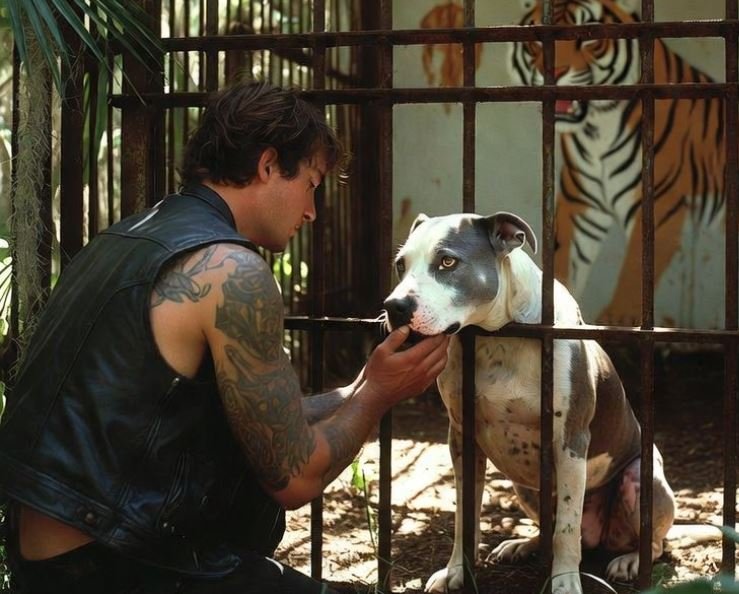
My name is Caleb Dunn, and I am twenty-nine years old. I have seen cages before. I have been in places where the walls were concrete and the doors were steel. I have known the feeling of being trapped, of waiting for someone to open the door. But I have never opened a cage that a dog had chosen to stay in until the morning of November 12th, when a scarred pit bull mix taught me that freedom means nothing if it means leaving your family behind.
The Iron Mercy Riders were riding through the Florida Everglades. We had delivered supplies to a rural veterans’ clinic in Naples, and we were taking the back roads through the swamp, looking for old landmarks, abandoned places, the bones of Florida’s forgotten tourism. We found a sign, faded and peeling, that read “Tiger World — Closed 1987.” Behind it, hidden in overgrown vegetation and Spanish moss, were the remains of a roadside zoo.
The cages were still there. Rusted iron bars, concrete floors, faded murals of tigers and elephants painted on the walls. The jungle had reclaimed most of it. Vines grew through the bars. Palms had sprouted inside the enclosures. It was a place where animals had once been displayed for passing motorists, and then abandoned when the owners left.
I walked around the back, past the main enclosure, to a smaller cage that had been hidden by a fallen palm. The bars were rusted orange. The door was closed. And inside, sitting in the dirt, was a dog.
A white-and-gray pit bull mix. She was scarred. Her ears were torn, healed poorly. Her body was thin, her ribs visible, her fur matted with mud and swamp water. She had been in the cage for weeks. Maybe longer.
I knelt in the grass. I reached my hand through the bars. She looked at me. Her eyes were amber. Exhausted. Cautious. But not empty. There was still something in them. A warmth. A hope.
She didn’t growl. She didn’t bark. She leaned forward, slowly, and she licked my hand.
I pulled out my bolt cutters. I snapped the lock. The door swung open with a groan that sounded like a century of rust.
She didn’t move.
“Come on, baby,” I whispered. “You’re free.”
She looked at me. Then she looked behind her. At the floor.
I followed her gaze. The concrete was old, cracked, overgrown with weeds. But in the corner, near the back wall, there was a section that looked different. The dirt was disturbed. The weeds were dead. And there was a gap, small and dark, where a floorboard had been.
I crawled into the cage. She didn’t flinch. She watched me with those amber eyes, her body tense, as I knelt in the dirt and I pulled at the board.
It lifted.
Underneath, in a hollow dug into the earth beneath the concrete, was a nest.
A nest of puppies.
Five of them. Newborn. Their eyes were closed, their bodies pink and helpless. They were huddled together in a bed of dried grass, old leaves, and a faded red shirt that smelled like the dog who had been wearing it.
She had dug under the concrete floor. She had found a space beneath the cage, safe from the rain, safe from the sun, and she had made a nursery. She had been locked in a cage, but she had turned it into a home. She had chosen to stay because leaving meant leaving them.
I sat in the dirt and I cried. I cried because she had been scarred and starving and abandoned, and she had still found the mercy to create a world for her children inside a prison.
I reached into the hollow. I lifted the puppies, one by one, and I placed them in a towel that Darlene had brought. Then I reached for the mother. She came to me. She pressed her body against my chest and she sighed, a sound that seemed to release six weeks of held breath.
I named her Gypsy. Because she had wandered into a cage and made it a palace.
Gypsy and her puppies came home with us. The animal control officer who arrived — a woman named Marisol, who had helped us with other rescues — sat down in the grass and cried when she saw the hollow under the floor. She had seen cruelty. She had seen neglect. But she had never seen a dog turn a concrete cage into a nursery.
The puppies — we named them Fern, Moss, Palm, Bloom, and River — were adopted by families across Florida. Gypsy stayed with me.
She is afraid of cages. Of course she is. She will not enter a crate. She will not go into a room with a closed door. She will not walk past a chain-link fence without trembling. But she is not afraid of small spaces. She sleeps under my bed, in the dark, pressed against the wall, where she feels safe.
Some people see a pit bull and they see a fighter. They see scars and they see aggression. They see a breed that should be banned.
But I see a mother who dug under concrete to keep her babies warm. I see a dog who chose a cage over freedom because love does not run. I see a woman in uniform sitting in the grass, crying because she has finally seen what loyalty looks like.
And that’s enough.