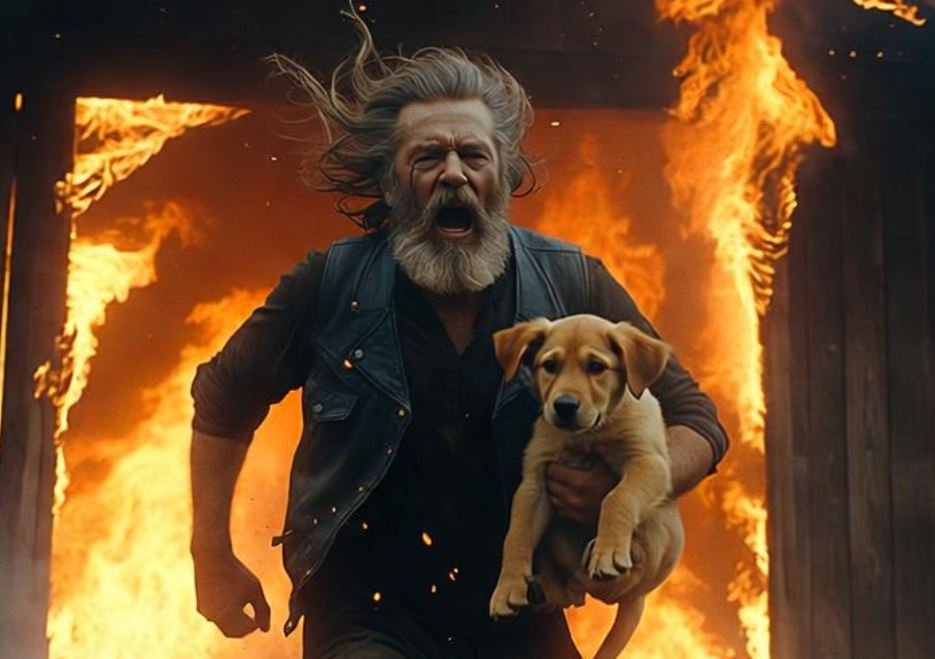
My name is James “Tank” Morrison, and I have been called a lot of things in my sixty-one years. Biker. Veteran. Fool. Hero. None of them ever felt true until the morning I ran into a burning barn to save a dog I had never met.
It was October 14th. The Iron Mercy Riders were on our annual fall charity run through rural Missouri, delivering winter coats and supplies to three small towns that the rest of America had forgotten existed. Six bikes. Six men who looked like the kind of people mothers warn their children about.
Leather vests. Beards. Tattoos that told stories we rarely spoke aloud. We were on Highway 19, thirty miles north of Salem, when Eddie “Preacher” Boone spotted the smoke.
“That’s a barn fire,” he said, killing his engine.
We pulled onto the gravel shoulder. The barn sat a quarter mile off the road, an old wooden structure with a rusted tin roof, and it was burning with a ferocity that made the air shimmer. Black smoke rose in a column so thick it blotted out the autumn sky. We could hear the wood popping, the tin groaning, the fire eating everything.
Then we heard something else.
A whimper. Faint. Desperate. Coming from inside.
I was off my bike before I made the decision. My boots hit the gravel and I was running. The fire was visible from two hundred yards away, heat pressing against my face like a wall. I could smell the pine going up, the hay, the old timber. I could hear the roof beginning to sag.
A pickup truck sat near the barn, engine running, a man in a flannel shirt standing beside it with a phone to his ear. He saw us coming.
“Help’s on the way!” he shouted. “Fire department’s coming!”
“There’s a dog in there!” I yelled.
He looked at the barn. Then at me. Then back at the barn.
“Not my dog,” he said.
Those three words are burned into my memory deeper than the scars on my arms.
I kept running. Eddie was behind me. Luis Vega, our youngest rider at thirty-four, was already on his phone calling 911. The other three bikers — Darlene “Doc” Reeves, Caleb Dunn, and Marcus “Wrench” Holt — were moving the motorcycles to block the driveway so the fire trucks could get through.
The barn door was already warped from heat. I grabbed the handle and the metal seared my palm. I didn’t let go. I pulled it open and smoke poured out in a wave so thick I couldn’t see my own boots. The heat was immediate, suffocating, a physical weight that pressed against my chest and made my eyes water instantly.
“Tank!” Eddie shouted. “The roof!”
I looked up. The roof was sagging in the center, the tin glowing orange at the edges. It had maybe minutes. Maybe less.
Then I heard it again. The whimper. Louder now. Coming from the back left corner, behind a wall of flames that had consumed what looked like a hay storage area.
I took a breath — a mistake, the smoke hit my lungs like a fist — and I ran.
The barn was a nightmare of falling embers and collapsing beams. A board fell three feet to my right, spraying sparks. The heat was so intense I felt my beard beginning to curl, my leather vest growing hot against my back. I kept my eyes on the back corner, where the sound had come from.
And then I saw her.
A golden retriever mix, maybe six months old, lying on a pile of old horse blankets. She was not moving. Her fur was matted with smoke, her eyes closed, her chest barely rising. Above her, a beam was burning, sending chunks of flaming wood down like rain. She was trapped in a corner that was becoming an oven.
I didn’t think. I lunged through the flames, feeling the heat scorch my left arm, and I grabbed her. She was lighter than I expected, maybe twenty pounds, limp as a rag doll. I pulled her against my chest and turned.
The way out was worse. The fire had spread across the center of the barn, creating a wall of orange and black that hadn’t been there thirty seconds ago. The roof groaned above me, a sound like a dying animal. I could hear Eddie screaming my name from the doorway, but his voice sounded far away, underwater.
I ran at the flames. There was no other way. I turned my shoulder and crashed through a burning partition, feeling the wood splinter and the fire lick my vest, my jeans, my skin. I stumbled, caught myself, kept moving. The puppy in my arms was warm but not from the fire — from my own body, pressed against her, trying to shield her from everything.
When I burst out of the doorway, the fresh air hit me like a slap. I fell to my knees in the dirt, still holding her, gasping, coughing, my lungs full of smoke and my vision swimming. Eddie grabbed my shoulder and dragged me backward, away from the building, as the roof finally gave way with a roar that shook the ground.
I looked down at the puppy in my arms.
She was not breathing.
“Doc!” I screamed. “DARLENE!”
Darlene was already there, her medic’s hands moving before she even knelt. She checked the puppy’s airway, cleared smoke and debris from her mouth, and began rescue breathing. Small puffs. Gentle. Precise. The kind of care that only comes from someone who has done this before, who has held life in her hands and refused to let it slip away.
I watched, my own body shaking, my left arm burning where the fire had found skin. I didn’t care. I watched Darlene’s hands, the puppy’s chest, the world narrowing to one small dog and one breath at a time.
Then the puppy coughed.
It was the smallest sound. A wet, ragged cough, and then a gasp, and then her eyes opened. They were blue. Sky blue. And they looked up at me with confusion and fear and something else — recognition, maybe. The knowledge that she had been somewhere terrible, and now she was not.
I started crying. I am not ashamed to say it. Sixty-one years old, two tours, more bar fights than I can count, and I sat in the dirt outside a burning barn with a puppy in my arms and tears cutting through the soot on my face.
The fire department arrived seven minutes later. The barn was already gone, a pile of glowing embers and twisted tin. The man in the flannel shirt had left. We never got his name. We never needed it. The fire chief told us we were lucky to be alive. I told him luck had nothing to do with it. He looked at the puppy, wrapped in Darlene’s emergency blanket, and he didn’t argue.
We took her to Ozark Valley Veterinary Clinic, the same place that had saved River two years before. Dr. Karen Whitcomb met us in the parking lot, took one look at the puppy, one look at my burned arm, and said, “Both of you. Inside. Now.”
The puppy — we named her Ember, because that was what she had survived — had smoke inhalation, first-degree burns on her back, and dehydration. But she was alive. That was the miracle Dr. Whitcomb kept repeating. Alive. She should not have been. The temperature in that corner of the barn had reached over 400 degrees. The smoke should have killed her. The falling debris should have killed her.
The fire should have killed her.
But it didn’t.
I stayed at the clinic for three days. Not because my arm needed it, though Dr. Whitcomb treated the burns and scolded me for not going to the hospital. I stayed because every time I tried to leave, Ember woke up and cried. Not a bark. A cry. The kind of sound that comes from a place of terror so deep it has no name.
So I stayed. I sat on the floor beside her kennel and I talked. I told her about the fire. I told her about the barn. I told her about the smoke and the heat and the way the roof had sounded when it fell. I told her she was safe. I told her the fire was gone. I told her I was there.
By the third day, she was eating on her own. By the fifth, she was walking. By the seventh, she wagged her tail when I came into the room.
I adopted her on the tenth day. Eddie said it was the least surprising thing that had ever happened. Luis said he had already engraved her tag. Darlene said she had known from the moment I ran into that barn.
Ember is two years old now. Her fur grew back golden and thick, though there is a patch on her back where the hair grows white, a scar from the fire that she wears like a badge. She is not afraid of fire. She is not afraid of smoke. But she is afraid of being alone. When I go to the garage, she follows. When I ride, she sits on the porch and watches the road until I return. When I sleep, she sleeps against my chest, her head on my heart, listening to the beat that carried her out of the flames.
The Iron Mercy Riders still do charity runs. We still deliver coats and supplies to forgotten towns. But now we carry something else. Fire extinguishers. Emergency blankets. And a small red bandana that Ember wore the day she left the clinic. It hangs from my handlebars, and when the wind catches it, I remember the sound of a roof falling and the weight of a dog in my arms and the knowledge that some things are worth running into fire for.
Not my dog, the man had said.
He was wrong.
She was always somebody’s dog. She just had to wait for the right somebody to hear her crying.