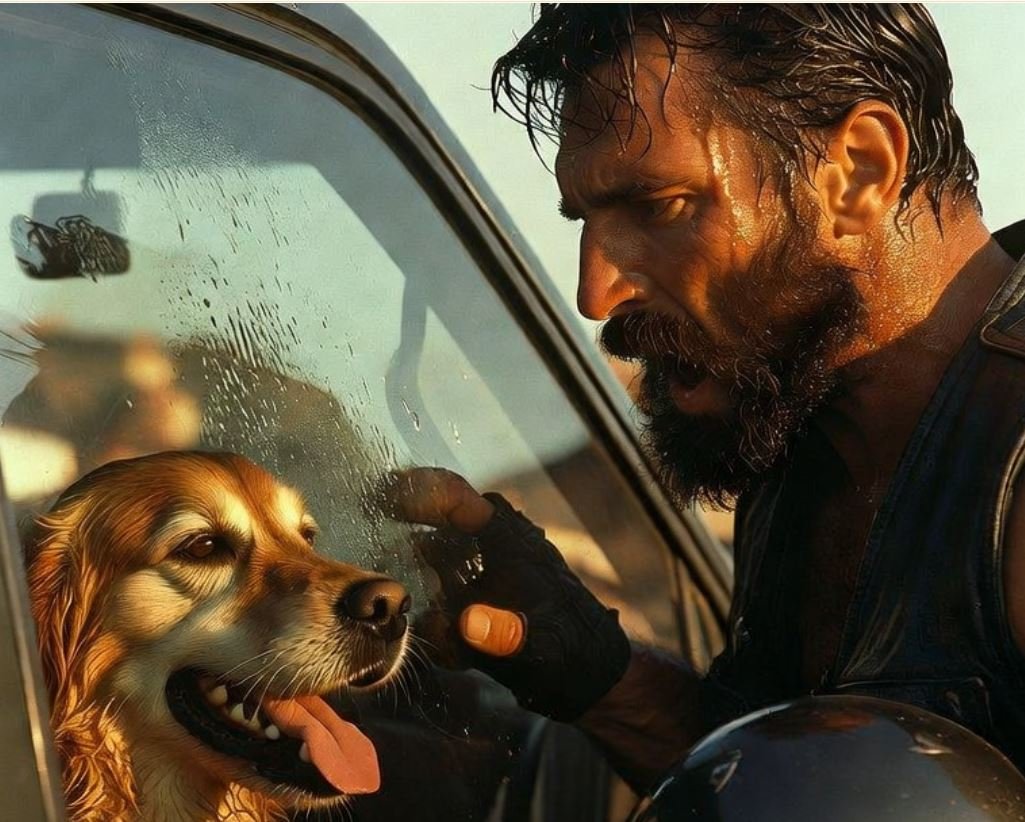
My name is Mason “Bear” Callahan, and I have been hot before. I have ridden through Death Valley in July. I have worn leather in hundred-and-ten-degree heat until my vest was soaked through and my hands slipped on the grips. But I have never felt heat like I did on the afternoon of July 14th, standing in a Walmart parking lot in San Antonio, Texas, looking through the glass at a dog who was dying in front of me.
The Iron Mercy Riders were on a summer supply run. We had delivered fans, water, and sunscreen to a senior center on the south side of the city, and we were stopping at a Walmart Supercenter for cold drinks and ice before the two-hour ride back to our motel. Six bikes. Six people looking for shade. The parking lot was asphalt, black and radiating, the kind of heat that comes up through your boots and makes the air shimmer.
Luis was the first to see her. He had parked beside a silver SUV, a Ford Explorer, the windows up, the sun reflecting off the windshield like a mirror. But through the side window, he saw movement.
“Bear,” he said. His voice was wrong. “Dog. Inside.”
I walked over. The SUV was parked in the middle of the lot, no shade, direct sun. The windows were up. The doors were locked. And inside, on the back seat, was a golden retriever mix. She was lying on her side, her chest heaving, her tongue hanging out and purple at the edges. Her paws were pressed against the glass. Her eyes were half-closed, glazed, the look of an animal whose body was shutting down.
I touched the glass. It was burning hot.
“How long?” I asked a security guard who had wandered over.
“Forty, forty-five minutes,” he said. “I called the manager. They’re paging the owner.”
“She doesn’t have forty-five minutes,” I said.
I have a tool on my belt. A window punch, for emergencies. But it was in my saddlebag, and I didn’t want to wait. I pulled off my helmet. It was a full-face, solid, heavy. I gripped it by the chin bar.
“Bear,” Eddie said. “The law—”
“The law can catch up,” I said.
I struck the driver’s side window.
The glass shattered. Not into shards, but into the small cubes that safety glass becomes. It fell outward, a cascade of glittering pieces, and I reached my arm through the opening. The air that came out was like an oven. It hit my face, my arm, my chest, a wave of heat that made me gasp.
The dog didn’t move. She was too weak. Her head lifted slightly, her eyes finding mine, and I saw something in them that I will never forget. It wasn’t fear. It was resignation. She had given up. She was waiting for it to end.
I reached in. I grabbed her collar. She was heavy, maybe sixty pounds, but her body was limp. I pulled her toward the window. She didn’t help. Her legs dragged across the seat. I got my other arm in, got my hands under her chest, and I lifted her out through the broken window.
The fresh air hit her face. She gasped. It was a terrible sound, a ragged, desperate pull of breath, and then she coughed. Her body convulsed against my chest. I held her, kneeling on the asphalt, my vest absorbing the heat from the ground, and I pressed her against me.
“You’re okay,” I whispered. “You’re out. You’re safe.”
She shook. Her whole body trembled, a deep, uncontrollable shiver that comes from heat exhaustion, from the body trying to regulate itself after being pushed past its limits. Her tongue was still purple, but her eyes were opening. She looked at me. She looked at the sky. She looked at the world outside the glass, and she sighed.
I sat on the asphalt, holding her, while the other bikers formed a circle around us. Eddie had a bottle of water. He poured it over my hands, over her head, her neck, her chest. Darlene had a thermal blanket from her medical kit, but we didn’t use it. She needed to cool down, not warm up. Luis was on the phone with 911, then animal control, then every emergency vet in San Antonio.
The owner came out twelve minutes later. A woman in her thirties, carrying bags, talking on her phone. She saw the circle of bikers, the broken window, the dog in my arms, and she stopped.
“What did you do to my car?” she said.
“Saved your dog’s life,” Eddie said. His voice was calm. It was the calmest I had ever heard him. “While you were buying discount shoes.”
She called the police. They arrived in eight minutes. By then, the dog had stopped shaking. She was breathing easier, her tongue pinking, her eyes tracking movement. I held her the entire time, my arms around her, my helmet on the ground beside me, the broken glass glittering in the sun.
The police took statements. The security guard confirmed the time. The vet clinic, when they arrived, confirmed heat exhaustion, dehydration, and early stages of organ stress. They said another fifteen minutes would have been fatal. The police cited the owner. The bikers gave our information. I didn’t care about any of it. I cared about the dog in my arms, who had lifted her head and was now looking at the other bikers with curiosity, not terror.
I named her Summer. Because she survived the thing that should have killed her, and because she was born to live in the light.
Summer stayed at the emergency veterinary clinic for two days. I stayed in the parking lot for the first hour, sitting on the curb, refusing to leave until the vet called with an update. When they said she was stable, I went to the motel. I came back the next morning. And the next.
On the third day, they released her to me. The owner had surrendered her, unwilling to face the fines and the court date. I signed the adoption papers in the clinic lobby, Summer sitting on my lap, her head on my arm, her body still thin but her eyes bright.
The ride home was long. We were in Texas, and home was Missouri. I bought a carrier that strapped to my backrest, with shade and ventilation and a water bottle attached. She rode the entire way, her nose in the wind, her eyes half-closed, her body relaxed in a way that made me think she had never felt safe in a car before.
The first month was hard. Summer was afraid of cars. Not motorcycles — she loved the bike, the wind, the open air. But cars. Sedans, SUVs, trucks. She would flatten to the ground if a car door closed. She would tremble if we walked past a parked vehicle. She would not get into my truck, even with the windows down and the air conditioning on.
So I stopped using the truck. I rode everywhere with her. To the store. To the vet. To the park. She rode behind me, in her carrier, her head out, her ears flapping. She learned that vehicles could mean wind and sky, not heat and glass.
The second month, she began to trust. She would approach a parked car if I was beside her. She would sit in the passenger seat of my truck if the door was open and the engine was off. She would let me lift her into the cab if the windows were down and the air was moving.
The third month, she reclaimed the car. I took her on a short drive, windows open, music low, air conditioning on. She sat in the passenger seat, her head out the window, her tongue in the wind. She looked at me, and her tail moved.
That was enough.
Summer is three years old now. She is golden and thick-furred, with a white patch on her chest that looks like a sunburst. She rides with me on every charity run, in her carrier, her head out, watching the world. She loves the wind. She loves the road. She loves the open sky.
But she still hates closed windows. If we are in a car and someone tries to roll the windows up, she whines. She presses her nose to the glass. She looks at me with eyes that remember the heat, the glass, the purple tongue, the dying.
I roll the windows down. Every time. No matter the weather. Because Summer taught me that air is not a luxury. It is life.
Some people see a biker with a broken helmet and a shattered car window and they see vandalism. They see a crime. They see a man who should have waited for the police.
But Summer sees something else. She sees the man who reached through the glass and pulled her out of the oven. She sees the arms that held her on the asphalt while the world argued about who was right. She sees the wind on the motorcycle, the open road, the sky.
And that’s enough.