My name is Eddie “Preacher” Boone, and I have ridden through storms that turned the sky green and made the air taste like copper. I have felt hailstones the size of golf balls crack against my helmet at seventy miles per hour. I have driven through flash floods that made the highway disappear beneath a river of mud and debris. But I have never been as terrified as I was standing chest-deep in a flooded street in rural Texas, holding a puppy above my head while the water tried to tear us both away.
The Iron Mercy Riders were on an emergency supply run. A tropical storm had stalled over the Texas Hill Country, dropping fourteen inches of rain in six hours. Rivers were jumping their banks. Roads were becoming lakes. We had loaded our saddlebags with bottled water, MREs, diapers, and medical supplies, and we were heading toward a cutoff community near Kerrville when the highway disappeared.
We stopped at an intersection that had become a river. The water was brown, fast, and filled with debris — branches, trash cans, pieces of fencing, a child’s bicycle seat. Cars were submerged up to their windows. A pickup truck had been pushed against a telephone pole, its bed filled with muddy water.
Luis was the first to see her.
“Preacher,” he said, his voice strange. “On the car.”
I looked. Twenty yards into the current, a silver sedan was almost completely submerged. Only the roof and the rack rails were visible. And on top of the rack, clinging with her front paws, was a dog.
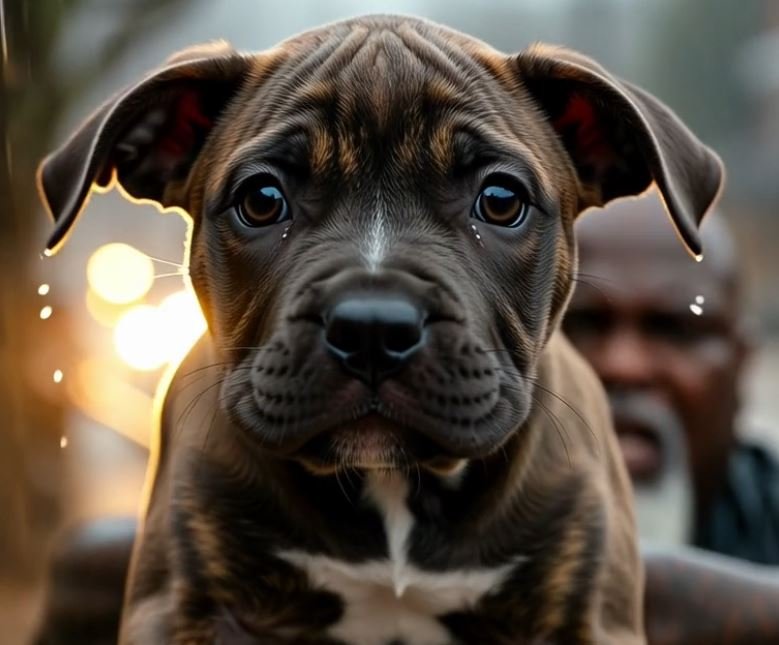
A puppy. Small. Brindle coat, maybe a pit mix, no more than four months old. The water was rushing past her, splashing over the roof, threatening to wash her off with every wave. She was soaked, trembling, her ears pinned flat against her head. Her eyes were fixed on us with a look I can only describe as the last light of a candle in a hurricane.
“Call 911,” I said.
“Already did,” Luis said. “They said twenty minutes minimum. Every road is flooded.”
I looked at the water. Twenty yards. In a current moving at twenty-five miles per hour. The water was chest-deep at the car, maybe deeper. One slip, and the current would have me. One mistake, and I would be another piece of debris.
“We have the tow rope,” Caleb said.
It was a hundred-foot braided tow strap, rated for ten thousand pounds. We carried it for motorcycle recovery, for pulling trucks out of mud, for the kind of situations that charity riders find themselves in more often than people think.
I looked at the puppy. She was slipping. Her back paws were losing grip on the wet metal. In another minute, maybe two, she would be in the water.
“Tie me off,” I said.
Bear grabbed my arm. “Preacher, that current’ll take you.”
“Then don’t let go of the rope,” I said.
They tied the tow strap around my waist, looped it around a massive oak tree on the shore, and six bikers — Bear, Luis, Caleb, Wrench, Darlene, and a local man who had stopped his truck — gripped the line with both hands. I walked into the water.
The first step was cold. The second was stronger. By the third, the current hit my thighs and I had to lean into it to stay upright. By the fifth, I was waist-deep and the water was pulling at my boots, trying to lift me off my feet.
I kept my eyes on the puppy. She saw me coming. Her head lifted. Her eyes met mine.
“Hold on, baby,” I said. “I’m coming.”
The water at the car was chest-deep and violent. The current slammed against my back, pushing me toward the submerged vehicle. I grabbed the roof rack with one hand and reached for the puppy with the other.
She didn’t come to me.
She was terrified. Human hands had put her on that car, or left her there, or abandoned her in the storm. Human hands were danger. She pressed herself against the far side of the roof, growling, her body shaking so hard I could see it from three feet away.
I didn’t grab her.
I reached into my vest pocket and pulled out a protein bar. I unwrapped it with one hand, fighting the current, and I broke off a piece. I held it out.
“Hey, little one,” I said. “You hungry?”
The smell cut through the rain. She looked at the bar. Then at me. Then at the water raging around her paws.
She let go of the roof rack and lunged into my arms.
I caught her and lifted her above my head. She was light, maybe fifteen pounds, but in that current, with one hand on the car and one holding her, she felt like everything.
“Pull!” I shouted.
The bikers on the shore heaved. The rope went taut. I pushed off the car and let the current carry me toward the rope’s angle, my boots dragging along the submerged pavement, my legs scraping against hidden debris. A branch hit my knee. Something metal scraped my shin. I didn’t care. I held the puppy above the water and I let them pull us in.
When we reached the shore, Bear grabbed my vest and dragged me onto the grass. I fell to my knees, still holding the puppy above my head, my arms shaking, my chest heaving. Luis took her from me. She was limp, hypothermic, her body temperature dangerously low. Darlene wrapped her in thermal blankets and began rubbing her limbs, stimulating circulation.
I sat in the mud and I watched. My hands were trembling. Not from cold. From the aftermath. From the knowledge that I had been one slip away from being swept under a car, under a building, under the brown water that didn’t care about my name or my vest or my intentions.
The puppy coughed. Then she whimpered. Then she opened her eyes and looked at me.
I named her Juniper. Because junipers grow in the Texas hills. Because they bend in floods and they don’t break.
Juniper stayed at a veterinary clinic in Kerrville for four days. I stayed in a motel nearby, visiting every morning and evening. She was malnourished, dehydrated, and had a respiratory infection from inhaling floodwater. But she was alive. That was the word the veterinarian kept using. Alive.
On the fifth day, I brought her home.
The drive back to Missouri was long. She rode in my jacket, her head poking out, watching the world with eyes that were no longer terrified. When we crossed the first river, she tensed. I felt her body go rigid against my chest.
“It’s okay,” I said. “You’re not in the flood anymore.”
She relaxed. Slowly. But she relaxed.
Juniper is two years old now. She is small for her age, the flood having stunted her growth slightly, but she is fierce. She plays with the other dogs in our crew — River, Ember, Haven, Grace — and she holds her own. She is fast, clever, and deeply attached to me in a way that makes the other bikers tease me mercilessly.
But rain still frightens her.
When the first drops fall, she finds me. She doesn’t hide. She just comes to me, presses her body against my leg, and waits. I have learned to read the weather for her. I know when a storm is coming before the meteorologists do, because Juniper tells me with her body, her breathing, her eyes.
I sit with her on the porch. I tell her about the flood. I tell her about the car, the current, the rope. I tell her that the water tried to take her, but six bikers and a tow strap said no. I tell her that she is safe. That she is home. That the rain is just rain now.
Sometimes she believes me. Sometimes she just leans harder against my leg.
Both are victories.
The oak tree we tied the rope to is still standing. I went back a year later, on another supply run, and I stopped at that intersection. The water was gone. The cars had been towed. The road was dry. But I could still see the rope marks on the tree trunk, faint grooves in the bark where ten thousand pounds of braided nylon had held me against the current.
I touched the bark. I thought about the puppy on the roof. I thought about the water. I thought about the hands that held the rope.
Then I got back on my bike, and I rode home to Juniper, who was waiting on the porch, watching the sky for clouds.