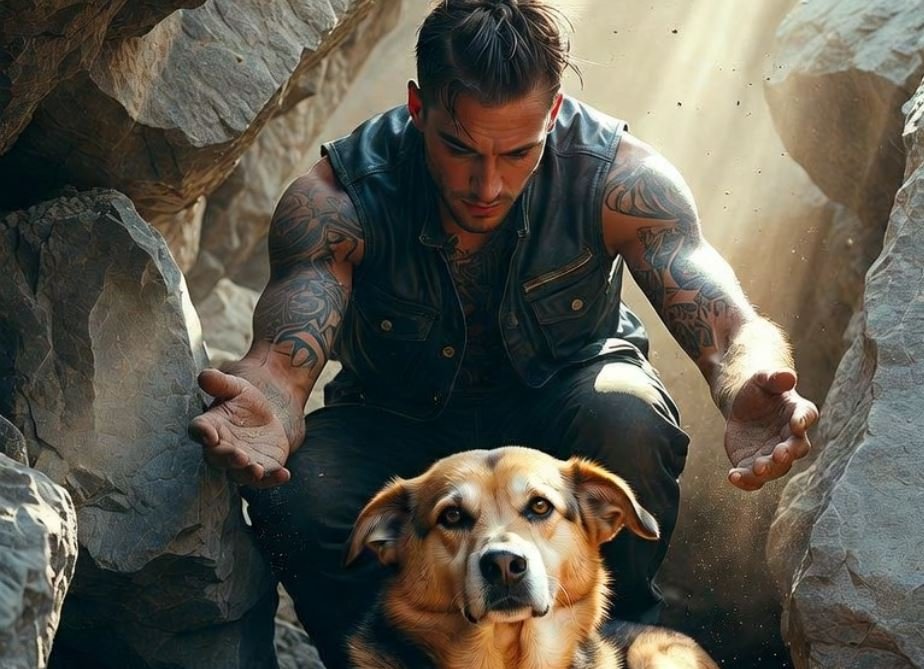
My name is Caleb Dunn, and I am twenty-nine years old. I have moved earth before. I have dug trenches in the desert, cleared roads in the mountains, and pushed my body past what it was supposed to do. But I have never dug with my bare hands for two hours until the afternoon of September 18th, when a senior German shepherd mix taught me that some things are worth moving mountains for.
The Iron Mercy Riders were crossing a mountain pass in Montana. The road was narrow, winding, carved into the side of a cliff that dropped five hundred feet to a river gorge. The views were stunning — granite peaks, pine forests, a sky so blue it hurt to look at. And then we rounded a bend and found the rockslide.
It had come down in the night. A section of the cliff face, maybe forty feet wide, had sheared off and buried the road in boulders the size of cars. We stopped. We were not engineers. We were not road crews. But we were there, and the road was blocked, and somewhere in the pile, something was crying.
I heard it first. A whimper. Faint. Muffled by stone.
“That’s a dog,” I said.
We dismounted. The pile was massive. Boulders, gravel, dust, the raw violence of gravity. We could not see the dog. We could only hear it, somewhere in the center, behind rocks that weighed more than our bikes.
“We need a winch,” Bear said.
We had one. A heavy-duty tow winch, mounted on Bear’s bike, rated for pulling trucks out of mud. We hooked it to the largest boulder, a gray monolith that had to weigh two tons, and we engaged the motor. The winch whined. The cable went taut. The boulder groaned, shifted, and rolled.
We dug. With our hands, with pry bars, with our boots. We moved rocks that scraped our palms and bruised our fingers. We worked for two hours, the sun moving across the sky, the air thin and cold, the whimper coming and going as the dog tired.
Then I saw her.
A gap, maybe two feet wide, between two boulders. Inside, lying on a bed of dust and gravel, was a dog.
A German shepherd mix. Senior. Maybe ten years old. Her fur was gray around the muzzle, her body thin, her eyes tired. She was lying on her side, her head up, watching us. And beneath her chest, visible in the dust, was a shape.
Red. Faded. Worn.
A bandana.
I reached through the gap. She growled. Not a threat. A warning. She was protecting something. In the middle of a rockslide, trapped for fourteen hours, starving and dehydrated, she was protecting a piece of red cloth.
“Hey, baby,” I whispered. “Hey, brave girl. I’m here to help.”
She looked at me. Her eyes were amber. Tired. Defiant. She had been waiting for someone to come, and now someone had come, and she was not sure if she could trust him.
I reached for the bandana. She growled again, softer this time. I did not pull it away. I lifted it gently, carefully, and I tied it around her neck. I let her keep it. I let her know that I was not taking the only thing she had left.
Then I reached under her chest and I lifted her.
She was light. Too light. Maybe forty pounds, when a shepherd her size should have been sixty. She had been on the mountain for days, not just hours. She had been with her owner. The bandana was his. She had stayed with him when the rocks fell, and she had stayed with the bandana when he was gone.
I carried her out of the gap. The other bikers made a path. I laid her on the road, on a thermal blanket, and Darlene checked her. Dehydration. Malnutrition. Exhaustion. But alive. Miraculously alive.
I held her and I cried. I am not ashamed. I cried because she was old, and she was tired, and she had still found the strength to guard a piece of cloth because it smelled like someone she loved.
I named her Remy. Because she was a reminder. A reminder that loyalty does not end when the body fails. A reminder that love is not a feeling. It is a decision you make every day, even when the mountain falls on you.
Remy came home with me. She was afraid of loud noises. Of course she was. The rockslide had been loud. The world had screamed and then fallen on her. She would flinch at thunder. She would hide under the bed when trucks passed. She would not go near gravel or construction sites.
So I made the world quiet for her. I moved to a house on the edge of town, away from the highway. I walked her on soft paths. I played gentle music. I did not raise my voice.
But I also knew she needed to reclaim the mountain.
Six months after the rescue, I took her to a hill near my house. The sun was setting. The air was cool. I sat on the grass, and I placed her beside me. She tensed. The ground was stone. The ground was danger.
I lay down. I placed the bandana on the grass between us. She looked at it. She sniffed it. She lay down beside it, her head on her paws, and she watched the sunset.
That was enough.
Remy is eleven now. She is gray and slow, with eyes that see less than they used to. She rides with me on every charity run, in a padded carrier, her head out, the wind ruffling her fur. She loves the road. She loves the open air. She loves the world from the safety of my bike.
But she still carries the bandana. It hangs from her collar, faded and worn, a piece of red cloth that smells like a man she will not forget. When she sleeps, she dreams of him. I can see it in her paws, twitching, running. She is young in her dreams. She is on the mountain. She is with him.
Some people see a senior dog and they see the end. They see arthritis and gray fur and the slow walk toward goodbye. They see an animal that has already lived its life.
But I see something else. I see a dog who guarded a memory for fourteen hours under three tons of stone. I see a dog who would not leave a piece of cloth because it was all she had left of a man who loved her. I see a dog who taught me that the end of a story is not the end of the love.
And that’s enough.