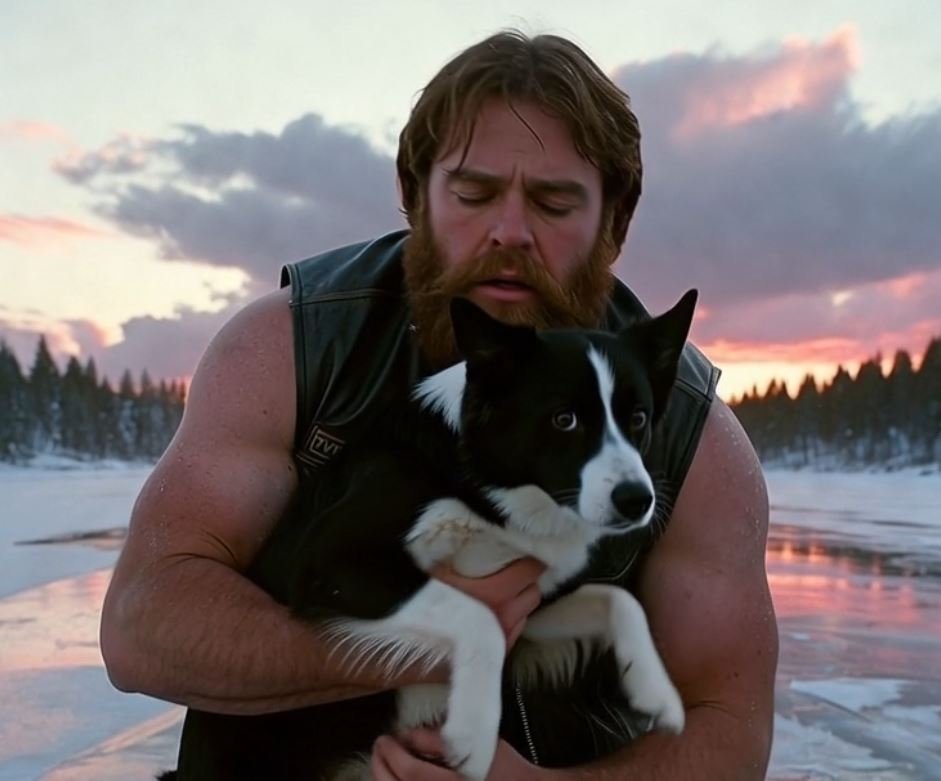
My name is Mason “Bear” Callahan, and I have been cold before. I have ridden through blizzards that turned the world white and made the road disappear. I have felt my fingers go numb on the grips and my face burn from the wind. But I have never been as cold as I was on the evening of February 20th, lying on my stomach on a frozen lake in Minnesota, crawling across ice that cracked beneath my weight toward a dog who was floating away on a piece of ice no bigger than a door.
The Iron Mercy Riders were on a winter charity run. We had delivered blankets, heaters, and food to a shelter in Excelsior, and we were riding the perimeter of Lake Minnetonka at sunset, looking for a place to stop and watch the light fade. Six bikes. Six people wrapped in layers that made us look like bears. The temperature was twelve degrees. The wind was light, but the cold was deep, the kind that settles into your bones and stays.
Eddie was riding point. He saw her first.
A black-and-white shape. Small. Still. On the ice.
“That’s not a buoy,” he said.
We stopped on the shore. From the bank, we could see her clearly. A border collie mix. Maybe twenty-five pounds. She was sitting on a piece of ice that had separated from the main sheet, surrounded by dark water on all sides. The ice around her was thin, cracking, breaking into smaller pieces as the current moved beneath. She was trembling. Her fur was wet, frozen into spikes. Her eyes were fixed on the shore, on us, on the only things that might save her.
“How did she get out there?” Caleb asked.
“Chased something,” Luis said. “A bird. A deer. Now she’s stuck.”
“How do we get her?” Darlene asked.
I looked at the ice. It was thin. Two inches, maybe less. The main sheet was solid enough for us to stand on the shore, but the area around the dog was broken, shifting, alive with the movement of the water beneath. One wrong step, and the ice would give. One wrong move, and I would be in the water with her.
“The fire department is twenty-five minutes out,” Luis said. He had called 911. “They said don’t go out there. The ice is too thin.”
I looked at the dog. She was shivering. Not just from cold. From fear. She was alone on a piece of ice in the middle of a lake, watching the shore drift away, watching the world become smaller and colder and more distant with every second.
I took off my vest. My leather would be heavy if I went in. I took off my boots. I would need to feel the ice. I lay down on my stomach on the frozen shore and I pushed myself forward.
“Bear,” Eddie said. “The ice—”
“I know,” I said.
I crawled.
The ice was cold against my chest, my stomach, my arms. It groaned beneath me, a deep, ancient sound that made my stomach clench. I kept my weight distributed, my body flat, my movements slow. I had grown up near lakes. I knew how ice worked. I knew that standing was death. But crawling, spreading your weight, giving the ice time to hold, that was the way.
I crawled ten feet. Twenty. The ice cracked beneath me, a sharp, snapping sound that echoed across the lake. I stopped. I waited. The crack spread, then stopped. I crawled again.
The dog watched me. She was thirty feet away, then twenty, then fifteen. Her eyes were wide, fixed on me, her body pressed low to the ice. She was too scared to move. The floe was drifting, slowly, carried by the current beneath. Every minute brought her further from safety.
“Come on, baby,” I whispered. “Stay with me.”
I reached the edge of the broken ice. There was a gap, three feet of black water between me and her floe. The ice around the gap was thin, translucent, bending beneath my weight. I could see the water beneath, dark and cold and waiting.
I lay flat. I reached out my right hand. Then my left. I stretched across the gap, my fingers reaching for the edge of her floe. She watched me. She trembled. She whined, a high, desperate sound that carried across the ice.
“Come here,” I whispered. “Come to me, baby.”
She didn’t move. She was frozen in terror, her paws gripping the ice, her body pressed low. She had been there for hours. The cold had sapped her strength. The fear had frozen her courage.
I reached further. My fingers touched the edge of her floe. It was cold. Wet. Slippery. I gripped it and I pulled myself closer, my chest sliding over the thin ice, my body bridging the gap. The ice beneath me cracked, a long, sharp sound that made my heart stop. I held still. I breathed. The crack stopped.
I reached my hand toward her.
She looked at my hand. She looked at the water. She looked at me.
“Come on,” I said. “Take my hand.”
She lifted one paw. She placed it in my palm. Her paw was cold, wet, trembling. I closed my fingers around it. I pulled, gently, slowly, and she came toward me, sliding across the ice, her body low, her eyes wide.
I got my arm around her chest. I pulled her against me. I rolled backward, away from the gap, onto the thicker ice, and I held her against my chest. She was wet, frozen, her body shaking so hard I could feel it in my own bones. I wrapped my arms around her and I crawled backward, toward the shore, my body shielding her from the wind.
The floe she had been on broke apart. It cracked, split, and the pieces drifted into the dark water. I watched it go. I held her tighter. We had been seconds away. Seconds.
When we reached the shore, Eddie pulled me onto the bank. Darlene wrapped the dog in thermal blankets. Luis handed me a flask of coffee that burned my throat. I sat in the snow, holding the dog, my clothes wet and freezing, my body shaking, and I cried.
I named her Frost. Because she survived the ice. Because she was cold, but she was alive.
Frost stayed at a veterinary clinic in Excelsior for two days. I stayed with her. I slept on the floor beside her kennel. The staff brought me dry clothes and hot coffee. Eddie brought me a new vest. Luis brought me a heated blanket.
Dr. Karen Whitcomb, who happened to be consulting at the clinic, examined Frost. Hypothermia. Dehydration. Frostnip on her paw pads. But alive. Miraculously alive.
“She shouldn’t have survived,” Dr. Whitcomb said. “The water was thirty-eight degrees. Another twenty minutes, and her body would have shut down.”
“She held on,” I said.
“She held on because she saw you coming,” Dr. Whitcomb said.
Frost came home with me. She rode in my sidecar, wrapped in six blankets, her head on my lap. She slept the entire way, her body finally warm, her breathing finally slow.
The first month was hard. Frost was afraid of ice. Of course she was. She would not walk on the kitchen floor if it was cold. She would not go outside if there was frost on the grass. She would not look at the lake when we passed it.
So I made the world warm for her. Heated blankets in every room. Boots for her paws when we walked. No ice. No snow. No frozen lakes.
But I also knew she needed to reclaim the cold.
In March, when the thaw came, I took her to a small pond near my house. The ice was gone. The water was still cold, but not freezing. I sat on the bank and I let her choose.
She walked to the edge. She sniffed the water. She looked at me.
“It’s okay,” I said. “You’re not on the ice anymore.”
She touched the water with one paw. Then she stepped back. Then she did it again. Then, slowly, she waded in up to her ankles.
She didn’t swim. She didn’t play. She just stood there, feeling the water around her legs, and she looked at me, and her tail moved.
That was enough.
Frost is three years old now. She is black and white, with eyes that reflect the winter sky. She loves the summer. She swims in the pond every day from June to September. She chases frogs. She lies in the sun until her fur is hot to the touch.
But winter is still hard. When the first frost comes, she hesitates at the door. I kneel beside her, my arms around her, and I say the same words.
“The ice is gone, Frost. You’re safe.”
And she walks out. Carefully. Slowly. But she walks out.
Some people see a biker lying on a frozen lake and they see a fool. They see a man who risked his life for a dog. They see someone who should have waited for the fire department.
But Frost sees something else. She sees the man who crawled across cracking ice to reach her. She sees the hand that she placed her paw in. She sees the arms that held her on the shore while the world went dark.
And that’s enough.