My name is Caleb Dunn, and I am twenty-nine years old. I have ridden on interstates that stretch across the desert like ribbons of gray steel. I have felt the wind push against my chest at eighty miles per hour. I have passed trucks that block the sun and make the air shake. But I have never been as scared as I was on the afternoon of March 8th, kneeling on the median of Interstate 40 in New Mexico, holding my arms open to a dog the size of a football while semis roared past us at seventy-five miles per hour.
The Iron Mercy Riders were crossing New Mexico on our way to a veterans’ outreach event in Flagstaff, Arizona. Six bikes. Six people looking for the next horizon. The highway was wide, straight, and fast. The desert rolled away on both sides, red and gold and empty. The sky was blue and endless.
Caleb was riding point. He saw her first.
A white shape. Small. Trembling. In the grass median that divided the eastbound and westbound lanes.
“Dog,” he said over the comm. His voice was sharp. “Median. Moving.”
We slowed. We pulled onto the shoulder. From the side of the road, we could see her clearly. A terrier mix. White and tan. Maybe eight pounds. She was huddled in the grass, pressed low to the ground, her ears pinned back, her eyes wide with terror. Every time a truck passed, the wind blast flattened her fur and made her body shake.
“How long?” Eddie asked.
A truck driver had pulled onto the shoulder ahead of us. He walked over, a heavyset man in a denim shirt and a baseball cap.
“Three hours,” he said. “I called animal control. They said forty-five minutes. I been watching her. She tried to cross once. Almost got hit by a Camry. She’s too scared to move.”
I looked at the dog. She looked at me. Her eyes were brown. Terrified. Exhausted. She had been sitting in the middle of a highway for three hours, watching death fly past her in both directions, too scared to run, too tired to fight.
“We can’t wait,” I said.
“How do we get her?” Luis asked. “If we walk out there, we become targets too.”
I looked at the bikes. I looked at the highway. I looked at the dog.
“We make a wall,” I said.
We mounted up. Six bikes. We rode onto the highway, single file, and we pulled across the two eastbound lanes. We parked in a diagonal line, front wheels turned, engines running, headlights on, forming a wall of chrome and steel that spanned the width of the road. We turned on our hazard lights. We waved our arms.
The traffic slowed. A semi honked. A sedan swerved. But the wall held. The bikes were big, loud, impossible to ignore. Drivers stopped. They waited. They watched.
I ran to the median.
The dog saw me coming. She flattened to the ground. Her body was pressed into the grass, her tail tucked, her eyes fixed on me. I was a stranger. A giant in leather, running toward her, with monsters of steel roaring behind me. She had every reason to run.
But there was nowhere to run.
I slowed. I stopped ten feet from her. I knelt. I put my arms out.
“Hey, baby,” I said. “Hey, little one. Come here.”
She didn’t move.
A truck passed on the other side of the median, the wind blast hitting us both. She flinched. Her eyes squeezed shut. Her body shook.
“I know,” I said. “I know it’s loud. But you’re safe. Come here.”
I stayed still. I didn’t move. I let her look at me. I let her decide. The sun was warm on my back. The asphalt was hot beneath my knees. The traffic was a river of noise on both sides. But in the space between us, there was silence.
She took one step.
Then another.
Then she ran.
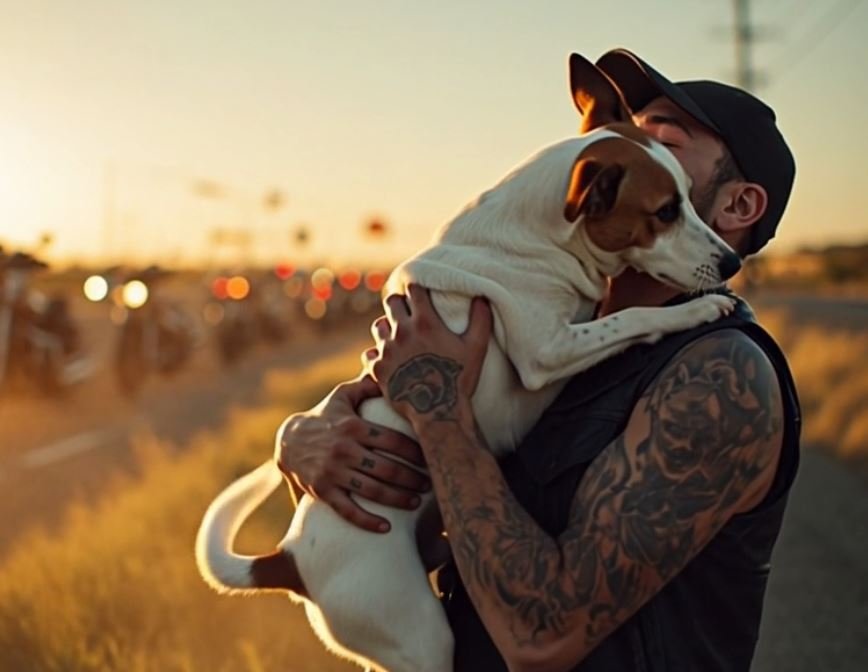
She crossed the last five feet in a blur of white and tan, and she leaped into my arms. I caught her. She was light, trembling, her heart hammering against my palm. I pulled her against my chest and I stood up. I turned my back to the traffic and I walked to the bikes, shielding her with my body.
The truck driver who had been watching stepped forward. He had tears in his eyes.
“Three hours,” he said. “I watched her for three hours. Thank you.”
I handed the dog to Darlene, who had climbed off her bike and was waiting with a thermal blanket. She wrapped the dog, held her, checked her heart rate. The dog was dehydrated, stressed, and had minor abrasions on her paws from the grass and gravel. But she was alive.
We opened a lane. The traffic moved. Drivers waved. Some honked, not in anger, but in support. One woman in a minivan rolled down her window and shouted, “You guys are heroes!” We didn’t feel like heroes. We felt like men who had done what any decent person should do.
I named her Dash. Because she dashed across the median into my arms. And because she taught me that sometimes the bravest thing is to run toward safety.
Dash came home with me that day. She rode in a carrier on my handlebars, wrapped in a blanket, her head resting against the mesh. She slept most of the way, her body finally relaxing, her breathing slowing. When we stopped for gas, she woke up and looked at me with eyes that were no longer terrified. Just tired. Just grateful.
The first month was hard. Dash was afraid of cars. Not motorcycles — she loved the bike, the vibration, the wind. But cars. The sound of engines, the blur of metal, the speed. She would tremble when a car passed us on the road. She would hide behind my legs when a truck pulled up beside us at a light.
So I stopped driving with her in cars. We rode everywhere. To the store. To the park. To the vet. She learned that the road could mean wind and freedom, not noise and danger.
The second month, she began to trust. She would walk on sidewalks beside me, her tail up, her ears forward. She would sit on the porch and watch cars pass without trembling. She would sleep through the night without waking at every engine sound.
The third month, she reclaimed the highway. We rode back across Interstate 40, heading east. She sat in her carrier, her head out, her ears flapping in the wind. She looked at the semis, the cars, the endless road, and she did not flinch. She looked at me, and her tail moved.
That was enough.
Dash is three years old now. She is small and fierce, with a white coat and tan patches that look like someone spilled coffee on her. She rides with me on every charity run, in her carrier, her head out, watching the world. She loves the highway. She loves the wind. She loves the open road.
But she still hates medians. If we stop on a divided highway, she presses against my leg. She looks at the grass strip between the lanes, and she remembers. I kneel beside her. I tell her about the wall of bikes. I tell her about the truck driver who cried. I tell her that she is safe. That she is home. That the road leads to good places now.
Some people see six bikers blocking a highway and they see a nuisance. They see a traffic jam. They see men who think they own the road.
But Dash sees something else. She sees the wall of chrome that stopped the world for her. She sees the man who knelt in the dirt and held his arms open. She sees the wind on the motorcycle, the open road, the sky.
And that’s enough.