My name is Eddie “Preacher” Boone, and I have been the road captain of the Iron Mercy Riders for eleven years. I am fifty-nine years old, six-foot-four, bald, with a silver goatee and tattoos that run from my wrists to my shoulders. I have ridden through hurricanes, blizzards, and dust storms that turned the sky red. I have never been as cold as I was on the night of January 17th.
We were returning from a supply run to a veterans’ shelter in Joplin, Missouri. Six bikes stretched across I-44, our headlights cutting through the snow that had been falling since noon. The temperature had dropped to seven degrees. The wind, funneled by the highway cuts, was gusting to forty miles per hour. Our leather was frozen stiff. Our faces were numb. All any of us wanted was a warm garage, a hot shower, and sleep.
Then my headlight caught the overpass.
It was a concrete structure, old, stained with road salt and diesel exhaust, the kind of place where people throw trash and hope nobody looks too closely. But something moved. A shape, dark against the gray concrete, huddled in the corner where the pillar met the embankment.
“Hold up,” I said into my helmet comm.
We pulled onto the shoulder. The snow was already drifting, and the wind hit us like a physical force when we stopped moving. I killed my engine and swung off my bike, my boots crunching on frozen gravel.
“Eddie,” Tank said. “What is it?”
“I don’t know.”
I walked toward the overpass, my flashlight in hand. The beam cut through the snow and found her.
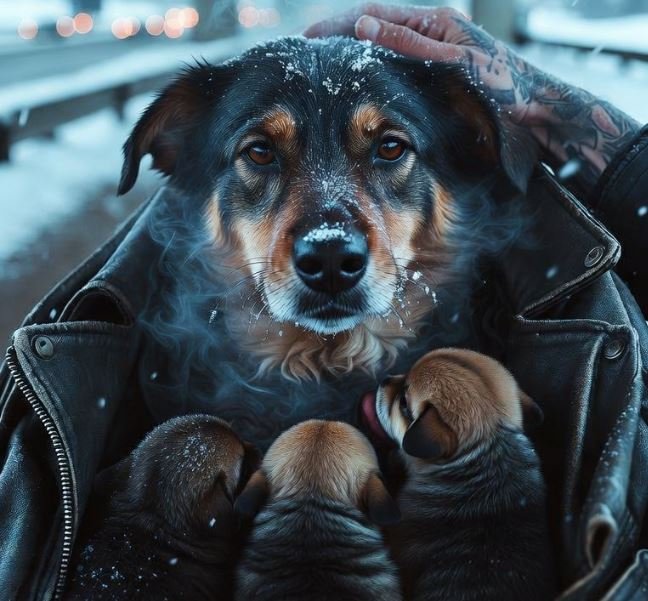
A German shepherd mix. Black and tan, her fur matted with ice and road grime. She was pressed against the concrete, her body curled into a tight ball, and beneath her belly, I could see movement. Tiny shapes. Puppies. Three of them, maybe four, pressed against her stomach, trying to nurse.
She looked up at me.
Her eyes were amber. Exhausted. Terrified. But not empty. There was still something in them. A refusal. A mother’s refusal to let the cold win.
I knelt in the snow. The wind was howling under the overpass, creating a tunnel of freezing air that cut through my vest like it wasn’t there. I could see the dog’s body shaking. Not from fear. From cold. Her muscles were spasming, trying to generate heat that the wind was stealing faster than she could make it.
“She’s got puppies,” I called back.
The other bikers were already moving. Tank was pulling his emergency kit from his saddlebag. Luis was on the phone, trying to get a signal to call animal control. Darlene was running toward us with a thermal blanket from her bike. Caleb and Wrench were positioning the motorcycles to block the wind, creating a rough wall of chrome and steel against the gale.
I looked at the dog. She looked at me. And then she did something that broke my heart.
She licked one of her puppies. A tiny black pup, no bigger than my hand, squirming against her belly. She licked it, cleaning it, warming it, even as her own body shook so hard I could hear her teeth chattering.
“Hey, mama,” I whispered. “Hey, brave girl.”
I reached out slowly. She didn’t growl. She didn’t flinch. She just watched me with those exhausted eyes, and I understood. She had no energy left for fear. She had given everything to keeping her puppies alive.
My hand touched her head. She was ice cold. The fur was frozen in places, stiff and sharp. But beneath it, I could feel her skull, her bones, the thinness of a dog who had been starving while feeding three lives.
“She’s hypothermic,” Darlene said, kneeling beside me. “We need to get them warm now.”
I didn’t think. I reached down and unzipped my leather vest. Then I pulled it off, feeling the wind hit my chest like a knife. I laid the vest on the ground beside her, then I lifted the first puppy. It was cold. So cold. I placed it on the vest, wrapped in the warm leather. Then the second. Then the third.
The mother dog watched me take her babies. She didn’t try to stop me. She just watched, her body still shaking, her eyes following every movement.
Then I lifted her.
She was lighter than she should have been. Maybe forty pounds, when a shepherd her size should have been sixty. I placed her on the vest, wrapped the leather around her and the puppies, and then I took off my flannel shirt — the one I wore under my vest — and I wrapped that around them too.
I sat in the snow, in seven-degree weather, in a t-shirt, with a dog and three puppies in my lap, and I held them.
Tank knelt beside me and wrapped his own vest around my shoulders. “You’re gonna freeze, Preacher.”
“I’m already frozen,” I said. “But they’re not gonna die.”
We sat there for twenty minutes. The bikers formed a circle around us, blocking the wind with their bodies. Darlene checked the puppies’ breathing, their heartbeats, their temperatures. Luis finally got a signal and called 911, then animal control, then every vet clinic within fifty miles. Caleb ran to his bike and came back with hand warmers, which he tucked into the flannel around the puppies.
The mother dog — we later named her Haven, because that was what she had tried to make under that bridge — slowly stopped shaking. Her body absorbed the warmth of my shirt, my vest, my own skin. She lifted her head and looked at me, and then she did something I will never forget.
She licked my hand. Once. Twice. Then she rested her head on my arm and closed her eyes.
“She’s trusting us,” Darlene whispered.
“She didn’t have a choice,” I said.
“Yes, she did,” Darlene said. “She could have fought. She didn’t. She chose to trust.”
The animal rescue van arrived forty minutes later. By then, my hands were numb. My lips were blue. Tank had made me drink coffee from his thermos, and Wrench had rubbed my shoulders to keep blood moving. But I wouldn’t let go of Haven. I wouldn’t let anyone take her until I knew the puppies were safe.
Marisol Grant, the same animal control officer who had helped with River two years before, took one look at the scene and said, “You sat in a snowstorm without a shirt for a dog?”
“For four dogs,” I said.
She nodded. “Let’s get them to the clinic.”
We rode in the van with her. Haven and her puppies on a heated blanket in the back, me beside them, still wrapped in Tank’s vest, my hands on Haven’s head. The puppies — we named them Scout, Ranger, and Trooper — were warming up, their tiny bodies pinking, their eyes opening for the first time to look at a world that had almost killed them.
At Ozark Valley Veterinary Clinic, Dr. Whitcomb worked for three hours. Haven was severely malnourished, hypothermic, and had frostbite on three of her paw pads. The puppies were underweight but otherwise healthy, protected by their mother’s body heat in a way that had nearly cost Haven her life.
“She gave them everything she had,” Dr. Whitcomb said. “Another hour, and she would have been gone. The puppies would have followed within minutes.”
I stayed at the clinic for two days. I slept on the floor beside Haven’s kennel. The other bikers rotated shifts, bringing food, coffee, and clean clothes. Eddie — that’s me — refused to leave until Haven ate on her own.
On the third day, she did. She stood up, walked to the bowl, and drank. Then she ate. Then she looked at me, and her tail moved. Just once. A small thump against the kennel floor.
I started crying. I am a big man. I have been shot at. I have been stabbed. I have buried friends. But I sat on a veterinary clinic floor and cried because a dog’s tail moved.
We adopted Haven and her puppies as a group. The Iron Mercy Riders became a family of nine instead of six. Scout went to Caleb, who built her a ramp and a heated bed and treats her like a princess. Ranger went to Wrench, who claims he doesn’t like small dogs but carries Ranger in his jacket on every ride. Trooper went to Luis, who says Trooper is the only creature who understands his Spanish curses.
Haven stayed with me.
She is three years old now. Her fur is thick and black and shines in the sun. Her paws healed, though she still limps slightly when it is very cold, a reminder of the concrete and the snow. She sleeps on a heated bed beside my fireplace, and when the wind blows hard against the house, she does not tremble. She looks at the fire, then at me, and she knows she is home.
The puppies are grown now. Scout is a therapy dog at the veterans’ shelter we used to supply. Ranger rides in Wrench’s sidecar and barks at every squirrel in Missouri. Trooper learned to swim in Luis’s backyard pool and jumps in every chance he gets.
And Haven? Haven watches the road. Every morning, she sits on my porch and looks at the highway in the distance. I don’t know what she sees. Maybe the overpass. Maybe the snow. Maybe the six motorcycles that stopped when everything else kept driving.
But when I come home from a ride, she doesn’t just wag. She runs. She runs to me like I am the only thing in the world that matters, and I kneel down and I hold her, and I remember the snow and the cold and the weight of a dog who refused to let her babies die.
Some people see a biker and they see leather and noise and danger.
They don’t see the man who sat in a snowstorm without a shirt so four dogs could live.
But Haven sees it.
And that’s enough.