Maya was six months pregnant and living out of her 2004 Honda Civic. She had lost her job, her apartment, and her boyfriend in the span of three weeks. The only thing she had left was a worn-out winter coat she’d picked up from a church donation bin—just thick enough to keep her warm through the freezing Chicago nights.
One freezing morning, she reached into the coat’s inner pocket. Her fingers brushed against a folded piece of paper. She pulled it out—a faded Polaroid photo. A young man in a denim jacket, arm around a laughing woman. On the back, handwritten in blue ink: “Maya’s parents. 1998. Never forget.”
Maya’s hands started shaking. That was her mother. And that man—her father—had died in a car accident when she was two years old. Or so her mother had always told her.
But there was more. Beneath the photo, scribbled in tiny letters, was a phone number. An area code she didn’t recognize.
She found a payphone at the bus terminal. She dialed with trembling fingers.
A gruff male voice answered: “Hello?”
Maya froze. She couldn’t speak.
“Hello? Who is this?”
She whispered: “I found your photo. In a coat. Who are you?”
Silence. Then, a shaky breath. “That coat… it was my wife’s. She passed away last year. I donated her clothes. Who are you?”
Maya’s voice cracked. “My name is Maya. My mother was Elena.”
A choked sob echoed through the receiver. “Elena? She told me you were adopted. She said she had a miscarriage. She took you away from me. I’ve been looking for you for 24 years!”
Maya dropped the phone. The world spun. She wasn’t abandoned by a dead father—she was stolen from a living one.
She asked him to meet her at the same bus terminal. The place where her mother had supposedly fled with her as a baby.
The next day, Maya stood in the middle of the crowded Greyhound station, her pregnant belly rounded under her cheap sweater. She held the Polaroid like a lifeline.
The doors opened. A man in his 50s, with graying hair and tired eyes, walked in. He scanned the crowd. Their eyes met.
He walked toward her—slowly, as if afraid she was a ghost. Commuters parted around him like water around a stone. Maya’s knees buckled. A stranger caught her arm, steadying her.
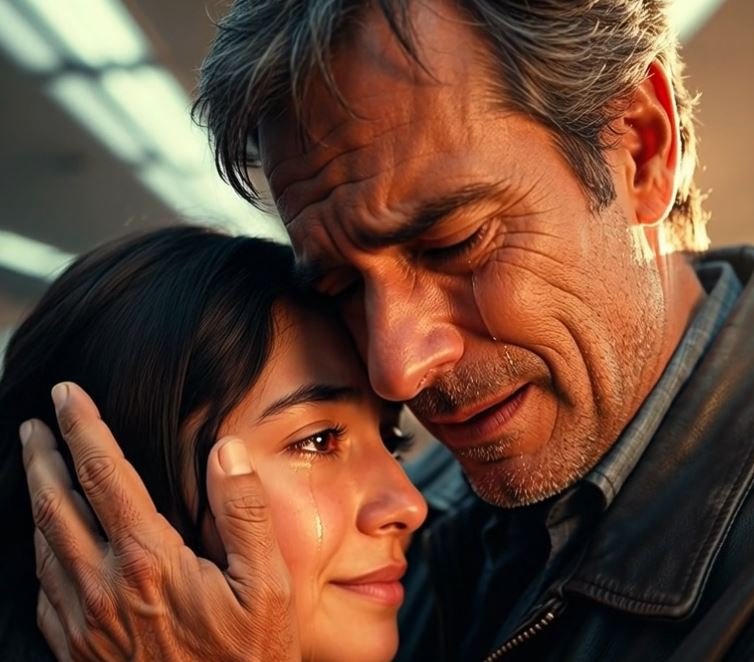
The man stopped three feet away. Tears rolled down his weather-beaten face. “You have her eyes,” he whispered. “You have your mother’s eyes.”
Maya tried to speak but only a raw cry came out. She shoved the photograph into his chest. “You’re real. You’re actually real.”
“I’m real, baby girl. I never stopped looking.”
He wrapped his arms around her and her unborn child. The bus terminal, usually a place of cold indifference, melted. Passengers stopped running for their buses. A janitor put down his mop. A teenage girl started recording. One by one, strangers began to applaud and cry.
A homeless man in the corner shouted: “That’s real love right there!”
Through her sobs, Maya asked the question that burned in her chest: “Why did she lie?”
Her father pulled back, cupped her face, and said: “Because I was in prison. I did ten years for a robbery I didn’t commit. She was ashamed. She wanted to protect you from the truth. But I’m out now. I’m clean. I have a house. I have a room for you and my grandchild.”
Maya collapsed into his chest. The crowd erupted into thunderous applause. A bus driver handed her a bottle of water. A grandmother offered her a tissue.
That was six months ago. Today, Maya’s daughter is three weeks old. Her father rocks her to sleep every night in the room he painted pink before she was born. The Polaroid sits framed on the nightstand—proof that some stories don’t end in tragedy. Some just take 24 years to find their way home.