Jake stayed for three days.
Not because he planned to. Because his bike wouldn’t start — the cold, the particular vulnerability of a machine that isn’t designed for South Dakota January. Because the McAllisters wouldn’t let him leave — the particular hospitality of rural America that feeds you, houses you, refuses your money with the particular ferocity of people who measure worth in actions, not dollars.
Because of the puppies.
Not just Daisy. The six — three male, three female, gray and white like their mother, with the particular markings that would make them beautiful, that would make them desirable, that would make them easy to give away when the time came.
Jake held them.
Not immediately. Not without hesitation. The particular reluctance of a man who has learned not to attach, not to love, not to want things that he cannot keep. But they were warm. And small. And alive in a way that felt — after the night in the ditch, after Afghanistan, after the particular numbness of his life — like something he needed.
He named them.
Not all. Just one. The runt. The smallest, weakest, the particular puppy that Jean said might not make it, that needed bottle feeding, that required the particular attention that mother dogs sometimes deny to the weakest of their litter.
He named her Thaw.
Because she was. Because the night in the ditch had been frozen, and she had been frozen, and somehow — through fire, through presence, through the particular stubbornness of creatures who refuse to die — they had both thawed.
Jean let him keep her.
Not as payment. Not as gift. As recognition. The particular understanding that some bonds are formed in extremity, that some rescues go both ways, that the man who had saved Daisy and her puppies had also been saved by them — from the cold, from the road, from the particular emptiness that had led him to South Dakota in January on a motorcycle.
Jake rebuilt his bike.
In the McAllisters’ barn. With Earl’s tools. With the particular patience of a man who has learned that machines, like people, sometimes need to be taken apart and put back together before they can run again.
He installed a sidecar.
Not planned. Not necessary. But Earl had one — rusted, from a Harley that had died in the 90s, the particular detritus of rural life that accumulates in barns and sheds and becomes useful when you least expect it.
Jake fitted it for Thaw.
Padded with blankets. Shielded from wind. The particular luxury of a dog who had been born in a ditch and would now ride in a sidecar, nose to the wind, watching the world go by at 70 mph.
He left on the fourth day.
Not early. Not late. Just… when the bike was ready, when Thaw was weaned enough to travel, when the particular moment arrived that felt like departure instead of escape.
Jean hugged him.
Not thanked him — she had done that, repeatedly, with food and coffee and the particular tears that rural women shed when words fail them. She hugged him. The particular embrace of a mother who recognizes another mother’s grief, who sees in a stranger the particular loneliness that her own children might carry someday.
“Come back,” she said.
Not an invitation. A command. The particular imperative of people who have decided you belong to them, that you are part of their story, that the night in the ditch has made you family.
Jake nodded.
Not promised. Just acknowledged. The particular honesty of a man who has learned not to make promises he can’t keep, who has broken too many, who has been broken by too many.
He rode away.
Thaw in the sidecar. Nose to the wind. The particular posture of a dog who has never known this — speed, freedom, the particular joy of movement without fear. She barked once, at a passing truck, and Jake laughed — the particular laugh of a man who has forgotten how, who has been surprised by his own happiness.
He didn’t go home.
Not immediately. He rode — through Montana, through Wyoming, through the particular vastness of the American West that makes you feel small and large at the same time. Thaw grew. Stronger. Larger. The particular transformation of a runt who was not supposed to survive into a dog who thrived.
Jake posted videos.
Not for fame. For Jean. For the McAllisters. For the particular community that had formed around a night in a ditch, a fire built from a Harley manual, six puppies who should have died and didn’t.
The videos went viral.
Not because Jake tried. Because they were real. Because Thaw — in her sidecar, nose to wind, ears flapping — was the particular image of joy that the internet loves. Because Jake’s voice, in the background, saying “Good girl, Thaw. Good girl” was the particular sound of a man who had found something to love.
2 million followers.
Not Jake’s goal. Not his desire. Just… what happened. The particular machinery of social media that takes authentic moments and amplifies them, that turns a trucker and his dog into celebrities without their consent or their understanding.
He used the platform.
Not for himself. For rescue. For the particular organizations that had helped Daisy, that would help other dogs, that needed the particular visibility that viral fame provides. He posted about shelters. About fostering. About the particular choice to stop when you see steam rising from a ditch in South Dakota in January.
He went back.
Not once. Every year. On the anniversary of the night in the ditch. To the McAllisters’ farm. To Jean’s kitchen. To the particular warmth of people who had decided he was family.
Daisy was there.
Older. Gray-muzzled. Slow. But alive. The particular miracle of a dog who had survived the unsurvivable, who had kept six puppies alive through sheer will, who had taught a stranger that stopping was possible, that rescue went both ways, that love — the particular love between humans and dogs — was worth the risk.
She remembered him.
Not with excitement. With recognition. The particular greeting of a creature who has seen too much to be surprised by anything, who assesses you, finds you acceptable, and returns to her particular spot by the woodstove.
The puppies were grown.
Scattered — some with the McAllisters, some with neighbors, one with a family in Minnesota who had seen Jake’s videos and driven 600 miles to adopt. All alive. All thriving. All carrying in their DNA the particular resilience of a mother who had refused to let them die.
Thaw was 4 now.
Not a puppy. A dog. Strong. Confident. The particular transformation of a runt who had been bottle-fed in a barn into a creature who rode in a sidecar, who met strangers without fear, who had learned — from Jake, from the road, from the particular life they had built — that the world was not always cruel.
Jake still rode.
Not as a trucker — he had quit, finally, the particular job that had kept him moving but never going anywhere. He rode for rescue now. Transporting dogs. Bringing Thaw to shelters, to events, to the particular places where her story could convince someone to adopt, to foster, to stop when they saw steam rising from a ditch.
He was happy.
Not always. Not completely. The particular happiness of a man who has known loss and found something anyway, who carries grief and gratitude in the same heart, who has learned that joy doesn’t erase pain but exists alongside it.
On the fifth anniversary, he made a video.
Not for views. For Thaw. For Daisy. For the particular night that had changed everything.
He sat in the ditch.
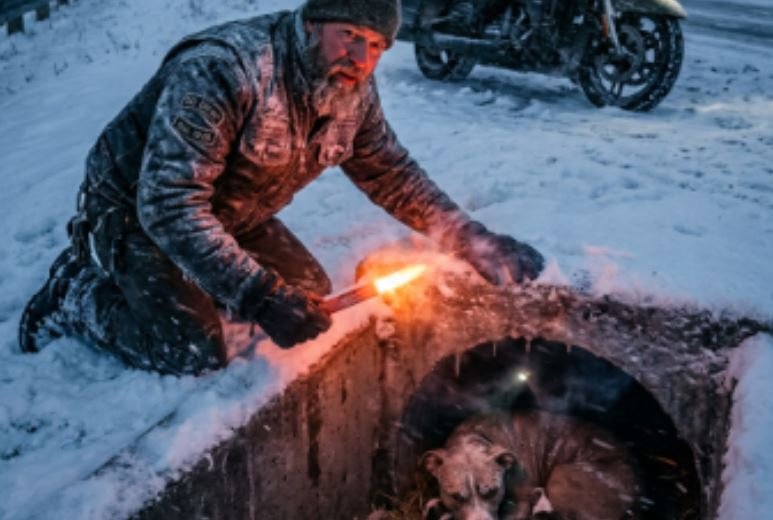
The same ditch. The culvert was still there — concrete, rusted, unchanged. The snow was falling — not a storm, just flakes, the particular gentleness of a South Dakota January that sometimes forgets to be cruel.
Thaw sat beside him.
In her sidecar — parked, engine off, the particular silence of a machine at rest. She watched him. Nose to the wind. The particular posture of a dog who has learned to read her person, who knows when he is remembering, when he needs presence without demand.
“I saw steam,” Jake said.
Not to Thaw. To the camera. To the particular audience that had formed around his story, that expected wisdom, that wanted the particular lesson that viral stories are supposed to provide.
“I almost didn’t stop. Almost kept going. Almost let the cold win, the way I had let everything else win — my marriage, my job, my particular will to live.”
He paused. Looked at Thaw. At the dog who had been a runt, who had been frozen, who had thawed.
“But I stopped. And I built a fire. And I burned my Harley manual page by page to keep a dog I didn’t know alive. And that dog — Daisy — kept six puppies alive. And one of those puppies —”
He touched Thaw’s head. She leaned into it. The particular pressure of a creature who has learned to trust, who has learned to love, who has learned that the world contains people who will stop.
“— became my reason to keep going.”
He stood. Brushed snow from his jeans. Looked at the culvert, at the ditch, at the particular landscape that had almost killed him and had instead saved him.
“Stop when you see steam,” he said.
Not wisdom. Just… advice. The particular offering of a man who had learned that the world is full of signs of life that we ignore, that we drive past, that we decide are not our problem.
“Stop. Build a fire. Burn what you need to burn. Stay all night if you have to.”
He climbed on his bike. Started the engine. Thaw settled into her sidecar, nose to the wind, ready for the particular joy of movement, of freedom, of a life that had been frozen and had thawed.
“The steam is always worth it,” Jake said.
And he rode away.
Not into the sunset. Into snow. Into the particular future that he had built, page by page, fire by fire, with a dog in a sidecar and a story that had become bigger than him, that had become about all of them — about Daisy, about Jean, about Earl, about the particular community that forms around rescue.
About stopping.
About steam.
About the particular warmth that exists in a frozen world, if you are willing to look for it, to build it, to stay with it until the dawn comes and the temperature rises and the thaw begins.