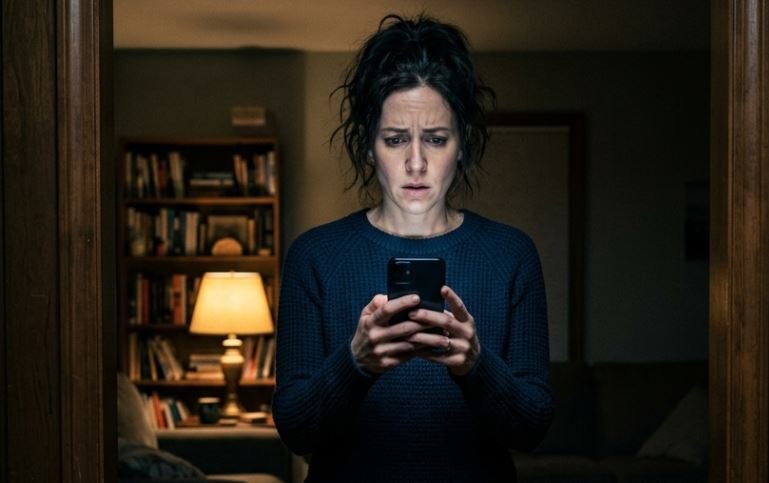
My phone started getting motion alerts from a camera I never installed. In my own living room.
The first alert came on a Tuesday afternoon, while I was at work. I almost dismissed it as some kind of glitch, a notification from an app I didn’t remember downloading, the kind of thing you swipe away without much thought. But the notification had a live thumbnail attached to it, a small, grainy preview image, and the image was unmistakably my living room — the same gray couch, the same bookshelf, the same rug my daughter’s stuffed rabbit was always getting lost under.
I stood in the break room at work staring at my phone for a full minute before I could make myself tap on it. The app was called SentryEye, something I’d genuinely never heard of, linked to a device ID I didn’t recognize, with a login history showing it had been active for exactly eleven days — eleven days of some camera, somewhere in my own house, quietly recording motion and sending alerts to what I could only assume was someone else’s phone, before some kind of account sync error had apparently started routing the notifications to mine as well.
I want to be honest about the next part, because I think it matters to the shape of this story: I didn’t call the police immediately. I know how that sounds. But my first instinct wasn’t fear of a stranger — it was something colder and more specific, a slow, uneasy suspicion that whoever had done this probably had a key to my house already, because there’d been no signs of forced entry, no disturbed locks, nothing out of place except, apparently, a hidden camera I couldn’t yet locate.
I spent that entire evening searching. I checked the smoke detectors, the bookshelf, the small decorative plants on the windowsill, anywhere a tiny lens might hide. I found nothing, and the not-finding was almost worse than finding something would have been — every ordinary object in my own living room started to feel faintly suspicious, every innocent gap between books or picture frames suddenly worth a second, uneasy glance.
By the second day, I’d started doubting myself in a way I didn’t like. I mentioned it to my husband, Ray, cautiously, half-expecting him to tell me I was imagining things, that the notification had probably just been some kind of spam or app malfunction. He took it seriously enough to help me search, methodically going through the whole house room by room with me that night, but we still found nothing, and by the time we gave up around midnight, I’d started to wonder if I actually had imagined the whole thing, if stress or exhaustion had made me misread some ordinary tech glitch as something sinister.
The alerts kept coming, though. Small, quiet notifications, two or three a day, always timestamped during hours when Ray and I were both usually out at work and our daughter was at daycare — as if whatever was recording only cared about capturing the house when it was supposedly empty.
On the third day, working from home with a headache, I finally noticed something I’d walked past a dozen times without really looking. On the bookshelf, tucked into the narrow gap between two picture frames — one of our wedding, one of my daughter’s first birthday — there was a small dark shape I’d always assumed was just a shadow, a slight irregularity in the wood grain I’d never consciously registered before. I crouched down slowly, reached toward it, and felt something small and hard and unmistakably not part of the shelf at all.
It was a camera, barely larger than a coin, tucked with what I can only describe as careful, deliberate precision into the one gap in the room where it would have a clear, unobstructed view of almost the entire living room, including the exact spot where my daughter usually played on the rug after daycare.
My hands were shaking as I pulled it free. My first thought, sitting on the floor with that tiny camera in my palm, was something close to panic — a stranger, a threat, something I needed to call the police about immediately. But turning it over, I noticed a small manufacturer sticker on the back, along with a barely visible serial number, and something about the specific model rang a distant bell I couldn’t place until I searched it a few minutes later and found it listed on a retail site under a category labeled, almost gently, “elderly and child monitoring cameras — remote family safety.”
I sat with that information for a long moment before the pieces started to click into a shape I hadn’t considered. There were only a handful of people who had a key to our house. And only one of them had spent the last several months expressing, with increasing anxiety, worry about my daughter’s safety after a scary but ultimately minor daycare incident where she’d wandered briefly out of a supervised play area.
My mother-in-law, Patricia, admitted it within about thirty seconds of me confronting her, far faster than I expected, mostly because she seemed almost relieved to finally explain herself rather than continue carrying the secret. She’d installed the camera nearly two weeks earlier, during a visit while Ray and I were both at work, terrified after the daycare incident and convinced, in a spiral of anxiety she now seemed genuinely embarrassed about, that she needed some way to personally reassure herself our daughter was safe when neither of us were home to supervise directly. She’d meant, she said, to eventually tell us, but had kept putting it off, worried we’d react exactly the way I initially had — with anger and a sense of violation rather than an understanding of the fear underneath it.
“I should have just asked you,” she admitted, sitting at our kitchen table, visibly shaken by how badly the whole thing had unraveled. “I know that. I just didn’t think you’d say yes, and I couldn’t stop thinking about what could happen if something went wrong again and I wasn’t watching.”
I understood the fear. I even, somewhere underneath the lingering unease, understood the impulse. But understanding it didn’t erase the deeper discomfort of three days spent doubting my own perception, half-convinced I was imagining a threat that had, it turned out, been entirely real the whole time — just not the kind of threat I’d braced myself for.
Ray and Patricia had a long, difficult conversation that week about boundaries, about what it actually means to trust the people raising your grandchild without needing to personally verify it through a hidden lens. Patricia removed the camera herself, apologized in a way that felt genuine rather than performative, and asked, cautiously, if there was some version of reassurance we’d actually be comfortable offering her going forward — regular photos during the day, maybe, something that didn’t involve secretly recording her own daughter-in-law’s living room for two weeks without permission.
We landed, eventually, on video calls three times a week and an open invitation for her to visit daycare pickup whenever she wanted, an arrangement that seemed to genuinely ease something in her that the hidden camera never actually had.
I still glance at that gap between the picture frames sometimes, months later, an old habit I haven’t quite shaken. It wasn’t a stranger in my house. It wasn’t the danger I’d braced myself for across three unsettling days of searching every shadow in my own living room.
It was someone who loved my daughter so much, she’d made a genuinely frightening choice trying to protect her — and I’ve had to learn, slowly, that the most unsettling betrayals aren’t always the ones built on malice. Sometimes they’re built on fear that never learned how to ask permission.
THE END