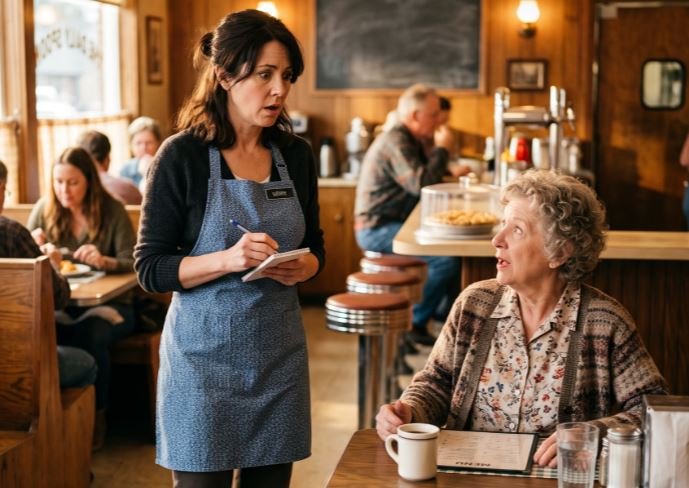
I recognized her voice before I even saw her face. It had been twenty-two years, and I still knew it instantly — that particular warm, steady cadence, the way she said “dear” at the end of ordinary sentences like it cost her nothing to mean it.
I was working the lunch shift at Rosie’s, the small diner I’ve managed for the past six years, when she walked in and sat down at table four, the same table I always take myself when the place is slow, because it catches the best afternoon light. I didn’t recognize her face right away — twenty-two years changes a person considerably, softens some things and sharpens others — but the moment she opened her mouth to order, something in my chest went completely still.
“I’ll just have the soup today, dear, and a coffee, thank you.”
I stood there with my order pad in hand for a beat too long, the ordinary hum of the diner suddenly very far away. I want to explain why that voice mattered so much, because out of context, I know it sounds strange to freeze over a stranger’s lunch order.
Twenty-two years ago, I was nineteen years old, driving home from a late shift at a grocery store, exhausted and half-asleep at the wheel on a stretch of highway outside town. I don’t remember the crash itself, not really — just fragments, headlights, the sound of metal, and then nothing, until I woke up in an ICU bed three days later with a fractured skull, a collapsed lung, and doctors who’d apparently told my parents, quietly, that the first forty-eight hours were the ones that mattered most.
What I remember clearly, more clearly than almost anything else from that entire blurred month in the hospital, was a nurse who sat with me during the worst of those first nights, when my parents had finally been convinced to go home and rest, when the machines beeping around me felt like the only company I had left in the world. She held my hand through two separate nights when my vitals dipped in ways that frightened everyone monitoring them, talked to me in a low, steady voice even when I was too sedated to respond, told me — I learned this detail only years later, when my mother finally repeated it to me — that she wasn’t going anywhere until I was stable, shift or no shift, because “nobody should wake up alone after a night like that, if I can help it.”
Her name was Nurse Callahan. I never learned her first name. I was too young, too scared, too focused on simply surviving to think to ask, and by the time I was well enough to properly thank her, she’d rotated to a different unit, and I never saw her again. I carried her voice with me anyway, for twenty-two years, through a slow recovery, through the version of my life that only existed because of those first forty-eight hours she’d apparently refused to leave me alone in.
Standing at table four with my order pad still in hand, I finally found my voice, unsteady in a way that surprised even me.
“…Nurse Callahan?”
The woman looked up sharply, clearly startled, studying my face with the confused, searching expression of someone trying to place a stranger who’d somehow known her name. “I’m sorry,” she said slowly, “have we met? I don’t usually get recognized these days — retired going on six years now.”
I had to set my order pad down on the table before my hands started shaking too badly to hold it steady. “Twenty-two years ago,” I said. “I was nineteen. Car accident, out on Route 9. I was in the ICU for almost two weeks. You sat with me two nights when things got bad. You told my mother you weren’t leaving until I was stable.”
Her expression shifted slowly from confusion into something gentler, though I could see she genuinely didn’t remember the specifics — which made sense, I told myself later, turning it over. She’d probably sat with hundreds of frightened, half-conscious patients over a thirty-year nursing career, and I was, to her, one night among thousands, while to me, she was the entire reason I still existed to remember it at all.
“I don’t remember the details, sweetheart, I’m sorry,” she said gently, “but I believe you completely. That sounds exactly like something I would have done. I never could stand the thought of someone waking up alone after something like that.”
I sat down across from her without really deciding to, my shift momentarily forgotten, and told her the rest — how the two weeks in that ICU had become six months of physical therapy, how I’d nearly dropped out of community college twice during the hardest stretch of recovery, how I’d eventually finished, gotten a job managing this small diner, built an entire ordinary, grateful life out of a recovery that had genuinely, medically, been uncertain for those first forty-eight hours she’d apparently refused to leave.
“I used to think about you a lot,” I told her, my voice cracking despite my best effort to keep it steady. “I never even knew your first name. I just knew I wanted to find you again someday and actually say thank you properly, instead of the barely-conscious mess I probably was the last time you saw me.”
She reached across the table and took my hand, the same gesture, I realized with a fresh wave of emotion, that she’d apparently done for me twenty-two years earlier without either of us remembering the specifics clearly enough to recognize each other on sight.
“Well,” she said, smiling, eyes bright with tears she was clearly fighting just as hard as I was, “it looks like you found me. Margaret Callahan. And for what it’s worth, sweetheart, seeing you sitting here, healthy, running your own restaurant — that’s a better thank you than anything you could have said to me twenty-two years ago in that hospital bed.”
I made her soup myself that day, though it wasn’t remotely my job anymore, and comped the whole meal despite her mild protests, and we sat together for nearly an hour after the lunch rush cleared out, trading pieces of the twenty-two years neither of us had known the other was living through. She’d retired five years earlier after a full career in the ICU, moved across town to be closer to her grandchildren, and had simply, entirely by coincidence, wandered into the one diner in the city where the girl she’d once sat with through two frightening nights had grown up to run the front of house.
She’s a regular now, comes in most Tuesdays for the same soup and coffee, and I still catch myself, some days, glancing over at table four just to make sure I’m not imagining the whole thing — a debt I never expected to be able to repay, showing up, entirely by chance, twenty-two years later, in the most ordinary way possible: a woman simply wanting soup, at the one diner in the whole city where someone was still quietly, gratefully remembering the sound of her voice.
THE END