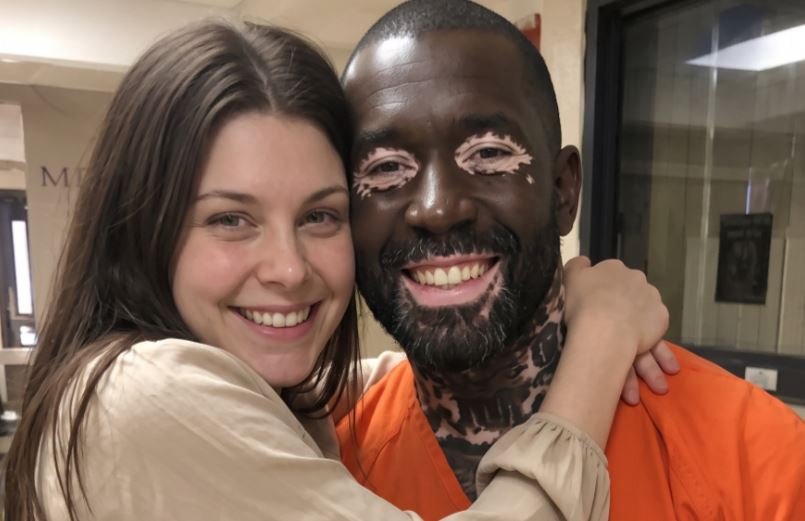
I married Jonah for money. Plain and simple.
I was twenty‑seven, raising my younger brother Owen on my own, and we were one missed payment away from losing our apartment. When Jonah’s mother, Celeste, offered me $2,000 a month to become his wife on paper, I didn’t think about love. I thought about rent, food, and keeping Owen in school.
She said Jonah needed stability — someone to visit him, write letters, and show the court he still had family. A wife, she called it. Something that would give him roots.
I knew it sounded wrong. But desperation has a way of quieting your doubts.
The Wedding Behind Glass
Our wedding happened through scratched plexiglass. Jonah sat across from me in a beige prison uniform — thin, weary, and surprisingly gentle.
“You don’t need to pretend I’m a good man,” he said.
“Good, because I’m not that generous,” I shot back.
I expected arrogance or bitterness. Instead, he looked guilty.
He admitted he’d taken $18,000 from a restricted foundation account — called it “borrowing from his future.” But he swore he didn’t take the $600,000 they pinned on him. His cousin Dean did that — moved the larger funds, forged Jonah’s signature, and let his smaller mistake make him an easy target.
“Why did you let them bury you?” I asked.
He glanced at the guard. “Because I already despised myself enough to believe I deserved it.”
So I signed the paperwork. He signed too. Just like that, I had a husband — and enough money to cover rent.
The Unexpected Kindness
At first, I was just acting. I visited twice a month because Celeste’s checks kept coming. I sent letters that were caring enough to matter but distant enough to stay insincere.
But Jonah always responded. His handwriting was neat, with little sketches in the margins — a coffee mug, a tired waitress, Owen dressed as “Captain Algebra” after I mentioned he’d failed a math quiz.
On my next visit, Jonah asked, “Did Owen retake the test?”
I blinked. “You remembered that?”
“You wrote it down,” he said.
“I jot down many things.”
“And I read them.”
That irritated me more than I expected. Kindness is far harder to dismiss than cruelty.
The Fight for the Truth
One night, after a double shift, I sat on the kitchen floor, poring over Jonah’s case files. Owen crouched beside me. Together, we mapped every date, signature, and witness statement on sheets of paper taped across the wall.
We found the smoking gun: Jonah was already in custody on October 4th — which meant he couldn’t have signed a transfer order dated that day. Dean had forged his signature.
I took our timeline to a legal aid attorney. It took three years of prison visits, courthouse hallways, missed work shifts, and pleading with people to read just one more page.
Celeste warned me twice. “You’re confusing loyalty with intelligence, Sadie.”
“No,” I replied. “I’m finally learning the difference.”
Even Jonah urged me to stop. “You’re wasting your life, Sadie.”
“It’s my life,” I said through the scratched glass. “I choose what to do with it.”
His eyes filled with tears. That was the moment I knew I loved him — not because he was innocent, but because he was finally trying to be truthful.
The Day He Walked Free
When the judge overturned his conviction, Jonah walked out of prison in a loose gray suit. Dean’s forged paperwork had finally been exposed.
I waited outside, expecting celebration. Instead, Jonah looked terrified.
“Come home with me,” I said. “It’s small, and Owen leaves cereal bowls everywhere, but it’s ours tonight.”
For one week, we practiced being normal. Jonah barely slept. Owen asked cautious questions. I bought groceries without counting every dollar twice.
The Black Box
On the eighth night, Jonah walked into the kitchen holding a small black box.
“What’s that?” I asked.
He placed it on the table. “Now it’s my turn to be honest.”
I tried to laugh. “Unless that box is filled with back rent and a functioning nervous system, I don’t want it.”
He didn’t smile. “Sadie, when you married me, you agreed to something larger than my name.”
“My mother didn’t choose you by accident,” he said.
My stomach tightened. “What did she do?”
“Open it.”
Inside was a cream‑colored notebook. Celeste’s handwriting flowed across the page:
“No active parents. Minor brother dependent. Behind on rent. Likely compliant if payments remain consistent.”
I couldn’t breathe. “She studied me,” I whispered. “She looked at my life and saw a handle.”
Beneath the notebook was a trust document — with my name on it. Jonah’s father had built a safeguard: if Jonah married while incarcerated and his conviction was overturned, his lawful spouse would receive emergency co‑trustee authority.
Celeste knew. She’d chosen someone poor enough to control.
And Jonah knew too — for six months before the appeal hearing.
“You let me stand in prison lines for three years,” I said, “without telling me I was part of your family’s war.”
“I told myself I was protecting you.”
“No. Say it correctly.”
He swallowed. “I lied by letting you remain oblivious.”
“There,” I said. “That’s the first honest thing you’ve said tonight. I married you for money — I can admit that. But I loved you of my own accord, and you betrayed me.”
I picked up the notebook and the trust documents.
“Sadie,” Jonah said, “where are you going?”
“Nowhere,” I replied. “You are.”
The Reckoning
Jonah left. Owen and I read Celeste’s notebook twice.
“She wrote about us like we were stains on a couch,” Owen said.
“She has money, lawyers, and people trained to believe her.”
Owen tapped the trust document. “And you have her signature.”
“That doesn’t mean I know how to fight her.”
“No,” he said. “But it means she knows you can.”
The next morning, Celeste called. “Sadie, dear, we have business to finalize.”
In her office, she slid a check across the desk: $100,000 — for me to resign as co‑trustee.
I pushed it back.
“Women like you survive by knowing when to step aside,” she said.
“No,” I said, standing. “Women like me survive by remembering every person who thought we would vanish.”
The Donor Luncheon
Celeste’s foundation held a donor luncheon to restore her reputation. I showed up — carrying the black box.
When I approached the podium, Celeste smiled tightly. “Sadie, dear, this isn’t the moment.”
“That’s what you counted on,” I said. “You counted on me never knowing when to speak.”
I placed the black box on the podium.
“You paid me $2,000 a month to marry Jonah in prison,” I announced. “That’s true.”
Whispers rippled through the room.
“But you didn’t choose me for my loyalty. You selected me because I had nothing.”
I held up her notebook. “No active parents. Minor brother dependent. Behind on rent. Likely compliant.”
Celeste reached for it. “That’s private.”
“No. That’s proof. You used a trust, a charity, and me to maintain power you were never meant to possess.”
Dean stood up. “She’s lying.”
I turned to him. “You moved money under Jonah’s name after he was already in custody. You allowed his $18,000 to conceal your $600,000.”
A board member stood. “Dean, don’t leave.”
I faced Celeste again. “You assumed I was poor enough to rent and weary enough to erase. You were mistaken about both.”
The board member stepped forward. “Celeste, step away from the podium. Counsel, call an emergency vote to suspend her pending review and notify the attorney general’s charity division.”
The Aftermath
Months later, Dean faced criminal charges. Celeste was removed from the foundation. Jonah repaid his restitution.
One afternoon, Jonah found me reading scholarship applications.
“You belong here,” he said.
“I know.”
“I should have trusted you.”
“Yes.”
“I’m sorry.”
“I know.”
“I’ll never manage you again.”
I looked up. “You don’t get to promise that once. You prove it every day.”
He nodded. “Then I will prove it every day.”
Owen appeared in the doorway. “Dinner, or are we doing emotional accountability all night?”
For the first time in months, I laughed.
I didn’t forgive Jonah overnight. The first time I married him, fear had cornered me. The second time I chose him, I did it standing firmly in the center of my own life.