The Voss Gallery was a converted warehouse in the Arts District—white walls, polished concrete, and a security system that cost more than most houses. I’d been working the night shift for three weeks, walking the empty halls from 10 PM to 6 AM, guarding paintings that were worth millions and meant nothing to me.
Until tonight.
The alarm system was state-of-the-art. Motion sensors in every room. Infrared cameras that recorded in complete darkness. A central security office that monitored the feed live, ready to dispatch police at the first sign of unauthorized movement.
I knew the system because I’d studied it. Because I was an artist who couldn’t sell her work, who needed the paycheck, who’d taken the security gig out of desperation. And because my stepsister, Elara Voss, had told me exactly how it worked.
Elara was twenty-nine. The gallery owner’s daughter. A curator with a trust fund and a smile that could make you forget your own name. She’d been avoiding me since the fundraiser three weeks ago—since the champagne, the bathroom, the marble sink where she’d kissed me until I couldn’t breathe and then said “I’m sorry, that was the alcohol” and walked away.
She wasn’t avoiding me tonight.
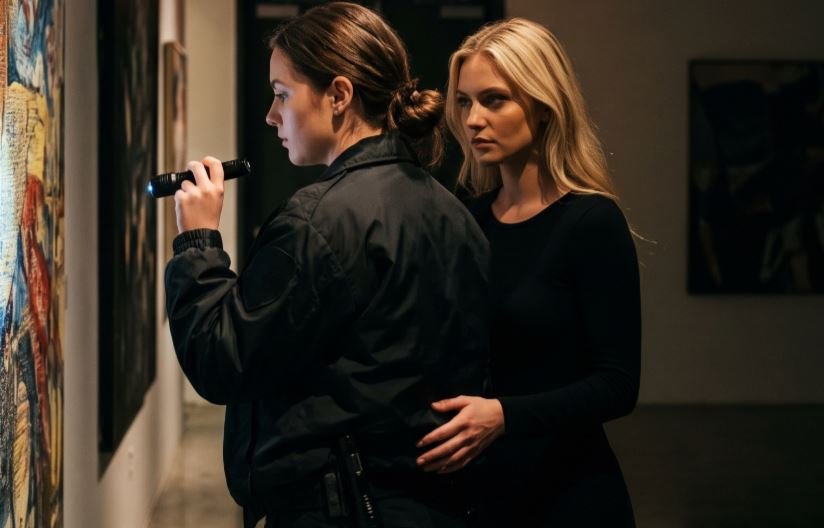
I was in the main gallery, my flashlight beam trained on a painting called The Scream in Red—an abstract piece that looked like violence committed with a brush. The room was silent. The motion sensor in the corner blinked green, then red, then green again.
“The motion sensors are live,” I said, though I wasn’t sure if I was warning her or myself. “The cameras record everything. If we trigger an alarm, security sees it live.”
She stepped out of the shadows between two sculptures. She was wearing a black dress that was completely wrong for a closed gallery—too formal, too expensive, too much like a woman who knew exactly what she was doing. Her blonde hair was loose. Her eyes were dark. And she was looking at me like I was the only art in the room worth studying.
She stepped closer. Her hand found my waist, her fingers sliding under the hem of my black uniform shirt, turning me away from the painting, toward her, toward the darkness between the exhibits where the cameras had blind spots.
“This is insane,” I breathed, my flashlight shaking in my hand. “Your father owns this gallery. He’ll watch the tapes. He’ll see us. He’ll know that his daughter and his stepdaughter are—”
She took the flashlight from my hand. Turned it off. The gallery went dark except for the red glow of the exit signs and the faint emergency lighting that made the paintings look like they were bleeding.
Then she kissed me.
It was quick. Hard. Completely silent. Her mouth was hot, her tongue was demanding, and her hands were already undoing the buttons of my uniform shirt in the darkness where the cameras could see shapes but not details, movement but not meaning.
“One move,” I whispered against her mouth. “One alarm. And we’re caught.”
“Then don’t move,” she whispered back.
The motion sensor above us blinked red.
A soft chime. Not the alarm—not yet. Just the sensor registering movement, sending a signal to the central office, alerting the night watchman that something was happening in Gallery 4.
Elara didn’t panic. She just grabbed my hand, pulled me behind a large marble sculpture—a twisted figure that was supposed to represent motherhood—and pressed me against the cold stone.
“Let them see shadows,” she whispered, her mouth on my neck, her hands inside my shirt, finding my breasts, my ribs, the place where my waist dipped inward. “Let them wonder what two women are doing in a dark gallery at midnight. But they can never have this. They can never know what your skin tastes like. They can never know how you sound when you’re about to come.”
She used her mouth on me. Right there, behind the sculpture, in the dark, with the motion sensor blinking red above us and the cameras recording shapes that looked like abstract art. She pulled my uniform pants down, pushed my underwear aside, and put her tongue on me with a hunger that was completely silent and completely devastating.
I bit my own hand to keep from screaming. The marble was cold against my back, Elara’s mouth was hot between my legs, and the red light blinked like a heartbeat above us. She worked me with a precision that was terrifying—her tongue circling my clit, her fingers pressing inside me, her eyes looking up at me in the darkness with an expression that said she owned this moment, this space, this completely forbidden act.
The alarm didn’t sound. The night watchman must have seen the shapes and dismissed them as shadows, as tricks of the light, as nothing worth investigating. But the cameras recorded everything. Every movement. Every shape. Every moment when Elara’s blonde head was between my legs and my hands were gripping the marble sculpture for dear life.
When I came, it was silent. Violent. Completely consuming—my body shaking, my vision blurring, my cry swallowed by the hand I pressed against my own mouth. Elara held me through it, her fingers still moving, drawing out every wave until I was limp and gasping and sliding down the sculpture into her arms.
After, she fixed my uniform. Smoothed my hair. Kissed my forehead.
“The tapes are reviewed every morning,” she whispered. “By my father. Or his assistant. Or whoever is unlucky enough to draw the short straw.”
I stared at her. “Then they’ll see—”
“They’ll see shadows,” she interrupted. “They’ll see two women standing close. They’ll see nothing that proves what we did. But they’ll wonder. And every time they wonder, they’ll think of us. And every time they think of us, we’ll have won.”
She was right. The next morning, I got a call from the security company. A “routine check” about “unusual movement in Gallery 4.” I told them I’d been inspecting the sculptures. They believed me. Or pretended to.
Elara and I still meet in the gallery. Different nights. Different rooms. Different blind spots where the cameras can’t see. She brings me to the edge of alarm, to the moment where one more movement will trigger the system, and then she makes me come in the silence and the dark.
The Scream in Red sold last month. The buyer said it reminded him of “something he couldn’t name.” Elara smiled when she told me. She said that was the point. Some things can’t be named. Some things can only be felt—in the dark, between shadows, where the cameras can’t follow.