She saw her on a Tuesday.
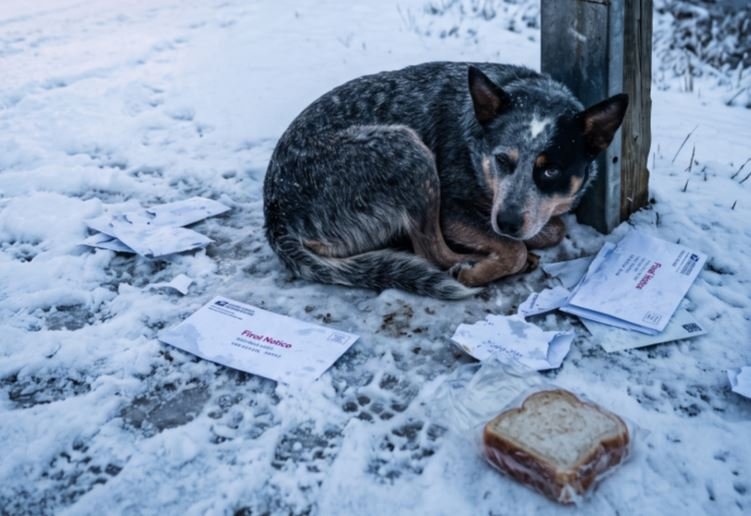
Not fully. Just a shape — gray and black, pressed against the back of the cluster box post, using the thin shadow for shelter from wind that found every gap in a coat. The dog was a Blue Heeler mix. 40 pounds that should have been 55. Ribs visible. Hip bones sharp. A scar across her nose where something — coyote, barbed wire, human — had marked her.
She was pulling a letter from the slot.
Not aggressively. Gently. The particular delicacy of a creature who had learned that paper could be insulation, that envelopes kept heat, that the words humans sent to each other were less important than the warmth those words could provide.
Linda stopped her Jeep.
Not close — 30 feet away. She didn’t want to scare the dog. She just watched. The dog pulled a white envelope — a utility bill, Linda would see later — and carried it to a gap beneath the cluster box. She arranged it. Carefully. Like a decorator placing a pillow. Then she curled around it, her body creating a pocket of air that the wind couldn’t steal.
Linda understood.
Not theft. Survival. The particular desperation of a dog who had found that mailboxes were metal, that metal held heat, that letters were layers, and that the humans who drove past every day never noticed her because she was small and the landscape was large and the world was cold.
She opened her door.
The dog didn’t run. She didn’t have the energy. She just looked at Linda with eyes that were yellow-brown, cloudy with exhaustion, and said I know. I know you see me. Do what you’re going to do.
Linda didn’t approach.
She placed her sandwich — turkey, Swiss, the particular offering of a woman who had been feeding a ghost for a week — on the ground. She stepped back. She sat in her Jeep with the engine running, the heater blasting, and she waited.
It took 12 minutes.
The dog stood. Stiff. Painful. She walked to the sandwich. She didn’t eat it. She picked it up, carried it to her nest beneath the box, and placed it on top of the envelopes. Saving it. The particular behavior of a creature who has learned that food is not guaranteed, that today plenty is tomorrow’s absence, that you store what you can because the world takes what you don’t protect.
Linda cried.
Not dramatically. Just tears that fell while her Jeep idled and a starving dog saved a sandwich for later. She wiped them. She drove away. She came back the next day with a bowl, a blanket, and a bag of kibble.
The dog was gone.
Not forever. Just hiding. Linda found her tracks — leading to a culvert, 200 yards north. She placed the bowl. She placed the blanket, folded small, near the cluster box. She drove away.
The bowl was empty the next day.
The blanket was moved — dragged to the culvert. The particular acceptance of a creature who was willing to take warmth but not yet willing to take trust.
This went on for three weeks.
Linda became the particular obsession of Box 9-14. She brought food twice a day — morning and afternoon. She brought a blue tarp, which appeared over the culvert entrance, creating a tent. She brought a heated water bowl, which the dog licked at cautiously, suspicious of anything that didn’t freeze.
She named her Blue.
Not original. Just accurate. The particular blue-gray of her coat against Montana snow.
Blue didn’t let her touch her.
Not for 21 days. Blue would eat while Linda sat in her Jeep, 20 feet away. She would sleep on the blanket while Linda sorted mail. She would watch — always watch — with eyes that said I am grateful but I am not yours yet.
The blizzard came on day 22.
Not predicted. Not prepared for. The particular storm that rolled off the Rockies and swallowed eastern Montana in 6 hours. Linda was on Route 9 when it hit. She couldn’t see 10 feet. She couldn’t turn around — the gravel road had become a suggestion, not a path.
She thought of Blue.
Not the mail. Not the 47 boxes still undelivered. The dog in a culvert, beneath a tarp, in a storm that was burying everything.
She drove to Box 9-14.
Not safely. Not sanely. The particular recklessness of a woman who had decided that 12 years of delivering mail mattered less than one dog surviving one night. She found the culvert buried. The tarp — gone, ripped away by wind. The cluster box — a white mound, indistinguishable from the drifts around it.
Linda dug.
With her hands. With a snow shovel from her Jeep. With the particular desperation of a person who has lost too much already — a marriage, a house in town, the particular belief that life owed her anything — and would not lose this.
She found Blue.
Not moving. Not dead — breathing, shallow, covered in snow that had melted against her body heat and frozen again, creating a shell. The particular cocoon of a creature who had tried to survive and had almost succeeded.
Linda wrapped her in her own coat.
The parka she wore — USPS-issue, green, insulated. She wrapped Blue in it, carried her to the Jeep, placed her on the passenger seat. She turned the heater to maximum. She drove not to the next box, not to the depot, but home.
Her home.
A trailer on 2 acres. Small. Warm. The particular sanctuary of a woman who lived alone and had made peace with it. She carried Blue inside. She placed her on a towel by the woodstove. She didn’t call a vet — the roads were closed, the storm was raging, the particular isolation of rural Montana that means you handle things yourself or they don’t get handled.
She warmed Blue with her body.
Not with hot water — you don’t warm a frozen creature too fast. She knew this. From growing up on a ranch. From calving season. From the particular knowledge that cold is patient and so must be the cure. She lay beside Blue, her hand on the dog’s chest, feeling the heartbeat — slow, faint, but there.
Blue opened her eyes at midnight.
Not fully. Just enough. She saw Linda. She smelled the woodstove, the wool blankets, the particular scent of a human who had not left, who had dug through a blizzard, who was lying on the floor of a trailer in her work clothes because a dog mattered.
She licked Linda’s hand.
Once. Dry. Cold. But a lick. The particular signature of trust.
Linda didn’t sleep.
She stayed on the floor all night, feeding Blue broth from a spoon, warming towels in the oven, doing the particular nursing that doesn’t require a degree, just patience. By dawn, Blue was sitting up. By noon, she was drinking water. By evening, she ate a scrambled egg — the particular food of recovery, gentle and warm.
The storm passed.
Linda should have taken Blue to a shelter. To a rescue. To the particular machinery of animal welfare that handles strays. But Blue was not a stray anymore. She was a patient. A project. A particular presence that had filled a trailer that had been too quiet for too long.
Linda kept her.
Not officially. Not with paperwork. Just… kept. Blue rode in the Jeep on Route 9. She sat in the passenger seat, nose to the vent, watching the particular landscape that had almost killed her. She didn’t steal mail anymore. She didn’t need to.
At Box 9-14, Linda placed something new.
Not mail. A sticker. Small. On the cluster box post. It read: “Blue’s House. Established January 2026.”
The ranchers on Route 9 noticed.
Not immediately. But eventually. They saw the dog in the Jeep. They saw Linda carrying two sandwiches again — one turkey, one kibble. They saw the particular transformation of a carrier who had been efficient and was now smiling.
They started leaving treats in their mailboxes.
Not for themselves. For Blue. A bone at Box 9-15. A toy at Box 9-22. The particular community that forms around a dog, that turns neighbors into family, that makes 74 miles of gravel road feel like a neighborhood.
Blue gained weight.
Her coat thickened. Her eyes cleared. The particular beauty of a creature who was always beautiful but had been hidden by survival. She became the unofficial mascot of the Philipsburg postal route — the dog who had lived in a mailbox, who had stolen letters for warmth, who had been dug out of a blizzard by a woman who refused to give up.
Linda was promoted.
Not to management. To training. She taught new rural carriers — the particular loneliness of the job, the importance of noticing, the fact that every missing letter might be a creature trying to survive.
She always told them about Blue.
Not as a lesson. As a story. The particular story of a dog who used mail to survive winter, and a carrier who realized that delivering letters was less important than delivering warmth.
Blue is 7 now.
She still rides Route 9. Every morning. In the passenger seat, nose to the vent, watching for the particular spot where she was found. When they pass Box 9-14, she wags her tail.
Once.
The particular wag of a dog who remembers being cold, being hungry, being invisible — and who knows, with the particular certainty of creatures who have been saved, that she will never be any of those things again.
Linda still packs two sandwiches.
One turkey. One kibble. The particular lunch of a woman who was lonely and found that the cure for loneliness was not another person.
It was a dog who stole her mail.