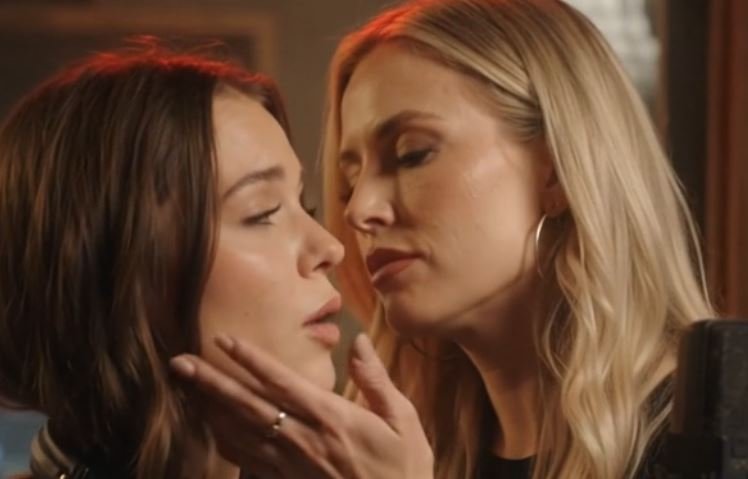
The studio was called Frequency, a basement space in East LA with foam walls and a vocal booth that was all glass and red lights. I’d been recording there for three weeks — my debut album, the one that was supposed to make me a star — and Sloane had been my producer since day one.
Sloane was thirty. She’d produced three Grammy winners and had a reputation for making singers cry — sometimes from frustration, sometimes from something else. She wore mesh tops that showed her tattoos and leather pants that creaked when she walked, and she had a habit of stepping into the vocal booth during takes to “adjust the energy.”
Tonight was the final vocal for the lead single. The engineer — Marcus, twenty-five, completely focused — was outside at the mixing desk. The red light was on. The mic was live. And Sloane had stepped into the booth.
“The engineer is mixing the track outside,” I whispered, sitting on the stool with the headphones around my neck. The booth was small, intimate, completely enclosed in glass. Through it, I could see Marcus’s back as he adjusted levels. Sloane was standing in front of me, her hand on my waist, her face inches from my neck. “The red light is on. We’re recording. The mic is live. And your hand is on my waist, not the pop filter. You’re supposed to be giving me notes on the bridge. Not touching me. Not pressing your thumb into my hip. Not—”
Sloane didn’t speak. She just leaned in, her cheek brushing my neck, her hand sliding from my waist to the button of my shorts, undoing it with a precision that was completely devastating.
“If he turns around,” I breathed, my voice barely audible over the hum of the mic, “he’ll see the producer kissing the lead singer in the vocal booth. He’ll see your mesh top against my band tee and the red light capturing everything and the glass showing every angle and he’ll know that the album isn’t the only thing being laid down tonight. He’ll know that while he mixes the track, his singer is being produced by someone who wants her for herself.”
She turned my face toward her with a hand on my jaw. Her mouth found mine. A kiss that tasted like studio air and pop filters and the exact moment when a demo becomes a master. Her tongue slid against mine, her hand sliding down my stomach, into my shorts, finding me wet and ready and completely on mic.
The engineer’s voice crackled through the talkback speaker.
“Hey Sloane? The mic is picking up something weird. Like… heavy breathing. You want me to adjust the gate?”
Sloane didn’t pull away. She just pressed her other hand over my mouth — her fingers still moving inside me, her eyes locked on mine — and reached over to press the talkback button.
“Just running a vocal exercise, Marcus,” she said, her voice perfectly steady, completely professional. “Give us five minutes. Don’t turn around.”
“Sure thing.”
Sloane released the button. Looked at me. The red light bathed her face in crimson.
“The mic is hot,” she whispered against my mouth, her thumb circling my clit, her fingers pressing deeper, finding a rhythm that matched the bass line bleeding through the headphones. “So stay quiet. Don’t make a sound. And let me produce the only sound that matters tonight — the sound of you coming while the red light records everything.”
She made me come on the vocal stool. Her fingers inside me, her mouth on my breast, the headphones around my neck amplifying my heartbeat, the red light capturing every silent scream. I came with her hand over my mouth, my cry swallowed by the foam walls, my body shaking so hard the mic stand rattled.
After, she fixed my shorts. Adjusted the pop filter. Kissed my forehead.
“Let’s take it from the top,” she said. “I want to capture that energy in the actual take.”
I sang the bridge. It was the best vocal of my life. Sloane said it was “pure sex.” Marcus said it was “Grammy-worthy.” Neither of them knew that the performance was real — that every breath, every tremor, every note was a direct result of what Sloane had done to me in that booth.
The album went platinum. The single went number one. And in the liner notes, under “Special Thanks,” I wrote: “To S. — for producing the best moments.”
Only she knows what that means. And every time we win an award, she finds me in the vocal booth afterward and shows me exactly what an encore looks like.
The red light is always on. And I’m always ready to perform.