The tractor driver was named Earl, seventy-one, and his megaphone commentary on the “spooky detour” was ninety percent of the attraction’s charm. The other ten percent was his pie.
I learned his whole biography that evening because after the announcement — “FOLKS, WE GOT A LOVE STORY IN ROW TWO, THAT’S A FIRST, HOLD ON TO YOUR GOURDS” — the entire wagon of children turned to stare, Sloane and I separated by exactly one pumpkin’s width, and Earl made the executive decision to end the detour early and reward us.
“You get pie,” he said, over the megaphone, while unloading us at the barn. “Both of you. My wife makes it. This is the first engagement the ride’s ever produced.”
“It’s been four minutes,” Sloane protested.
“Four GOOD minutes,” Earl said, and handed us two slices of apple pie on paper plates.
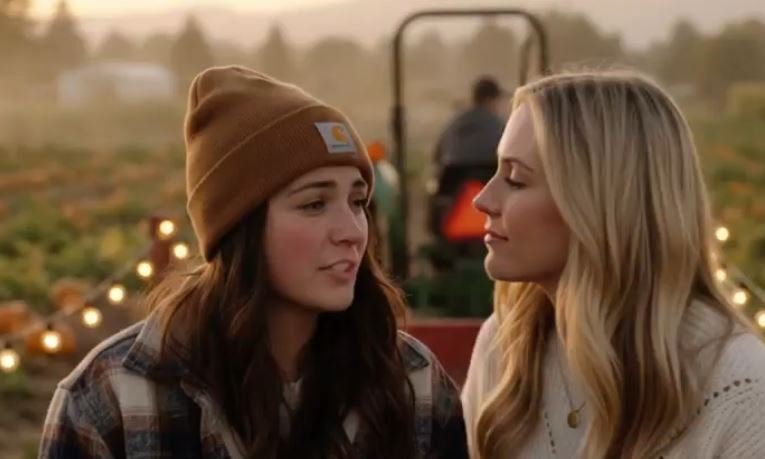
Her name was Sloane — the pumpkin patch was apparently a convergence point for Sloanes, I no longer question it — and she’d come alone because her friends had canceled, and had scooted over on the hay bale because “you were holding that pumpkin like it had personally let you down, and I needed to know its crime.”
“The pumpkin was fine,” I said. “I was the crime. First October in a new city. No friends yet. I was romancing a gourd.”
“And now?”
“Now the gourd’s a third wheel,” I said, and the pumpkin — which we’d kept, which sat between us on the picnic table like a chaperone — seemed to accept this with dignity.
We dated through October like people in a commercial: cider mill, corn maze (a different one, less haunted), a leaf-peeping drive where Earl’s pie tin rode shotgun and returned empty. She was a landscape architect, which explained why she’d noticed my beanie was crooked — “I correct visual misalignment reflexively, it’s a professional hazard” — and why the pumpkin, once carved, sat on her windowsill with a precision no other jack-o-lantern on her street matched.
Earl’s wife, Doris, put our photo on the barn wall the following year — the “row two love story” section, which now had a small corkboard. By year three, the corkboard had four couples. Earl claims the detour’s romantic success rate is “better than any app, and I provide pie.”
We got engaged at the patch, obviously, at dusk, on the hayride, in row two. Sloane hired Earl a week in advance. He modified his detour script, built the whole ride to a single moment — the bump at the exact same spot — and when the wagon lurched, she caught me the way she’d caught the moment the first time, and produced a ring from her jacket pocket where the thermos had been.
The megaphone announcement exists on video, taken by a mother in row three: “FOLKS, ROW TWO AGAIN. SAME COUPLE. SHE’S DOING IT PROPERLY THIS TIME. EVERYBODY HOLD YOUR GOURDS.”
We’re married now. The pumpkin from the first night — uncarved, preserved somehow by accident into a durable gourd-like artifact — sits on our mantel. Doris’s pie recipe came to us in a Christmas card, in Earl’s handwriting, because “she’s shy about it but I’m not.”
Every October we go back. Earl saves us row two. The corkboard grows. And every year, at the exact bump in the detour, the whole wagon — now full of people who’ve heard the story, who BOOK the ride hoping to witness it — holds its gourds, and we kiss, slow and harvested, forty children screaming about a scarecrow around us.
Some traditions you build. Some you just refuse to leave row two.