The darkroom was my sanctuary.
I’d built it in the basement of the university’s arts building, a space that the administration had forgotten existed and that I’d claimed through sheer persistence and a lock I’d installed myself. It smelled like fixer and developer and something else—something that smelled like secrets and patience and the exact moment when nothing becomes something.
I’d been alone for three hours, developing film from a shoot I’d done in the park, when the door opened.
The red light didn’t reveal her immediately. It never did. Red light turns everyone into shadows first, into silhouettes, into possibilities before they become people. She stepped inside, closed the door, and I recognized her by the way she moved—Clara, the MFA student who’d been borrowing my chemicals for weeks, who’d been asking questions about aperture and shutter speed that she already knew the answers to.
“Developing?” she asked. Her voice was low. The darkroom demanded whispers.
“Always,” I said.
She walked over. Stood beside me. Too close. Close enough that I could feel her arm brushing mine as we leaned over the chemical tray, close enough that her hip pressed against the edge of the table where my hands were submerged in developer fluid. Close enough that her breath moved the hair near my ear.
“Watch it appear,” I whispered, my voice barely audible over the drip of the faucet. “Slowly. Like a secret being revealed.”
The image cleared. The paper had been in the tray for ninety seconds, and the chemicals were doing their work, pulling light from darkness, pulling truth from silver halide. But as the image sharpened, I felt my stomach drop.
It wasn’t the landscape I’d told her I was developing. It wasn’t the architecture assignment or the still life or any of the acceptable things I’d claimed to be shooting.
It was us.
From yesterday. At the café across the street. Her leaning over my shoulder to look at my laptop, her face inches from mine, her expression soft and vulnerable and completely unaware that my camera had been sitting on the table, lens pointed at us, shutter released by my toe under the table.
She gasped. A small, sharp sound that echoed in the red room.
Her hand found mine in the tray. Our fingers touched in the chemical fluid, skin wet with developer, and she didn’t pull away. She interlaced our fingers, her thumb tracing my palm in a way that had nothing to do with photography and everything to do with the question we’d both been avoiding.
“I took that yesterday,” I admitted. My voice was hoarse. “When you weren’t looking.”
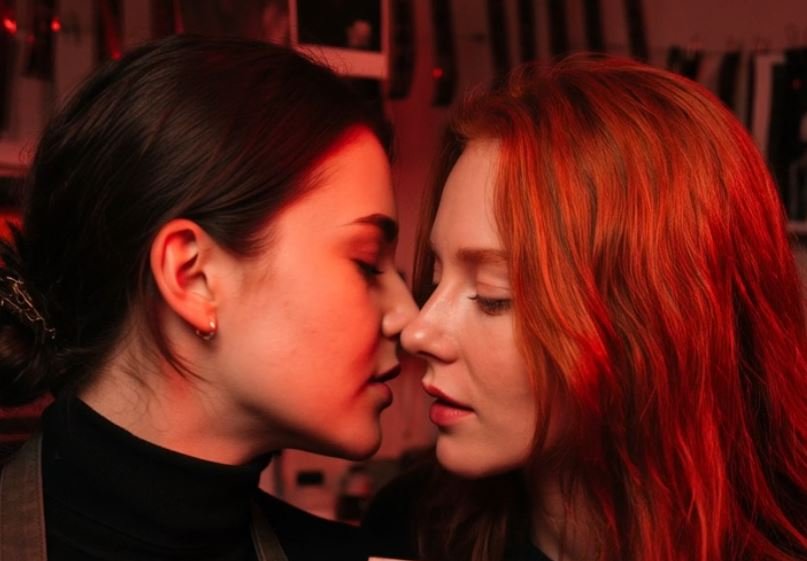
I turned toward her. In the red glow, her hair looked like fire, her eyes looked black and endless, her lips looked like the only color in a world that had been reduced to shadows and possibility. She didn’t pull away. She just leaned in, her breath warm and chemical-sweet against my mouth, and she kissed me.
The red light made everything feel like a dream. Like a darkroom print that was still developing, still changing, still becoming. Her apron—black, utilitarian, borrowed from my hook—brushed against my turtleneck, and when I pushed her back against the developing table, I felt something that made me dizzy.
She wasn’t wearing a bra. The apron was all that covered her, and it was loose, and my hands found her easily through the fabric, my fingers still wet with chemicals, leaving wet trails on her skin that looked black in the red light.
“Your hands taste like fixer,” she whispered against my mouth.
“Then let me develop you,” I whispered back.
I pushed her onto the table. Chemical trays rattled. One tipped—developer spilling across the metal surface, soaking her apron, turning the black fabric dark and heavy. She didn’t care. She pulled me on top of her, her legs wrapping around my waist, her hands tangled in my hair, and the red light watched us like a silent witness.
I discovered the truth in pieces. The apron ties coming undone with a single pull. Her skin underneath, pale and perfect and glowing red. The way she arched when my mouth found her breast. The way she made sounds that were part whisper, part moan, part the exact frequency of the safelight hum.
When I moved lower, when my tongue found her in the darkness where the red light couldn’t reach, she gripped the edge of the table and knocked a box of paper to the floor. Unexposed paper. White and pure and completely ruined by the chemical spill. We didn’t stop to pick it up.
She came with her hand over her own mouth, her body shaking, her thighs trembling against my cheeks. I didn’t stop until she pulled my hair—hard—and whispered my name like a prayer she hadn’t known she knew.
After, we lay tangled on the wet table, the red light making our skin look like wine, our hair like blood, our breathing like the only sound in the world.
“We should print that photo,” she said, her finger tracing my collarbone.
“Which one?”
“The café one. The secret one. The one where I’m already yours and I just don’t know it yet.”
We printed it. It’s on my wall now. In the darkroom that is no longer just mine. In the red light that no longer feels lonely.
Clara develops her own film there now. And sometimes, when the chemicals are right and the door is locked, we develop other things. Things that can’t be printed. Things that only exist in the dark.