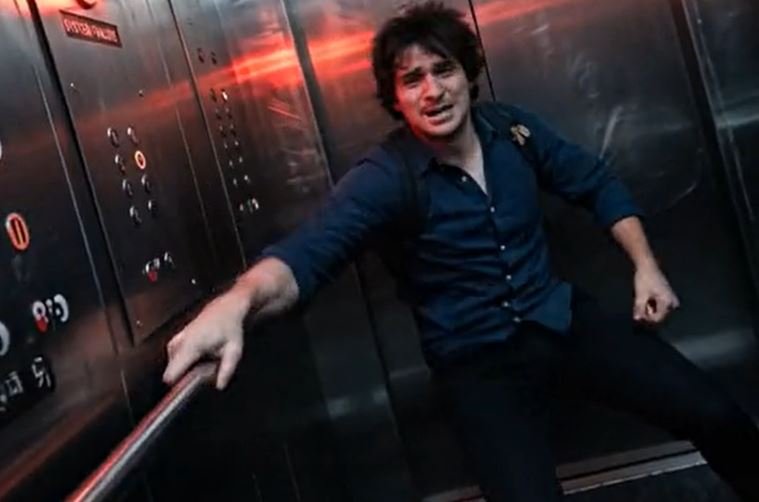
The elevator was already falling when the man realized something was wrong.
There was no warning.
No gradual malfunction.
One second, he was standing inside a modern office building elevator. The next, the entire cabin dropped violently, throwing him against the metal wall.
His phone flew from his hand and disappeared beneath the control panel.
The emergency lights came on.
The floor indicator began changing rapidly.
B2.
1.
7.
Then back to 1.
The elevator shook so violently that he struggled to remain standing. Somewhere above him, metal cables groaned under enormous pressure.
Then everything stopped.
For half a second, there was complete silence.
He turned toward the doors.
They began opening.
But there was no office hallway waiting outside.
Instead, the elevator opened onto a dark concrete space.
No lights.
No visible floor markings.
No doors.
No signs.
Just an unfinished-looking area extending into darkness.
The elevator’s emergency lights flickered.
The doors began closing again.
And then the man noticed something on the inside of the elevator door.
A dusty handprint.
It was positioned beside him at shoulder height.
He was certain it had not been there moments earlier.
The doors closed.
The elevator dropped again.
The recording ended.
When emergency crews eventually reached the elevator, the man was found alive and severely shaken.
The building’s maintenance team later reported that the elevator had experienced a serious mechanical fault. According to the official explanation, the cabin had stopped between levels before the emergency system activated.
But one detail remained difficult to explain.
The building had no accessible floor matching the dark space visible outside the elevator.
Maintenance workers later inspected the shaft and found a partially constructed service area behind one section of the building. However, they insisted that the elevator doors could not normally open at that location.
The handprint was never conclusively explained.
Some investigators believed it may have been an old mark revealed when dust shifted during the mechanical failure.
Others argued that the shape appeared too clearly defined.
The elevator itself was removed from service and eventually replaced.
The man never used an elevator again.
But the question that continues to bother people who study the footage is not simply:
Why did the elevator stop?
It is this:
If the elevator doors opened onto a place where no passenger should have been able to stand…
Who—or what—left the handprint inside the elevator?