The vet said the bullet missed everything important. Shoulder. Muscle. Painful but not permanent. Echo would limp. He would carry the scar. But he would live.
Mr. Kim didn’t take him back to the newspaper rack.
He unrolled the frayed blanket — the same one Echo had sat on for four years — and he laid it behind the counter. Inside the store. Where the security camera could see. Where Lin’s boots would find him every night.
Echo became the store’s witness.
Not to crimes. To people. To the regulars who came in at midnight for milk and loneliness. To the kids who stopped to pet him on their way to school. To Lin, who now sat behind the counter with him, not on the step, and told him about the cases that closed right.
The security footage went viral.
Not the shooting. The before. The footage of Echo sitting on his blanket, head tilted, listening to the world. The way his ears moved when Lin’s cruiser turned the corner three blocks away — before she was visible, before she was audible, before any human could have known she was coming.
The comments called him psychic. A ghost. A spirit animal.
Lin knew better.
She knew he was just a dog who had spent ten years in darkness, learning to see with everything else. Who had memorized the sound of her engine, her brakes, her door opening. Who had built a map of the world in echoes and scent and vibration — a map more detailed than anything with eyes could understand.
Three months after the shooting, Lin adopted him.
Not officially. Mr. Kim still owned the paperwork. But Echo slept in her apartment. He rode in her cruiser — not in the back, in the passenger seat, nose to the window, ears rotating at every siren. He went to the station. He sat in briefings. He became the mascot that nobody asked for and everyone needed.
The captain wanted to make him a therapy dog. Official. Badges. Vests. Lin refused.
“He’s not a therapy dog,” she said. “He’s a witness. He sees what we miss.”
She was right.
Echo solved three cases in his first year.
Not by finding drugs. Not by tracking suspects. By listening. By sitting in interrogation rooms — unofficially, against protocol, because Lin broke rules for him the way he had broken glass for Mr. Kim. By tilting his head when a suspect’s breathing changed. By standing when a lie entered the room.
Defense attorneys objected. Judges overruled them. Because Echo wasn’t evidence. He was a compass. A reminder that truth has a frequency, and some creatures are tuned to it.
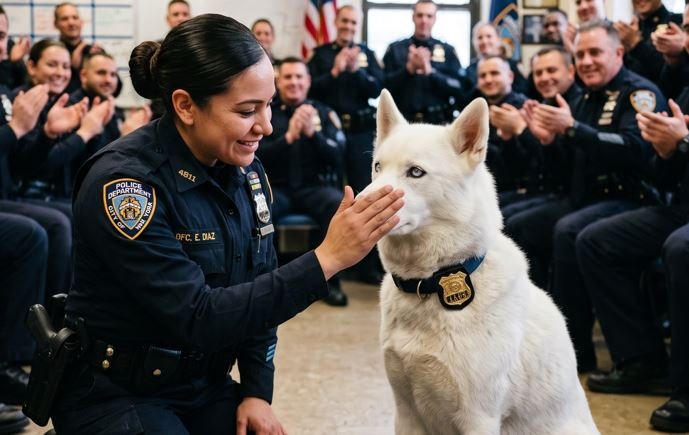
On his 12th birthday, the precinct threw him a party. Donuts. Coffee. A new blanket — blue, police-issue, embroidered with his name. He sat on it in the briefing room while the captain read a commendation that didn’t exist in any manual.
“For services rendered,” the captain said, “above and beyond the capacity of sight.”
Echo wagged his tail. Once. Twice. He pressed his nose into Lin’s palm.
She didn’t cry. She had stopped crying the night he barked. The night he remembered he was a wolf. The night a blind dog taught her that the darkest world holds the brightest courage.
They still stop at Kim’s Market every night. Lin buys coffee. Echo gets a biscuit from Mr. Kim. They sit on the concrete step — the old spot, the rusted rack, the place where everything changed.
And sometimes, when a car passes too slow, or a footstep sounds too heavy, or the world goes wrong in a way only he can hear — Echo stands.
Not to attack. Not to fear.
To witness.