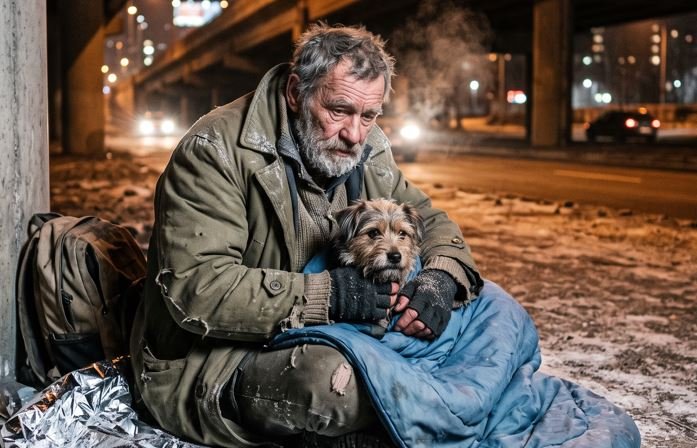
The warming center was a church basement.
Cots in rows. Fluorescent lights. The smell of soup and disinfectant and too many bodies in too small a space. James hadn’t been inside a building in 847 days. The walls felt like they were leaning in. The ceiling felt like it was pressing down. He stood in the doorway, the dog in his arms, and he couldn’t move.
Rosa took the dog. “I’ll hold her. You walk in. Five steps. That’s all.”
James walked. One. Two. Three. Four. Five.
The warmth hit him like a drug. His fingers burned as they thawed. His nose ran. His eyes watered. He found a cot — the one against the wall, closest to the door, closest to escape — and he sat. Rosa placed the dog in his lap. She curled immediately, nose under his chin, paws tucked against his chest.
He didn’t let go for six hours.
The vet came at noon. A volunteer. Young, tired, kind. She examined the dog in James’s lap — he wouldn’t release her, wouldn’t let her on the floor, wouldn’t let her out of his arms. The vet worked around him.
Malnourished. Ear infection. Worms. But young — maybe 2 years old. Strong enough to survive the night. Strong enough to survive a lot of nights, if someone gave her a chance.
“Does she have a name?” the vet asked.
James looked at her. The dog looked back. Her tail moved — once, hesitant, testing whether this was allowed.
“Warmth,” James said. “Her name is Warmth.”
The vet smiled. She wrote it on the chart. She gave James a bag of food, a leash, a pamphlet about low-cost spaying. She didn’t ask if he had an address. She knew.
The warming center allowed dogs for 72 hours. Then they had to go. The city had rules. The church had insurance. James knew the language of rules. He had been ruled out of every system he had ever trusted.
On day 3, Rosa found him packing.
“Where are you going?”
“Back,” James said. “Under the bridge. Warmth comes with me.”
Rosa sat on the cot. She looked at the dog — now cleaner, now fed, now wagging her tail when James spoke. She looked at James — now shaved, now showered, now wearing donated clothes that didn’t fit but were warmer than his old coat.
“I have a friend,” Rosa said. “She runs a dog rescue. She needs a night watchman. For the kennels. It’s not much. Minimum wage. But there’s a room. Above the kennels. Small. Smells like dogs. But it’s warm. And they allow dogs.”
James didn’t answer. He kept folding his sleeping bag. The same one. He wouldn’t leave it behind. It had saved Warmth. It was sacred now.
“She’s hiring tomorrow,” Rosa said. “8 AM. I’ll drive you.”
James stopped folding. He looked at Warmth. Warmth looked at him. Her tail thumped against the cot.
“I don’t have an ID,” he said.
“I know a guy at the DMV.”
“I don’t have a Social Security card.”
“I know a social worker.”
“I haven’t worked in three years.”
“The dogs don’t care.”
James laughed. It sounded wrong — rusty, broken, like a door hinge that hadn’t moved in years. Warmth’s ears perked. She licked his chin again. Twice. Confident now.
He took the job.
Not because he believed in second chances. Not because he believed in himself. Because Warmth had stopped trembling. Because her tail was wagging. Because she looked at him like he was already the person he was supposed to be.
The kennel room was 12 feet by 14 feet. A hot plate. A mini-fridge. A window that looked into the kennel yard, where 30 dogs barked and played and waited for homes. The smell was overwhelming. The sound was constant. The floor was concrete, covered in a rug that had been chewed by a teething puppy.
It was the most beautiful place James had ever lived.
He worked the night shift. 10 PM to 6 AM. He walked the kennels every hour. He checked water bowls. He comforted the new arrivals — the scared ones, the shaking ones, the ones who had been thrown away like he had been thrown away. He spoke to them in a voice he didn’t use for humans. Soft. Steady. Full of the understanding that only the broken can offer the broken.
Warmth went with him. Off-leash. She knew the routine. She would stop at each kennel, nose to the gate, tail wagging, as if telling the new dogs: It’s okay. He’s okay. You’re safe now.
Six months later, James found a carpenter’s union card in a box of donated clothes.
It was his. From 2017. Before the divorce. Before the bridge. Before the 847 days. He held it like a relic. Like proof that he had once been someone else.
He called the union. They remembered him. Not fondly — he had burned bridges, missed jobs, shown up drunk. But they remembered his work. The precision of his joints. The way he could make wood behave.
They gave him a day job. Renovating a community center. Minimum hours. Maximum supervision. James showed up early. He stayed late. He didn’t drink — not because he was cured, but because Warmth was waiting in the kennel room, and she was the only thing that had ever waited for him.
A year later, he moved out of the kennel room.
Not far. An apartment three blocks away. One bedroom. A kitchen with a table that wobbled. A window that faced the rescue’s kennel yard, where he could see the dogs playing while he drank his morning coffee.
Warmth got a bed. A real one. Memory foam. She still preferred his chest, but she accepted the bed for naps.
James got something else.
He started building dog houses. In the rescue’s yard. On weekends. Custom ones — insulated, elevated, designed for the specific dog who would sleep in them. He used scrap wood from the community center. He carved names into the lintels. Buster. Luna. Max.
Then he started building for the street.
For the men and women still under bridges. Still invisible. Still dying slowly in sleeping bags rated for temperatures they would never see. He built elevated platforms. Insulated boxes. Small, dignified shelters that said: You matter. Your dog matters. Your life matters.
He delivered them at night. With Warmth in the passenger seat of his used pickup — bought with union wages, rusted, perfect. He didn’t wake the sleepers. He just placed the house. Left a bag of dog food. Sometimes a thermos of coffee, still hot.
He never left his name.
But he carved something into every house. A word. Small. In the corner where only the dog would see it.
Warmth.
Because that was the gift she had given him. The thing he had forgotten existed. The thing that didn’t come from walls or wages or union cards.
The thing that came from a frozen night under a bridge, when a dying dog curled against his chest and taught him that the only way out of the cold is to stop trying to survive alone.
On the 1,000th day after the bridge, James went back.
Not to stay. To visit. The Morrison Bridge. His pillar. His initials, still carved, now weathered, now surrounded by something new.
A dog house. One of his. Insulated. Elevated. Painted blue — the color of Warmth’s blanket at the warming center.
Inside, a note. In his handwriting. Block letters. The only way he could make it legible.
“This house is for whoever needs it. The cold doesn’t last forever. Neither does being alone. — James and Warmth”
He stood there for a long time. Warmth sat beside him, nose to the wind, ears rotating, listening to the world she couldn’t see but understood completely.
A man approached. Young. Thin. Carrying a backpack that looked too heavy. He stopped at the dog house. He read the note. He looked at James — at his clean clothes, his steady hands, his dog with the healthy coat and the wagging tail.
“Is this real?” the man asked.
James nodded. “It’s warm inside. And there’s food in the bag.”
The man didn’t move. “Why?”
James looked at Warmth. Warmth looked back. Her tail thumped against his leg.
“Because someone did it for me,” James said. “And the only way to pay it back is to keep paying it forward.”
The man went inside the dog house. Not the man — a boy, really. Nineteen. Twenty. The age James’s son would have been, if he had known where his son was.
James walked away. Warmth walked with him. The bridge faded behind them, its sodium lights flickering in the winter dark.
They didn’t look back.
Some stories don’t end. They just keep becoming doorways.