The Dog Who Blocked the Door Every Night
The first time Sarah noticed the shoes, she thought her daughter had left them scattered across the hallway.
There were three pairs near the front door.
A pair of work boots.
A woman’s flats.
And one small sneaker.
She moved them aside before going to bed.
The next morning, the shoes were back.
This time, there were more.
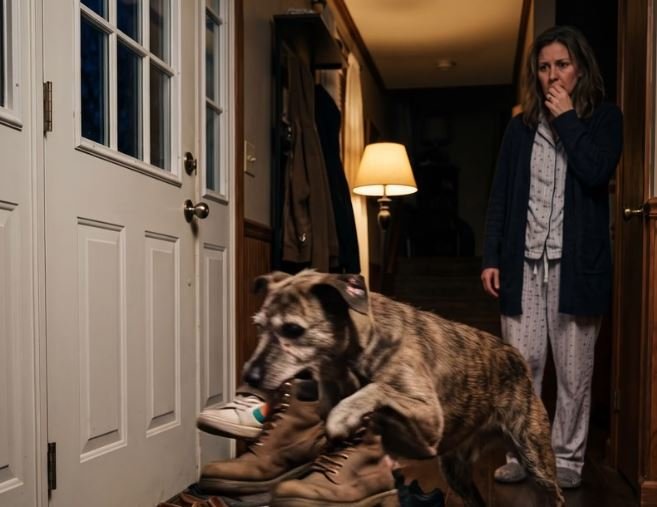
Sarah’s rescue dog, Murphy, was sitting beside them.
He was an older mixed-breed dog with a scar across one paw and one ear that folded at the tip. He had been adopted from a shelter several months earlier, and no one knew much about his life before arriving there.
At first, the family assumed the shoes were part of a strange new habit.
Then Murphy began collecting them.
Every night, he searched the house.
He pulled shoes from closets, bedrooms, and the garage.
Then he carried them to the front door and arranged them in a line.
The shoes were always pointed toward the inside of the house.
Sarah tried putting them away.
Murphy brought them back.
She tried closing the closets.
He waited outside them until someone opened the door.
The behavior became more intense whenever someone left the house.
If Sarah’s daughter was late returning from school, Murphy would collect another pair.
If Sarah’s husband left for work, the dog would sit beside his shoes until he came home.
The family eventually contacted a dog behavior specialist.
The specialist watched Murphy for several days.
Then she noticed something unusual.
Murphy was not guarding the shoes.
He was arranging them.
And every pair appeared to represent someone.
The behavior specialist suggested that the dog might have experienced repeated abandonment.
But the family still didn’t understand why he kept placing the shoes at the door.
The answer came when Sarah contacted the shelter where Murphy had originally been found.
The shelter had received him from an abandoned house.
The dog had been discovered inside after neighbors reported movement behind a window.
The house was empty.
There was no food.
No family.
No explanation.
But according to the shelter records, Murphy had refused to leave the front entrance.
Animal control officers had found shoes arranged around him.
The family later visited the old property.
The house had changed owners, but an elderly neighbor remembered the previous family.
She remembered a man who left first.
Then a teenage boy.
Then an older daughter.
Finally, the mother was taken to the hospital and never returned.
Each time someone left, Murphy had waited by the door.
And each time, he had taken their shoes and placed them near the entrance.
The dog had apparently learned one simple pattern:
People leave through the door.
Sometimes they come back.
Sometimes they don’t.
So Murphy kept the shoes where their owners could find them.
Years later, his new family discovered one final shoe in an old box from the previous house.
It was tiny.
A child’s shoe.
Murphy immediately recognized the scent.
He pressed his nose against it and lay down beside the door.
The family eventually learned that the child had been a relative who had stayed with the previous family for only a short time.
The dog had remembered him.
The shoes were not a barricade.
They were not a warning.
They were Murphy’s way of creating a return point.
A place where the people he had lost might still come home.
After the family understood what the shoes meant, they stopped taking them away.
Instead, they began leaving one shoe near the door whenever someone left.
Over time, Murphy became calmer.
He stopped searching every closet.
He stopped collecting shoes from the entire house.
But whenever someone left for a long trip, he still carried one shoe to the entrance.
And placed it carefully beside the door.
Because Murphy had spent years waiting for people who never came back.
His new family finally taught him something he had never understood before:
Sometimes people leave.
But sometimes…
They really do come home.