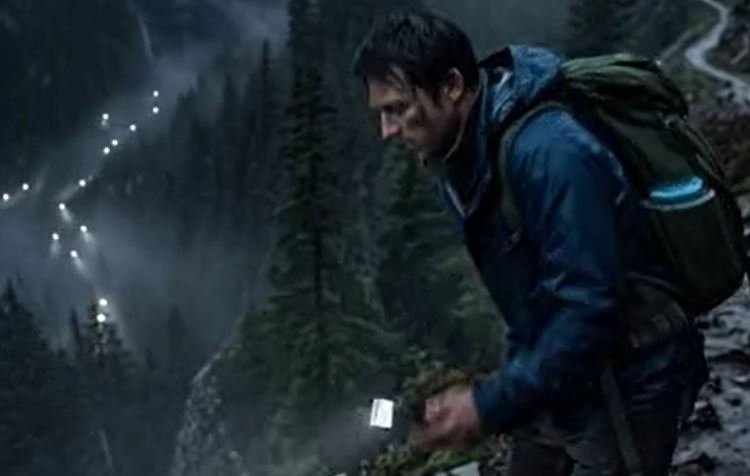
The footage begins in darkness.
A flashlight moves rapidly across the ground.
The beam catches loose rocks, tree roots, and the edge of a narrow mountain trail.
Then the camera rises.
A man is breathing heavily.
He appears exhausted.
His clothes are covered in dirt.
His backpack is hanging from one shoulder.
For several seconds, he says nothing.
Then he turns toward the valley.
Far below him, several lights are moving through the darkness.
They appear to be traveling in a line.
The man raises his phone and zooms in.
The lights continue moving.
He appears to believe they are rescuers.
He begins walking toward them.
Then a whistle echoes through the forest behind him.
The man stops.
The camera shakes.
He slowly turns around.
There is nothing visible between the trees.
A second whistle comes from the valley.
The man looks back toward the lights.
They are gone.
The recording ends shortly afterward.
The phone was recovered two days later.
The hiker was found alive several miles from the original trailhead.
He was dehydrated, injured, and unable to explain exactly how he had reached the location where rescuers discovered him.
According to the search records, he had disappeared during an afternoon hike.
The search operation began later that evening.
The first rescue teams entered the mountain area after dark.
But the phone footage created an immediate problem.
The video appeared to show search lights moving through the valley before the search teams had reached that area.
Investigators initially assumed the timestamp was incorrect.
The phone’s internal clock could have been wrong.
The file could have been copied or modified.
But the video contained details that made the explanation difficult.
The moon position matched the actual night.
The weather conditions matched the official records.
And the distant lights appeared to be moving through the same section of the mountain where the search teams eventually traveled.
The most unusual detail was discovered when investigators examined another video file on the phone.
It had been recorded earlier that evening.
The footage showed the hiker walking along a trail.
The trail appeared to be the same one where the later video had been recorded.
But the angle was different.
The hiker was walking toward the camera.
The problem was that no one else had been filming him.
The phone had been found inside his backpack.
The camera had apparently been placed on the ground.
The hiker then walked past it.
The recording ended.
A second video showed something similar.
The phone appeared to be lying several feet away from the hiker.
The man was standing on the trail.
He was facing away from the camera.
Then he turned.
The footage ended.
Investigators believed the phone may have accidentally recorded while the hiker was moving through the forest.
That was possible.
But the timing remained strange.
The final video appeared to show the hiker watching a search operation that had not yet begun.
The hiker himself remembered seeing lights.
He remembered hearing whistles.
But he could not explain where the lights had gone.
He also had no memory of placing the phone on the trail.
Search teams returned to the area.
They found no evidence of another group using the mountain trail that night.
No campfires.
No vehicles.
No additional footprints.
The distant lights could have been reflections from vehicles on a road far below.
The whistles could have been caused by wind passing through the trees.
And the strange video could have been an accidental recording.
Every detail had a possible explanation.
But none of the explanations answered the same question.
Why did the footage appear to show the search team before the search team was there?
The hiker eventually recovered from his injuries.
He returned home.
He never completed another mountain hike.
The phone was kept as evidence for several months before being returned.
According to the investigators, the case was ultimately classified as a wilderness disorientation incident.
The official conclusion was that the hiker had become confused, lost track of time, and misinterpreted distant lights and sounds.
But the recovered videos remained unexplained.
Because the final recording did not simply show a lost man trying to find his way back.
It showed a man standing on a trail.
Watching lights that may not have existed.
And recording a moment that appeared to happen before the search for him had even begun.
So what did the hiker actually see in the valley?
And why did his phone contain footage of him on the trail…
before anyone knew exactly where he was?