Nobody at St. Mercy General knew Elena Torres by name except the night-shift staff, and that was exactly how she’d wanted it.
For three weeks, ever since her husband David had collapsed at work from what turned out to be a ruptured appendix that spiraled into a severe post-surgical infection, Elena had been living a quiet, exhausting double life. By day, she worked her full shift as a dental hygienist across town, smiling through cleanings and consultations because the bills didn’t stop coming just because her husband was in a hospital bed fighting a fever that wouldn’t break. By night, the moment her shift ended, she drove straight to St. Mercy, parked in the same corner of the garage, and stayed in David’s room until well past visiting hours technically ended, an arrangement the night nurses had quietly allowed once they understood the situation.
She never posted about it. She never mentioned it to David’s parents, Carol and Frank, beyond the brief, exhausted updates she sent in the family group chat — “stable tonight,” “fever’s down half a degree,” “doctor says the infection is responding to the new antibiotics.” She didn’t think she needed to narrate her presence to anyone. She was there. That had always seemed like enough.
What she hadn’t accounted for was that Carol and Frank, who lived four hours away and had only been able to visit twice during the entire three weeks, had begun to form a very different picture of the situation — one shaped almost entirely by the brevity of Elena’s texts and the fact that they simply never saw her when they happened to call the hospital room during visiting hours, which, unbeknownst to them, fell squarely in the middle of Elena’s workday.
The confrontation happened on a Tuesday afternoon, the one day Carol and Frank had driven in for a longer visit, timed to coincide with a meeting with David’s surgical team. Elena had rearranged her schedule to be there too, sitting in the waiting room with a lukewarm coffee, waiting for the doctor to finish reviewing scans before the family meeting began.
Carol spotted her first. Elena watched her mother-in-law’s expression shift from surprise to something harder as she crossed the waiting room, Frank trailing a step behind.
“Three weeks in this hospital,” Carol said, her voice rising fast enough that the row of chairs nearby went quiet, “and where were you? We never once saw you here for him!”
Elena opened her mouth, startled, unsure where to even begin unpacking a statement built on three weeks of assumptions. But before she could speak, a voice cut in from behind Carol.
“Ma’am, I need to correct that.”
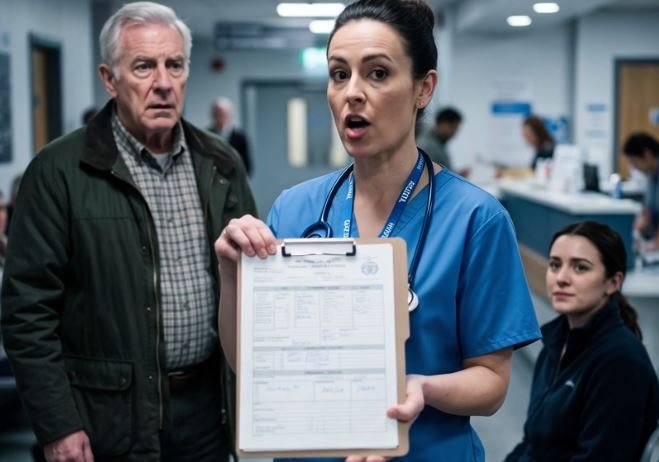
It was Renata, one of the night nurses who’d cared for David nearly every shift since he’d been admitted — a calm, no-nonsense woman in her forties who had, over the past three weeks, watched Elena arrive at the same time almost every single night, sometimes staying until one or two in the morning before dragging herself home for a few hours of sleep before her own job started again.
“She’s been here every single night after her shift,” Renata continued, stepping fully into the circle now, clipboard in hand. “Sometimes past midnight. I have the visitor log if you’d like to see it.”
Carol’s mouth opened, then closed. Frank’s raised hand — he’d been gesturing toward Elena mid-accusation — slowly lowered. “Every night…?” he repeated, quieter now, the certainty draining out of his voice.
Renata flipped open the clipboard and turned it so both of them could see. Three weeks of sign-in times, nearly all of them between 7:45 and 8:15 in the evening, checkout times ranging from 11:30 to well past midnight on several nights. Elena’s neat, tired handwriting, the same time pattern repeated night after night after night, a record more honest than any explanation she could have given in the moment.
“I assumed,” Renata added, not unkindly but without softening it either, “that her family knew. She’s asked us more questions about his recovery timeline than most spouses I’ve worked with in fifteen years on this floor. She was here when his fever spiked on day nine. She’s the one who caught that his pain medication schedule had been logged wrong on day twelve, before it became a real problem. I don’t say this to embarrass anyone — but she has not missed a night.”
The waiting room, which had gone quiet during Carol’s initial outburst, stayed quiet now for an entirely different reason. Carol’s face had gone pale, then flushed with something that looked less like anger and more like the specific shame of having been loudly, publicly wrong.
“Elena,” Carol started, “I didn’t — we called during the day, and you were never—”
“I work during the day, Carol,” Elena said, and her voice came out steadier than she expected, not sharp, just tired. “I have to. Someone has to keep the insurance active and the mortgage paid while he’s out. I come here every night the second my shift ends. I didn’t think I needed to send you a schedule to prove it.”
Frank, who had said very little throughout, finally spoke. “We should have asked instead of assuming,” he said quietly. “That was wrong of us. Both of us. I’m sorry, Elena.”
Carol, still visibly shaken, nodded but couldn’t quite meet Elena’s eyes yet. “I’m sorry too. I don’t know why I assumed the worst instead of just asking you directly.”
Renata, sensing the moment had shifted from confrontation to something more fragile, gave a small nod and stepped back toward the nurses’ station, leaving the family to sort out what came next on their own. She didn’t need thanks for it, and didn’t wait around for any — she simply went back to her rounds, the clipboard tucked back under her arm, already thinking about her next patient.
The family meeting with the surgical team went ahead twenty minutes later, all four of them — Elena, Carol, Frank, and the surgeon — reviewing David’s progress together for the first time as something closer to an actual team rather than two separate camps operating on entirely different information. The infection was responding well. Barring complications, David would likely be discharged within the week.
That evening, after Carol and Frank had made the four-hour drive back home, Elena stayed in David’s room as usual, past midnight, holding his hand while he slept fitfully through the last of his fever. He’d been drifting in and out of full consciousness all week, but around eleven, his eyes opened, tired but clear, and found her sitting there in the same chair she’d occupied every night for three weeks.
“You’re still here,” he murmured.
“Where else would I be,” she said, and meant it as a simple fact rather than a question.
He managed a small, exhausted smile and drifted back to sleep. Elena sat with him a while longer, the hallway quiet outside except for the soft rhythm of monitors and the occasional pass of a nurse’s shoes on the linoleum, and thought, not for the first time that month, that some kinds of love were never going to be loud enough for anyone else to notice.
They just kept showing up anyway.
THE END