Just Went Up for Auction — And It Could Sell for $30 Million
If you’ve ever wanted to own an actual Tyrannosaurus rex — not a toy, the real thing — Tuesday was your chance. It’s just going to cost you a small fortune.
Meet Gus
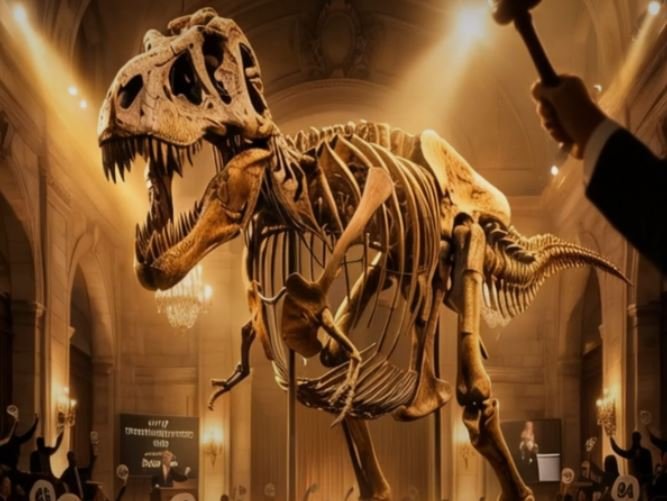
A Tyrannosaurus rex fossil nicknamed “Gus” went up for auction at Sotheby’s New York office, with a starting bid of $19 million and an estimated final sale price between $20 and $30 million.The 38-foot-long skeleton stands more than 12 feet tall and is considered one of the most complete T. rex specimens ever found.
The estimate places Gus at the highest presale valuation ever attached to a dinosaur skeleton a staggering figure for a creature that walked the earth long before humans existed.
Where Gus Was Found
Gus was discovered on a 6,500-acre cattle ranch in Harding County, South Dakota, owned by rancher Gary “Gus” Licking, who spent years noticing small bone and teeth fragments scattered across his land before realizing something significant might be buried beneath it.
The story behind the discovery carries an emotional weight rarely associated with a record-breaking auction. Licking died during the excavation process, which continued through 2023, and never got to see Gus fully assembled. In total, the skeleton includes 183 individual fossil bone elements, making it roughly 63 percent complete — including a well-preserved skull and a rare set of arm bones.
Why the Price Tag Makes Sense — Sort Of
Gus isn’t the first dinosaur to command headline-grabbing money at auction, but the trend has accelerated dramatically in recent years. otheby’s held the first-ever dinosaur auction back in 1997, when a T. rex named Sue sold for $8.4 million to the Field Museum in Chicago.Since then, prices have climbed sharply: in 2024, a Stegosaurus skeleton named Apex sold for $44.6 million, setting the current record for any dinosaur fossil at auction.
Paleontologist Scott Persons, curator of natural history at the South Carolina State Museum, says the rising prices reflect a genuine increase in market demand, noting that more dinosaurs are being sold this way, and at increasingly dramatic figures.
Not Everyone Is Celebrating
The sale has reignited a long-running debate in the scientific community. Paleontologists have raised concerns that sales like this could push some of the most complete and scientifically valuable fossils permanently out of reach for researchers and public museums. Critics argue that skyrocketing private auction prices increasingly price out the institutions best equipped to study these specimens, while Sotheby’s has defended the sales as a way of connecting a broadening range of collectors, museums, and foundations with pieces of natural history.
Whether Gus ends up in a museum, a private collection, or somewhere in between, one thing is clear: the market for prehistoric giants shows no signs of slowing down.
What Happens Next
Gus was on public display at Sotheby’s New York galleries in the lead-up to the sale, drawing crowds eager to see a 67-million-year-old predator up close before it potentially disappeared into a private collection. Whoever placed the winning bid will own a piece of Earth’s history that predates humanity by tens of millions of years.
Would you spend millions on a dinosaur skeleton if you had the money? Let us know in the comments.