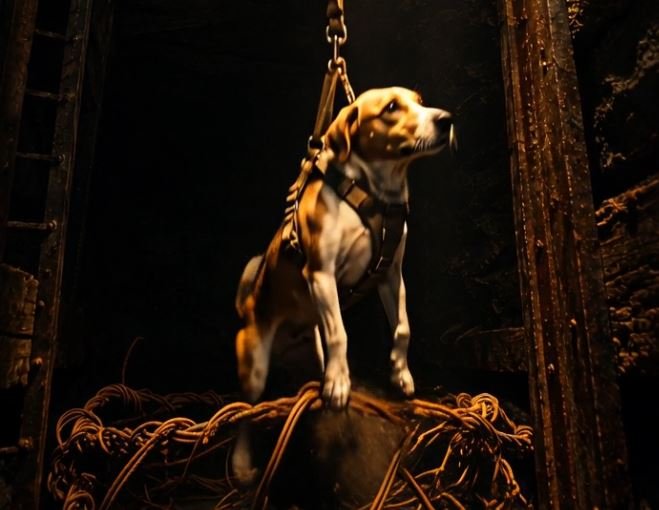
My name is Mason “Bear” Callahan, and I have been in dark places before. I have ridden through tunnels where the air was thin and the walls pressed close. I have slept in basements and bunkers and the spaces beneath bridges where the light never reaches. But I have never lowered myself into a hole in the earth until the morning of October 22nd, when my own dog told me that something alive was waiting forty feet down in the dark.
The Iron Mercy Riders were on a photography run. Not a charity ride, not a supply drop — just six friends on six bikes, riding through the ghost towns of Colorado, looking for abandoned buildings and rusted machinery and the kind of light that only exists in places the world has forgotten. We had stopped near the old Silver Creek Mine, a nineteenth-century gold operation that had been boarded up in 1923 and left to the elements.
My dog, Diesel, was with me. She rides in my sidecar on every trip, her head out, her ears flapping, her nose working the wind. She is a brindle pit mix, three years old, rescued from a railroad track. She is fearless. She has faced trains and fire and the open road. But when we stopped near the mine, she began to bark.
Not her usual bark. Not the bark she uses for squirrels or mailmen. This was different. Urgent. Insistent. She ran to a spot near the mine entrance, a place where the ground had collapsed decades ago, leaving a shaft that plunged straight down into darkness. She pressed her nose to the edge. She barked again. And again.
“Diesel,” I said. “What is it?”
She looked at me. Then at the hole. Then she whined.
I walked over. The shaft was maybe four feet wide, lined with old timber that had rotted to the color of bone. The bottom was invisible, lost in shadow. I pulled out my phone and turned on the flashlight. I shone it down.
Forty feet down, something moved.
I saw fur. Tan and white. A shape, small, pressed against the wall. Then an eye caught the light. Reflected it back. A dog’s eye. Terrified. Exhausted. Alive.
“There’s a dog down there,” I said.
The other bikers gathered. Eddie looked down. Luis shone his own light. Darlene crouched at the edge, her medic’s eyes assessing.
“How?” Caleb asked.
“Fell,” Eddie said. “Or was thrown.”
“How long?”
“Look at the body,” Darlene said. “She’s thin. Dehydrated. Maybe days.”
I looked at Diesel. She was still at the edge, her nose pressed to the timber, her body tense. She had known. Somehow, from the surface, she had known that something was down there, suffering, waiting.
I had rope in my saddlebag. A hundred feet of climbing rope, rated for rescue. I had a harness. I had a headlamp. I had everything I needed except permission and time.
“Call 911,” I said to Luis.
“Already on it,” he said.
I tied the rope to a rusted ore cart, an iron behemoth that had been parked near the shaft for a hundred years. It weighed tons. It would hold. I tied a second rope around my waist, a safety line, and I clipped the harness to the main rope.
“Bear,” Eddie said. “That timber is rotted. The shaft could collapse.”
“I know,” I said.
I sat on the edge. I pushed off.
The descent was terrifying. The walls were close enough to touch, timber and stone and the smell of a hundred years of darkness. The air grew colder as I went down. The light from above shrank to a circle, then a coin, then a star. My headlamp cut through the blackness, revealing rusted rails, broken tools, the debris of a century.
Then I saw her.
She was a hound mix. Tan and white, maybe thirty pounds. She was pressed against the wall, her body curled, her eyes reflecting my light like mirrors. She was thin. Her ribs showed. Her fur was matted with dust and something darker. But she was alive.
And she was not alone.
Beside her, curled in the dust, was another shape. Smaller. Still.
A puppy. Dead. Maybe days dead, dried and preserved by the cold air of the shaft. The mother dog had been lying beside it, protecting it, keeping it close, even as her own body failed.
I understood then. She had fallen, or been thrown, while pregnant or with a newborn. She had given birth in the dark. The puppy had not survived. And she had stayed. She had stayed with her dead baby in a hole in the earth, because that was what mothers do.
“Hey, baby,” I whispered. “I’m here. I’m going to take you home.”
She didn’t move. She was too weak. I reached out and I touched her head. She flinched, but she didn’t run. She had nowhere to run. I slipped the harness around her chest, under her legs, and I tightened it gently.
“Pull!” I shouted.
The rope went taut. I held her against my chest, one arm around her, one hand on the rope, and I let them lift us. The ascent was harder than the descent. The walls pressed in. The timber groaned. The dead puppy receded into the darkness below, and I felt something in my chest break for a dog who had lost everything and still refused to leave.
When we reached the top, Eddie grabbed my vest and dragged me over the edge. I fell onto the ground, still holding her, my chest heaving, my headlamp blinding in the sunlight. She was limp, exhausted, her body trembling. I held her and I whispered the only words I could find.
“You’re out. You’re safe. You’re home.”
The sheriff arrived twenty minutes later. He was a young man, maybe thirty, with a face that had seen too much of the dark side of rural Colorado. He looked at the shaft. He looked at the dog in my arms. He looked at the other bikers, the ropes, the ore cart.
“You went down there?” he asked.
“She was alive,” I said.
He looked at me for a long time. Then he walked to the edge of the shaft and shone his own light down. He saw the puppy. He saw the nest of dust and fur where the mother had been lying. He stood there for a full minute, saying nothing.
Then he turned to me and said, “We need to call the county. This mine is supposed to be sealed. If there’s one dog down there, there could be more. We need to check every shaft.”
They found three more dogs that week. Two alive, one dead. All in abandoned shafts, all left to die, all in various stages of starvation and dehydration. The county launched an investigation. The local news picked up the story. The Iron Mercy Riders became, briefly, the faces of a movement to seal old mines and rescue trapped animals.
But I didn’t care about any of that. I cared about the dog in my arms, who had survived forty feet of darkness and the death of her child and the slow starvation of waiting.
I named her Shadow. Because she had lived in darkness. Because she had followed me out of it.
Shadow came home with me. She was afraid of the dark. Of course she was. She would not enter a room without a light on. She would not sleep in a crate. She would not go near the garage if the door was closed. The dark was a place where babies died and mothers waited alone.
So I made the world bright for her. I installed nightlights in every room. I left the porch light on. I carried a flashlight on every walk, shining it ahead of us, making sure she could see where she was going.
But I also knew she needed to reclaim the night.
Six months after the rescue, I took her to a hill at dusk. The sun was setting. The first stars were appearing. I sat on the grass, and I placed her beside me. She tensed. The darkness was coming. The shaft was somewhere in her memory, filling with silence, taking the light away.
I turned on a small lantern. Not bright. Just enough. I placed it between us, and I said, “Look, Shadow. The dark has light in it now.”
She looked at the lantern. Then at the stars. Then at me.
She lay down. She rested her head on my lap. She watched the stars come out, one by one, and she did not tremble.
That was enough.
Shadow is three years old now. She is tan and white, with eyes that reflect light like the bottom of a shaft looking up at the sky. She sleeps on my bed, under the skylight, where the moon falls on her fur. She is still afraid of dark rooms. But she is no longer afraid of the dark itself.
Because she knows that if the light goes out, I will come for her. I will lower myself down. I will bring her back to the surface.
Some people see a biker lowering himself into a mine shaft and they see a fool. They see a man who risked his life for a dog. They see someone who should have waited for the authorities.
But Shadow sees something else. She sees the man who climbed down forty feet of darkness to pull her into the light. She sees the arms that held her when she reached the surface. She sees the night sky, the stars, the moon.
And that’s enough.