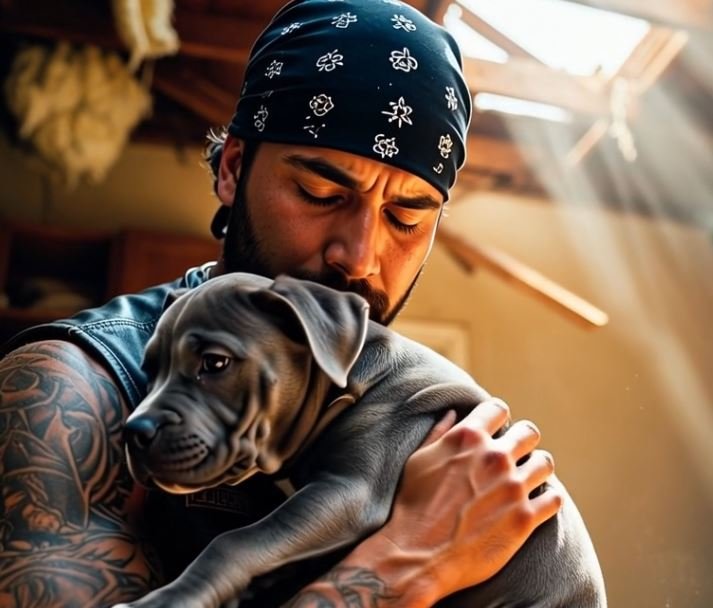
My name is Luis Vega, and I am thirty-six years old. I have seen destruction before. I have ridden through towns after floods, after fires, after storms that took everything and left only the foundations. But I have never run into a destroyed house twenty minutes after a tornado until the afternoon of May 15th, when a gray pit bull mix puppy led me to something I was not prepared to find.
The Iron Mercy Riders were on disaster relief. An EF-3 tornado had torn through rural Oklahoma, leveling houses, tossing cars, and leaving a scar across the land that was visible from the highway. We had loaded our saddlebags with water, medical supplies, tarps, and tools, and we were navigating the debris-strewn roads near Moore when we saw the house.
It had been a farmhouse. White clapboard, a porch, a swing. Now it was splinters. The roof was gone. The walls were collapsed inward. The porch swing hung from a single chain, spinning slowly in the wind. A child’s bicycle lay in the yard, pink and twisted.
We stopped. We were not search and rescue. We were not trained for this. But we were there, and the house was there, and somewhere inside, something was crying.
I heard it first. A whimper. Faint. Muffled by the debris.
“That’s a dog,” I said.
We dismounted. The ground was covered in nails, glass, insulation, the shredded remains of a family’s life. We picked our way through it, our boots crunching on splintered wood. The whimper came again, from the center of the house, from beneath the collapsed kitchen table.
I ran.
I didn’t think about the structure. I didn’t think about the danger of a house that had just been hit by a tornado, walls that could shift, roofs that could fall. I ran through the debris, climbing over a fallen beam, pushing aside a door that had been blown off its hinges.
The kitchen was destroyed. The cabinets were gone. The refrigerator lay on its side. The table, an old wooden farmhouse table, had collapsed but not completely — the legs had buckled, but the top had caught on the counter, creating a pocket of space beneath.
The whimper came from inside that pocket.
I dropped to my knees. I pulled at the debris. A chair. A pot. A curtain. I cleared a space and I looked under the table.
She was a gray pit bull mix. Small. Maybe four months old. She was huddled in the corner of the pocket, her body pressed against the wall, her eyes wide with terror. She was covered in dust and insulation, her fur matted, her body trembling.
But she was not alone.
Beside her, curled in the dust, was a child.
A girl. Maybe three years old. Blonde hair, covered in debris, her eyes closed, her chest rising and falling in shallow breaths. She was unconscious but alive. And the puppy was pressed against her, her body wrapped around the child’s torso, her head resting on the girl’s chest.
The puppy had been keeping her warm.
I stared. I could not move. I could not speak. The puppy looked at me. Her eyes were brown. Terrified. Exhausted. But she did not leave the child. She stayed. She pressed closer. She protected what was hers.
“Eddie!” I screamed. “DARLENE! CHILD!”
They ran. Darlene was a combat medic. She pushed past me, dropped to her knees, and checked the girl’s vitals. Breathing. Pulse weak but present. Dehydrated. Possible concussion. But alive.
“How long?” Eddie asked.
“The tornado hit twenty minutes ago,” I said. “She’s been under here for twenty minutes.”
“That puppy kept her alive,” Darlene said. “Body heat. Protection from debris. She didn’t leave her.”
I reached under the table. The puppy growled. Not a threat. A warning. She did not know me. She did not know if I was safe. All she knew was that the child was hers, and she would not let anyone take her.
“Hey, baby,” I whispered. “Hey, brave girl. I’m here to help.”
I extended my hand. She sniffed it. Her growl softened. She looked at the child, then at me, then at the child again. She was deciding. In the middle of a destroyed house, with the wind still blowing and the world still shaking, a four-month-old puppy was deciding if she could trust me.
She licked my hand.
I reached in and I lifted her. She was light, trembling, her body spent. I cradled her against my chest and I stepped back. Darlene and Eddie worked on the child, stabilizing her, clearing her airway, wrapping her in a thermal blanket. I held the puppy and I watched, my heart hammering, my hands shaking.
The Red Cross arrived five minutes later. Then the fire department. Then an ambulance. The child was loaded onto a stretcher, her eyes fluttering open, her hand reaching out. The puppy strained toward her. I held her close, but she whined, a high, desperate sound, and I understood.
“Wait,” I said to the paramedic. “Let her see.”
I carried the puppy to the stretcher. The child looked at her. The puppy licked her hand. The child smiled, a small, exhausted smile, and then her eyes closed again. The paramedic loaded her into the ambulance.
“Family?” the paramedic asked.
“Neighbor said they evacuated,” a firefighter said. “They thought the girl was with them. She must have wandered back inside.”
She had been left behind. In the chaos of evacuation, a three-year-old had wandered back into her house, and a four-month-old puppy had followed her. And when the tornado hit, the puppy had stayed. She had found the table. She had curled around the child. She had kept her warm, kept her safe, kept her alive for twenty minutes in the dark.
I held the puppy and I cried. I am not ashamed. I cried because she was braver than I would ever be. I cried because she had chosen to stay when she could have run. I cried because loyalty is not a human trait. It is a living thing, and it had just saved a child’s life.
The Red Cross worker who arrived started crying before she got out of her truck. She had seen the house. She had seen the destruction. And then she had seen me, standing in the rubble, holding a puppy who had just become a hero.
I named her Storm. Because she survived the thing that should have killed her. Because she was stronger than the wind.
Storm came home with me. The child’s family, when they were found, came to the clinic where we had taken her. The mother held Storm and cried. The father shook my hand and could not speak. They offered to take her. They said she belonged with them, with the child she had saved.
I looked at Storm. She looked at me. And I knew.
“She’s yours,” I said. “She always was.”
But the family lived in an apartment. No yard. No space. And Storm needed room. She needed to run. She needed to heal. They understood. They visited her every week. The child, whose name was Emma, sat on the floor and played with Storm for hours. They were bonded in a way that no tornado could break.
Storm is two years old now. She is gray and muscular, with eyes that watch everything. She rides with me on every charity run, in her carrier, her head out, her nose working the wind. She is not afraid of storms. She is not afraid of wind. But she is afraid of being separated from the people she loves.
When Emma visits, Storm does not leave her side. She sleeps at the foot of Emma’s bed. She follows her to the bathroom. She sits outside the door when Emma takes a bath, whining softly, waiting for her to come out.
Some people see a pit bull and they see danger. They see aggression. They see a breed that should be banned.
But Emma sees something else. She sees the puppy who curled around her in the dark. She sees the warmth that kept her alive. She sees the gray shape that was the last thing she saw before the tornado took the world away, and the first thing she saw when it came back.
And that’s enough.