On a cool September afternoon, 28-year-old Emily Carter set out alone to hike one of the quieter trails in a large national forest.
She had hiked dozens of times before and was known among friends for documenting every trip with photos.
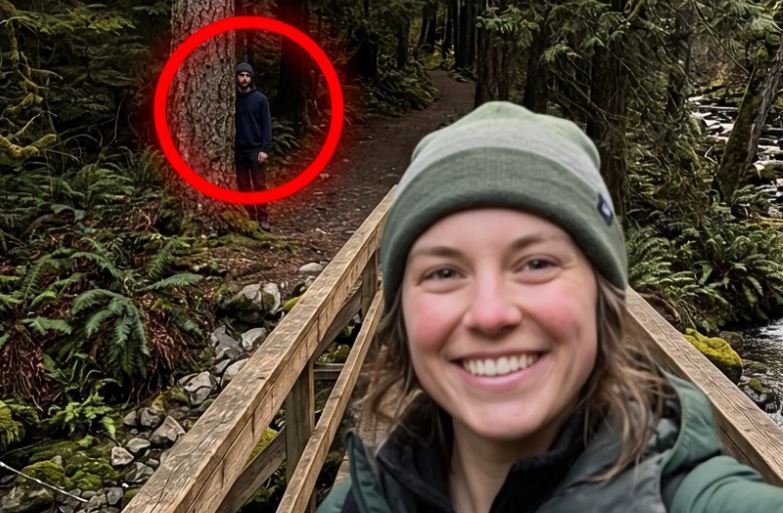
At 4:38 p.m., she stopped on a wooden footbridge overlooking a small creek and took a quick selfie.
She smiled, adjusted her backpack, and texted the picture to her sister with a short message:
“Almost back. See you for dinner.”
It would be the last confirmed message anyone ever received from her.
When Emily failed to return home that evening, her family contacted local authorities.
Search teams spent two days combing the trail.
They found her parked vehicle near the trailhead.
Her backpack.
Her water bottle.
But no sign of Emily.
Investigators reviewed her phone records and recovered the final selfie.
Initially, it offered no clues.
It simply showed Emily smiling beneath the trees.
Days later, while preparing enlarged copies for the investigation, a forensic imaging specialist noticed something unusual.
Far behind Emily, partially hidden by a pine tree, stood what appeared to be another person.
The figure wore dark clothing and seemed to be facing directly toward the camera.
The original image was analyzed by digital forensic experts.
There were no signs of editing, AI generation, or manipulation.
Lighting, shadows, and perspective all matched naturally.
The figure appeared to have been physically present when the photograph was taken.
Investigators immediately expanded the search to the area behind the footbridge.
Footprints had long since been washed away by rain, leaving no usable evidence.
Dozens of hikers who had visited the trail that afternoon were interviewed.
None recalled seeing anyone matching the description.
Facial recognition could not identify the individual because the figure occupied only a tiny portion of the image.
Police released an enlarged version of the background to the public, hoping someone would recognize the clothing or posture.
Hundreds of tips poured in.
None were confirmed.
Months later, Emily’s disappearance remained unsolved.
Authorities never publicly stated whether they believed the unidentified figure was connected to the case.
Some investigators suggested the person may have been another hiker who unknowingly wandered into the frame.
Others argued the timing was too significant to dismiss.
To this day, the identity of the background figure remains unknown.
The selfie is now used in training sessions for digital investigators as an example of why every image—even one that appears completely ordinary—deserves a second look.
Sometimes the most important clue isn’t in the center of the picture.
It’s the detail almost everyone overlooks.
And in Emily’s case, that one overlooked detail continues to raise the same unsettling question:
Was someone already watching her… before she knew she wasn’t alone?