The stage had been my home for fifteen years — the lights, the music, the roar of the audience that felt like oxygen. But tonight was my final performance. My body was failing me, my knees aching, my doctor’s warnings finally too loud to ignore. I had danced my last Giselle, taken my last bow, accepted my last bouquet from strangers who would forget my name by morning.
I was removing my makeup when I saw her in the mirror.
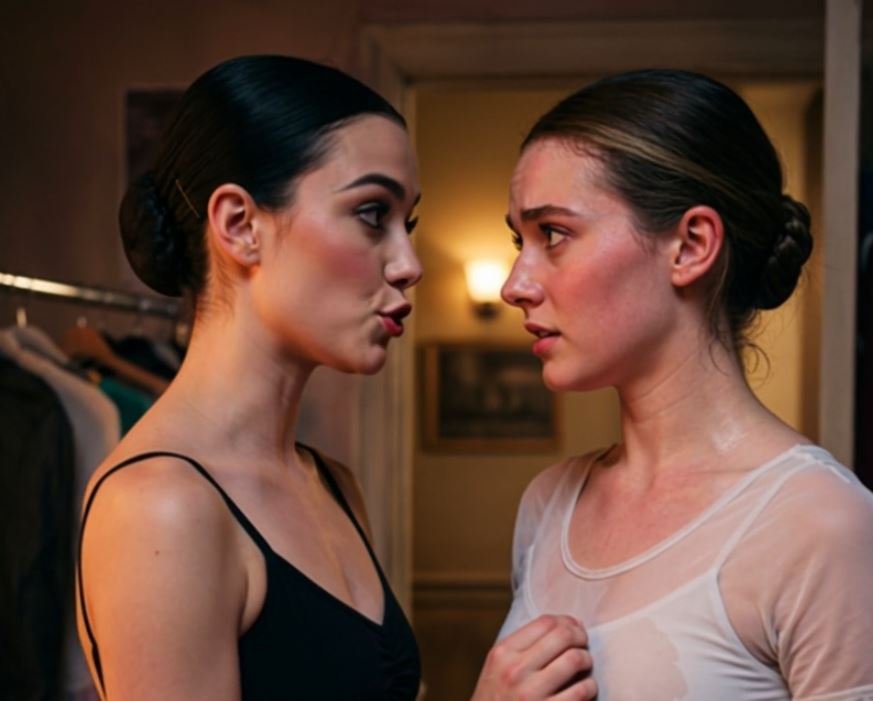
Maya. My understudy for three years. The woman who knew every step I danced, every breath I took, every moment of pain I hid behind my smile. She was standing in the doorway of my dressing room, wearing a sheer white practice tutu that was damp with sweat from watching me from the wings, holding a bouquet of roses she hadn’t given me, looking at me with an expression that made my exhausted heart hammer.
I stood up. Walked over. Took the roses from her trembling hands and set them on the makeup table. I reached out and touched the damp fabric of her tutu where it clung to her waist, my fingers tracing the edge where sweat had made the material transparent, revealing the silhouette beneath.
“You watched me dance tonight,” I said, my voice so deep and exhausted from performance that it barely held together, that it felt like it was coming from the last reserves of my strength. “From the wings. In that damp little tutu. Holding roses you were too shy to give me until the audience left.” My hand slid from her waist to her hip, the damp fabric shifting under my touch. “And I felt your eyes on me during every pirouette. Every extension. Every moment I pretended to be in love with my partner on stage.”
“Clara,” she breathed — but I pressed a finger to her lips.
“Tell me to take these roses and go home alone,” I continued, my voice rougher now, emotion cracking through my exhaustion. “Tell me to retire gracefully and leave you to inherit my role. Tell me you don’t feel this connection. This electricity. This unbearable need to know what I look like when I’m not performing.”
I removed my finger. She didn’t speak. But her eyes — her eyes told me everything. The longing. The patience. The three years of waiting in the wings, watching me, wanting me, never daring to step into the light.
“Or,” I whispered, my lips brushing her ear, “tell me to lock this dressing room door. To show you what my body can do when I’m not performing for an audience. When I’m not pretending. When I’m completely, utterly, finally real.”
She reached up. Her hand found mine on her hip, her fingers lacing through mine, her eyes telling me everything her voice couldn’t. I understood. I always understood.
I locked the door. The click echoed in the quiet room — the dressing room where I had prepared for a thousand performances, where I had laughed and cried and become characters that weren’t me. Tonight, I would finally be myself.
I pushed her back against the makeup table, my body pressing against hers, my mouth finding hers with a hunger that had nothing to do with choreography. She responded with equal desperation, her hands finding my leotard, pulling it down, her mouth following the path of her hands — my neck, my collarbone, the sensitive place where my pulse hammered.
“You don’t know how long I’ve wanted this,” she gasped against my breast, her fingers finding me with a confidence that spoke of years of watching, imagining, planning.
“I know,” I whispered, my hands tangled in her hair, pulling her closer. “I’ve known since the first time you handed me water during rehearsal. Since the first time you adjusted my costume with hands that trembled. Since the first time I caught you looking at me like I was the only thing on stage worth watching.”
She lifted me onto the makeup table, knocking aside palettes and brushes and the roses she had brought. She spread my legs, standing between them, her damp tutu pressing against my bare skin. She explored me with her mouth and her fingers, the vanity bulbs painting us in gold, her eyes locked on mine as she watched me fall apart.
“Look at me,” she commanded, her voice rough with desire. “Don’t close your eyes. I want to see you. The real you. Not Giselle. Not the swan. Just Clara. Just mine.”
I watched. I watched her mouth move against me, her fingers slide inside me, her face darken with satisfaction as she felt me tighten around her. And when I finally came apart, it was with her name breaking from my lips, my body convulsing on the makeup table, my fingers white-knuckled on the edge.
Afterward, she held me, her heartbeat steady against my back, her fingers tracing patterns on my arm. “What happens now?” she whispered. “You retire. I take your role. We can’t—”
“We can,” I interrupted, turning in her arms. “I’m not leaving the company. I’m becoming the director. I’ll be watching you from the front row instead of the wings. I’ll be the one handing you water, adjusting your costume, looking at you like you’re the only thing on stage worth watching.”
She looked at me, her eyes full of a hope I hadn’t expected. “And us?”
“Us,” I whispered, pressing a kiss to her forehead, “is the only performance that matters. The one we don’t rehearse. The one we don’t perform. The one that’s completely, utterly real.”
I kept the tutu. The damp white one she wore that night. It hangs in our apartment now, next to my retired leotards and her new costumes. And sometimes, when she comes home from performing the role that used to be mine, I help her out of it. Slowly. Carefully. The way she helped me out of my final performance.
Some bows aren’t endings. They’re beginnings. And my final bow was the beginning of everything.