Just before 2:00 a.m., Officer Ryan Ellis responded to what seemed like a routine welfare check.
A neighbor had called police after noticing the front door of a nearby home standing slightly open for more than an hour.
There were no reports of forced entry.
No alarms.
No signs of a struggle.
Officer Ellis arrived within minutes.
His body-worn camera activated automatically as he stepped from his patrol vehicle and walked toward the porch.
The footage showed exactly what his report described.
He knocked twice.
Announced himself.
Waited.
Receiving no response, he shined his flashlight through the narrow window beside the front door.
The house appeared dark and empty.
After checking the perimeter and finding no evidence of a break-in, Ellis secured the front door and cleared the call.
Nothing about the incident stood out.
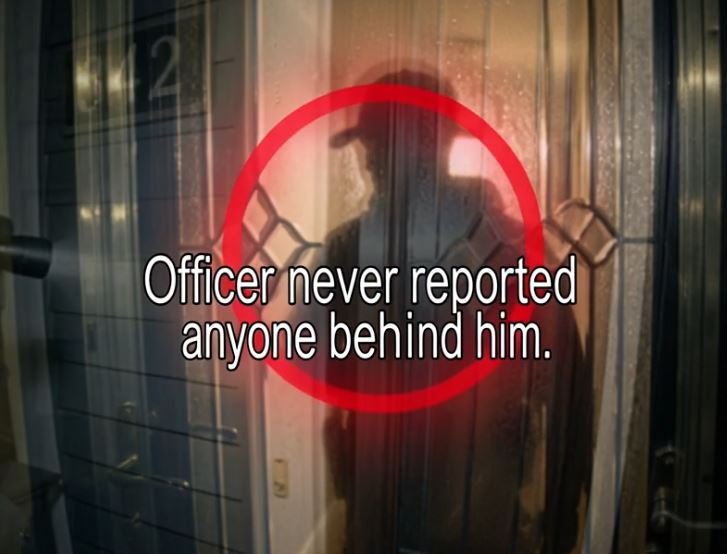
The next morning, a detective reviewing the bodycam for routine documentation paused the video at the exact moment Ellis stood on the porch.
Reflected in the storm door’s glass was what appeared to be another person.
The figure stood several feet behind the officer.
Dark hoodie.
Baseball cap.
Hands at the sides.
Facing directly toward him.
Yet Ellis never turned around.
His report never mentioned another individual.
Investigators initially suspected the reflection belonged to another responding officer.
Dispatch records ruled that out.
Ellis had arrived alone.
Forensic video specialists analyzed the recording frame by frame.
They found no evidence of digital editing or corruption.
The reflection behaved consistently with the angle of the glass and the porch lighting.
However, the image quality was too poor to identify facial features.
Detectives returned to the home to recreate the scene.
Volunteers stood in dozens of positions around the porch while technicians compared each reflection to the original footage.
None matched perfectly.
To produce the same reflected position, a person would have needed to stand on a narrow section of the porch that offered almost no space without being directly visible to the officer.
Investigators also interviewed neighbors again.
One resident remembered seeing “someone walking away” shortly before police arrived but couldn’t provide a useful description.
Another insisted no one else had been outside.
The welfare check itself ultimately had a simple explanation.
The homeowner had accidentally left the door unlatched before spending the night with relatives.
No crime had occurred.
Yet the unexplained reflection remained.
It wasn’t connected to a burglary.
It wasn’t tied to a missing person.
It simply became one more unanswered detail preserved forever on a body-worn camera.
Officer Ellis later watched the footage himself.
He maintained the same position every time he was asked about it.
“If someone was standing behind me,” he said, “I never saw them.”
Years later, the clip continues to be discussed in law enforcement training sessions—not as proof of anything extraordinary, but as a reminder of how easily critical details can escape even experienced observers.
Sometimes the camera notices what the human eye doesn’t.
And sometimes…
The recording leaves investigators with one question no report can answer:
Who was standing behind the officer that night?